Openness and Creativity: What the Research Shows

Openness to experience is the Big Five trait most consistently linked to creativity, but the link is modest in size and depends on how creativity is measured. In a 2023 meta-analysis of the Big Five and divergent thinking, openness correlated with divergent thinking at r = 0.20. That is a reliable association, not a guarantee. A high openness percentile signals creative potential, and other traits, skills and circumstances decide whether it becomes creative output.
This article covers the size of the effect, the difference between Openness and Intellect, the way workplace creativity departs from creativity outside work, and how to read your own Big Five percentile once you have it.
TL;DR
- Openness is the strongest Big Five correlate of creativity, yet the divergent thinking meta-analysis puts the correlation at r = 0.20, which is modest.
- Openness (aesthetics, fantasy, perception) tracks artistic creative achievement. Intellect (abstract reasoning) tracks scientific creative achievement.
- At work, creativity usually draws on openness together with extraversion and conscientiousness, not openness alone.
- A Big Five percentile tells you where you stand relative to a reference group. It does not tell you how creative you are.
- Divergent thinking is one measurable component of creativity, not the whole of it.
Table of Contents
- What the Index Measures: Openness, Defined
- How Strong Is the Link? The Numbers
- Openness Versus Intellect: Arts and Sciences
- Creativity at Work Versus Creativity Outside Work
- A Two-Way Relationship
- Levels of Creativity: Why the Four-C Model Matters
- How to Read Big Five Percentiles
- Where Personality Tests Are and Are Not Useful
- Our Perspective
- Get Your Own Big Five Profile
- Applying the Research: A Short Checklist
- FAQ
- Sources
What the Index Measures: Openness, Defined
Openness to experience describes the desire for novelty and variety, curiosity about ideas, and receptiveness to aesthetic and emotional experience. A 2023 review in Frontiers in Neurology describes it as the desire for novelty and variety in experiences, which can include an inclination to engage with people from diverse cultural backgrounds.
Two features of the construct matter for what follows:
- It is a trait, not a talent. Openness describes tendencies to explore and engage. It does not measure skill in drawing, writing, engineering or any other craft.
- It has aspects. Many models split the domain into Openness (fantasy, aesthetics, perception) and Intellect (abstract reasoning, interest in ideas). Facet-level reports show this structure. A single domain score hides it.
How Strong Is the Link? The Numbers
The most useful single figure comes from the 2023 meta-analysis on the Big Five and divergent thinking, which pooled 63 studies and 24,298 participants. It reported a significant positive correlation between divergent thinking and openness (r = 0.20, 156 effect sizes) and between divergent thinking and extraversion (r = 0.09, 110 effect sizes).
| Trait | Correlation with divergent thinking | Effect sizes pooled |
|---|---|---|
| Openness | r = 0.20 | 156 |
| Extraversion | r = 0.09 | 110 |
How should r = 0.20 be read? Squaring a correlation gives the share of variance shared by the two measures: 0.20 × 0.20 = 0.04, or about 4%. This is our arithmetic, not a figure from the paper. The practical reading is that openness is a real but partial predictor. Most of the difference between people’s divergent thinking scores comes from something else: knowledge, motivation, practice, working memory, task format and measurement noise.
Two cautions apply:
- Divergent thinking is not total creativity. It captures the ability to generate many varied ideas. As published work on divergent thinking and the Four-C framework argues, real creative output also requires evaluating whether an idea is useful, and metrics that rely on divergent thinking alone miss that process.
- Self-report is not behavior. Personality questionnaires capture how people describe themselves. Creative achievement is a separate measurement, and the correlation between the two varies by study design.
Openness Versus Intellect: Arts and Sciences
One reason the headline correlation is modest is that creativity is not one thing. A study in Openness to Experience and Intellect differentially predict creative achievement in the arts and sciences separated the two aspects of the broader Openness/Intellect dimension. Its framing: Openness (fantasy, aesthetics, perception) was the stronger predictor of artistic creative achievement, while Intellect (abstract reasoning, semantic information) was the stronger predictor of scientific creative achievement.
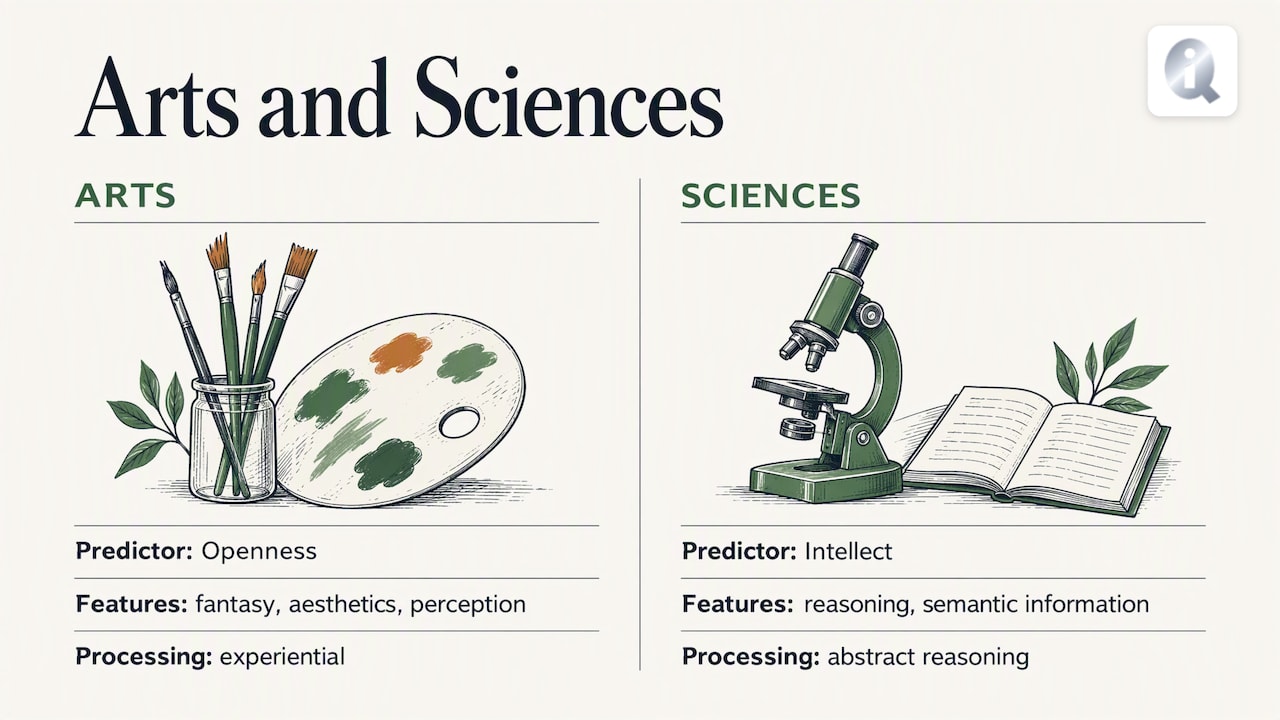
The same paper links this split to cognitive processing styles. Artistic creativity leans on experiential processing, which is perceptual, aesthetic and implicit. Scientific creativity leans more on abstract reasoning. This helps explain why a person can be highly inventive in one domain and conventional in another.
What this means for interpreting your own profile
- A high domain-level openness score with low Intellect-type facets suggests an aesthetic, imaginative orientation more than an analytical one.
- The reverse pattern suggests interest in ideas and abstraction with less pull toward aesthetic experience.
- Neither pattern is better. They point to different creative outlets.
Our facet-level Big Five personality profile is built to show this kind of within-domain structure, because one openness number cannot.
Creativity at Work Versus Creativity Outside Work
Personality antecedents change with context. A 2023 study in Frontiers in Psychology examined whether creativity at work and outside work share the same Big Five antecedents. Its results indicated that the antecedents differ: personal creativity outside work related to openness, while workplace creativity was associated with a broader combination of traits that also included extraversion and conscientiousness.
A second line of work separates the kind of creativity involved. A 2023 study in the Journal of Individual Differences distinguishes incremental creativity (minor modifications) from radical creativity, and examines how leader behaviors moderate the effect of openness. The abstract notes that openness has been consistently related to employee creativity, but less is known about how this plays out across those two types.
The practical reading, in our words: high openness may supply the raw material for radical ideas, while conscientiousness and social engagement often decide whether those ideas are refined, communicated and implemented.
| Setting | Traits most often involved | Typical output |
|---|---|---|
| Personal, everyday creativity | Openness | Hobbies, self-expression, new approaches to daily problems |
| Workplace creativity | Openness, extraversion, conscientiousness | Process improvements, products, solutions that must be adopted |
For readers thinking about careers, creative fields differ in their cognitive demands as well as their personality fit. Our page on the average IQ of 3D/VFX animators shows how one creative profession compares on published cognitive estimates. Use it as context, not as a gate.
A Two-Way Relationship
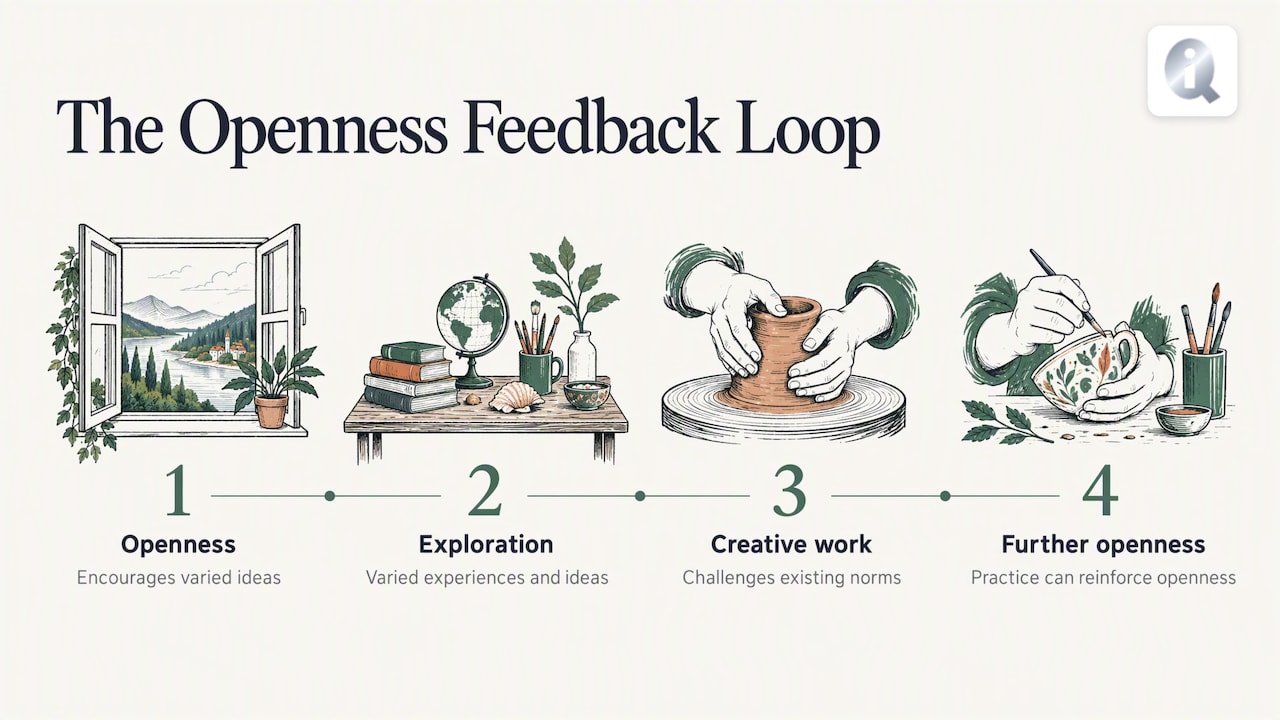
The direction of influence is not one-way. The Frontiers in Neurology review describes a reciprocal relationship: openness encourages exposure to varied experiences and ideas, and engaging in creative work challenges existing norms, which can encourage further openness. For readers who want to act on this, that suggests the trait is not purely a fixed endowment. Repeated creative practice can be part of the feedback loop.
A study of children in urban and rural areas offers a useful framing: openness may not directly cause creativity but may act as a catalyst for exploring creative ideas and activities. The same study reported that the openness-creativity correlation was stronger for urban children than rural children, which is a reminder that environment moderates the relationship.
Levels of Creativity: Why the Four-C Model Matters
People use the word creativity for very different things. The Four-C model, described in this overview of Kaufman and Beghetto’s framework, distinguishes four levels:
- mini-c: personal insights in the course of learning.
- little-c: everyday creative acts.
- Pro-c: professional-level creative work.
- Big-C: contributions that change a field or society.
Openness is identified as the primary personality antecedent across these levels. That does not mean it explains each level equally well. A modest correlation with divergent thinking tests (mostly a mini-c and little-c measure) cannot be stretched into a claim about Big-C achievement.
How to Read Big Five Percentiles
Many readers arrive here with a score in hand. A Big Five percentile compares your score with a reference group, usually a norm sample of adults who completed the same instrument.
What a percentile means
If your openness percentile is 70, your score is higher than about 70% of the reference group and lower than about 30%. The percentile describes rank, not the amount of the trait. Two people at the 70th percentile on different instruments may have been compared with different groups.
A practical interpretation guide
| Percentile range | Common label | Reasonable reading |
|---|---|---|
| 0 to 20 | Low | Preference for the familiar, concrete and practical |
| 21 to 40 | Moderately low | Selective curiosity, some preference for routine |
| 41 to 60 | Average | Balanced, flexible between novelty and routine |
| 61 to 80 | Moderately high | Frequent curiosity, interest in art and ideas |
| 81 to 100 | High | Strong pull toward novelty, imagination and abstraction |
These bands are an interpretive convention, not an official standard. Labels vary between test publishers, and some use different cutoffs. Check the manual or the report of the instrument you used.
Five points to keep in mind
- Percentiles cluster in the middle. Most people fall between roughly the 25th and 75th percentile, so small percentile differences near the center can reflect very small raw score differences.
- The norm group matters. A percentile against a general adult sample differs from one against students or a particular country.
- Self-report carries bias. Responses reflect self-perception, mood and social desirability.
- Facets differ from domains. A domain percentile averages facets that can point in different directions.
- Percentile is not predictive on its own. Given r = 0.20 for divergent thinking, even a 90th percentile score does not guarantee high creative output.
For the cognitive side of the same question, our IQ score meaning tool explains how IQ numbers and percentiles relate, and the cognitive strength finder offers a free domain-level view.
Where Personality Tests Are and Are Not Useful
The Big Five is the most widely used trait model in personality research, and in our analysis of predictive validity it fares better than type-based alternatives. See our comparison in Personality Test Accuracy: Big Five Nearly Twice as Predictive as MBTI. If you are weighing trait models against each other, Big Five vs HEXACO covers what each predicts.
The limits are equally important. A personality assessment is informational and supports personal development. It is not a clinical diagnosis and not a formal employment qualification.
Our Perspective
We see the same misreading again and again. A reader scores in the 90th percentile for openness and concludes, “I am highly creative.” Another scores in the 30th percentile and concludes the opposite. Neither inference is supported by the research above.
The evidence supports a narrower and more useful statement. Openness is a reliable but modest predictor of creative potential. It points to where a person is likely to explore, and it differs by aspect: aesthetic and imaginative openness aligns with artistic work, intellectual openness with scientific work. Whether potential turns into output depends on conscientiousness, skill, feedback and the environment.
This is why we report personality at the facet level and keep cognitive and personality results separate. A person with a modest openness percentile and strong abstract reasoning may be well suited to analytical, inventive work. A person with high openness and weaker structure may do better by pairing ideas with systems for follow-through. Both are actionable. A single score is not.
We also try to state the method plainly. Our assessments are calibrated against established psychometric norms, intended for informational purposes, and we would rather give you a range and its limits than a number that sounds more certain than the evidence allows.
— Steve
Get Your Own Big Five Profile
If you want to see where you stand on openness and its facets, you can take our Big Five personality test without registering. The full report is available through Personality Full Access at $14.99, a one-time payment. A full IQ result, which separates cognitive domains from personality, costs $9.99, also one-time, on the same page.
Applying the Research: A Short Checklist
- Read the aspects, not only the domain. Look for the split between aesthetic and intellectual openness.
- Match the outlet to the profile. Artistic outlets suit aesthetic openness. Research, engineering and strategy suit intellectual openness.
- Pair openness with follow-through. At work, conscientiousness and collaboration help ideas get adopted.
- Practice the behavior. Given the reciprocal relationship, regular creative practice may reinforce openness.
- Treat the percentile as a starting point. Use it to ask better questions, not to settle them.
FAQ
Is openness the same as creativity?
No. Openness is a personality trait describing curiosity and receptiveness to novelty, while creativity is an outcome or ability. The two are positively related, with r = 0.20 between openness and divergent thinking in a 2023 meta-analysis, but they are not interchangeable.
Can someone be creative with low openness?
Yes. Because the correlation is modest, many people with lower openness scores are creative, particularly in contexts where skill, discipline and domain knowledge matter. Workplace creativity is also associated with traits beyond openness, according to a 2023 Frontiers in Psychology study.
What is a good Big Five percentile for openness?
There is no good or bad percentile. A higher score suggests stronger interest in novelty and ideas, and a lower score suggests preference for the familiar and practical. Each suits different roles and settings. Check which reference group your percentile was calculated against before comparing it with anyone else’s.
Does openness change over time?
The research we reviewed describes a reciprocal relationship in which creative engagement can encourage further openness, as set out in the Frontiers in Neurology review. That suggests some responsiveness to experience. We do not claim that practice produces a specific change in your score.
Is divergent thinking the best measure of creativity?
It is a useful and measurable component, but it captures idea generation, not idea evaluation or real-world achievement. Treat divergent thinking scores as one input among several.
Sources
- The Big Five and divergent thinking: A meta-analysis (ScienceDirect, 2023)
- The reciprocal relationship between openness and creativity (Frontiers in Neurology, 2023)
- Different personality factors drive work and non-work creativity (Frontiers in Psychology, 2023)
- Openness to Experience and Intellect differentially predict creative achievement in the arts and sciences
- Effects of Openness on Incremental Versus Radical Creativity (Journal of Individual Differences, 2023)
- Divergent thinking and the Four-C framework (Personality and Individual Differences)
- Understanding Creativity, the Four-Cs model
- Openness to experience and creative thinking in urban and rural children (Frontiers in Psychology, 2016)