Personality Test Accuracy: Big Five Nearly Twice as Predictive as MBTI

Validated trait-based tests, especially Big Five inventories like the BFI and BFI-2, are generally the most accurate instruments available for measuring personality, with generally good short-term stability and moderate power to predict real outcomes. MBTI-style type tests are far less dependable, with a sizable portion of test-takers receiving a different type when retested within weeks. We recommend treating any result, ours included, as a tool for development and self-reflection rather than the sole basis for a hiring or clinical decision.
TL;DR:
- Big Five tests were roughly twice as accurate as MBTI style tests, while 39% to 76% of MBTI takers changed types within weeks.
- Use scores for reflection or coaching, not as sole grounds for hiring or clinical decisions; high stakes can reduce validity when applicants answer strategically.
- Choose continuous, validated trait scores and retake them after a few months; one sitting cannot separate temporary mood from stable traits.
Table of Contents
- How researchers measure accuracy in personality testing
- Accuracy differences: Big Five vs MBTI-style tests vs other approaches
- What the research numbers actually say
- When test results are useful: practical guidance for readers
- How to get more accurate, actionable results
- Why scientific caution matters but tests still have value
- Take a validated Big Five test with IQ Career Lab
- FAQ
- Sources
How researchers measure accuracy in personality testing
“Accuracy” in personality science is really two separate questions: does the test give a consistent answer, and does that answer mean anything. Psychologists call these reliability and validity, and conflating them is the most common mistake we see in casual accuracy claims.
- Test-retest reliability asks whether the same person gets a similar score when tested again after days or weeks.
- Internal consistency (often reported as Cronbach’s alpha) asks whether items meant to measure the same trait actually move together.
- Convergent and discriminant validity ask whether a trait score lines up with related measures and stays distinct from unrelated ones.
- Predictive validity asks whether the score forecasts something that matters later, like job performance or relationship satisfaction.
A dependability coefficient around .80 is considered reasonably good for short-term retest reliability, and meta-analytic work on the Big Five lands right around that mark. Retest interval and sample composition both shift these numbers: a two-week gap in a homogeneous college sample tends to produce higher coefficients than a six-month gap in a mixed working population.
Accuracy differences: Big Five vs MBTI-style tests vs other approaches
Not every framework earns its popularity through evidence, and the accuracy gap between approaches is wide enough to matter for anyone choosing a test.
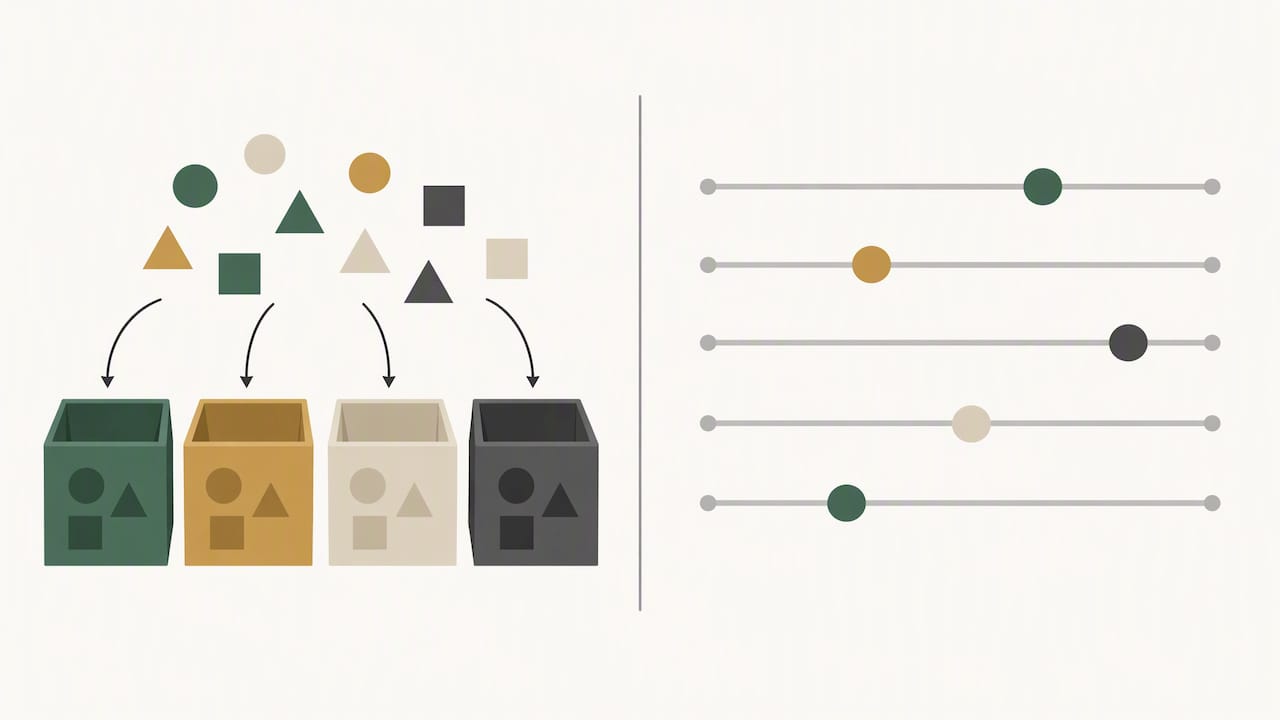
Big Five inventories report strong internal consistency and use continuous trait scores rather than forced categories, which preserves information that type-based scoring throws away. MBTI-style tests, by contrast, split continuous traits into binary categories (introvert versus extravert, for example), and comparative research summarized by Scientific American found Big Five instruments roughly twice as accurate as MBTI-style tests at predicting life outcomes, partly because MBTI-style frameworks omit neuroticism entirely and partly because dichotomization adds measurement noise.
- Big Five (BFI/BFI-2): continuous scoring, good internal consistency, moderate predictive power for behavior and outcomes.
- MBTI-style type tests: forced categories, weaker predictive validity, and frequent type changes on retest.
- Enneagram and similar typologies: limited peer-reviewed validation; more suited to reflection than prediction.
- Computer and machine-learning judgments: can match or exceed human accuracy when given enough behavioral data.
On that last point, a PNAS study comparing computer models to human judges found that models trained on digital footprints achieved accuracy around r = .56, compared with around .49 for average human judges working from the same kind of information. That is a meaningful gap in a field where most correlations are modest, though it raises separate questions about privacy and consent that have nothing to do with psychometric accuracy.
Pro Tip: If a test forces you into one of a handful of fixed categories, treat the result as a conversation starter, not a verdict.
What the research numbers actually say
The strongest evidence for Big Five accuracy comes from a meta-analysis of dependability coefficients pooling 682 test-retest correlations across 74 samples and nearly 15,000 participants. The median aggregated estimate came out to ρtt ≈ .816, a solid figure for short-term stability in psychological measurement.
Internal consistency tells a similar story. A reliability generalization meta-analysis of the BFI and BFI-2 found the BFI-2 performing better across all five factors, with alpha coefficients generally in the 0.80s across factors including openness, conscientiousness, extraversion, agreeableness, and neuroticism.
MBTI-style tests look far less stable under the same scrutiny.
- Big Five dependability: median dependability coefficient around .816 across short-term retests.
- BFI-2 internal consistency: alpha ranging from .80 to .88 across factors.
- MBTI-style retest instability: 39 to 76% of people reclassified within weeks.
- Computer vs human judgment: r ≈ .56 versus r ≈ .49, respectively.
These figures all carry caveats. Retest intervals, sample types, and the stakes of the testing situation all move the numbers, which is why a single reported coefficient should never be read as a universal truth about a test.
When test results are useful: practical guidance for readers
A personality score is only as useful as the decision you attach to it. The research points to a fairly clear line between appropriate and inappropriate uses.
- Use results for personal development, coaching conversations, and identifying blind spots you want to work on.
- Use group-level or research findings to understand general tendencies, not to make absolute claims about one individual.
- Avoid treating any single score as sufficient grounds for a hiring decision, since validity tends to drop in high-stakes settings where applicants have an incentive to answer strategically.
- Avoid using any personality test as a substitute for a clinical diagnosis, which requires a licensed professional.
- Favor continuous trait scores over forced types when you want the most defensible read on your results.
- Retake validated instruments after a few months rather than relying on one sitting, since a single score cannot distinguish a temporary mood from a stable trait.
How to get more accurate, actionable results
Accuracy improves when you choose the right instrument and use it the right way. Several habits consistently separate a trustworthy result from a vague one.
- Choose validated trait-based instruments over type-sorting quizzes whenever the goal is prediction rather than entertainment.
- Retake the test periodically to check whether your scores hold steady or shift with circumstances.
- Look for published reliability and validity numbers, including facet-level detail, before trusting a report’s conclusions.
Our Big Five personality assessment gives facet-level reporting on top of the five broad traits, with an optional upgrade to a full report and a verifiable certificate you can share with an employer or an educator. The baseline test requires no signup, and the detailed breakdown is available through Personality Full Access when you want the complete picture.
Pro Tip: Take any personality test in a low-stakes, honest frame of mind, and save your report so you can compare it against a future retest.
Why scientific caution matters but tests still have value
Type labels are appealing because they offer a tidy identity, but trait science holds up better under scrutiny because it predicts behavior rather than just describing it. We think the right posture is to treat a result as a starting point for reflection, never as a fixed label that closes off how you see yourself.
— Steve
Take a validated Big Five test with IQ Career Lab
Our Big Five Personality assessment gives you facet-level trait scores grounded in established psychometric norms, with a verifiable certificate available once you choose to go deeper.
You can start with the free baseline result and decide afterward whether to unlock the complete report. Personality Full Access runs $14.99 one-off and adds the detailed facet breakdown, percentile context, and your shareable certificate. If you would rather gift a result to someone else, that option starts at $14.99 as well through the same pricing page.
FAQ
What is the top 3 rarest personality type?
Rarity figures come from specific typing systems and vary by the population sampled, so there is no single agreed-upon “rarest” ranking that holds across instruments. We would rather point you toward a validated trait score, which tells you where you fall on a spectrum instead of sorting you into a rare or common bucket.
Which personality test is the most accurate?
Validated Big Five inventories, particularly the BFI-2, currently have the strongest reliability and predictive validity evidence among widely used personality tests, with internal consistency estimates between .80 and .88 across the five factors. Type-based tests like MBTI-style instruments score lower on both reliability and predictive power by comparison.
Is the 16 Personalities test accurate?
Tests built on MBTI-style typing, which the 16 Personalities framework follows, tend to show weak test-retest reliability, with 39 to 76% of people receiving a different type when retested within weeks. That instability makes it a better tool for casual self-reflection than for any decision that depends on a stable, accurate label.
Is the Big Five personality test accurate?
Yes, by the standards of personality psychology. The Big Five shows a median short-term dependability of about 0.816, and comparative research finds it outperforms MBTI-style tests at predicting real-life outcomes.
Sources
The claims in this article rest on peer-reviewed meta-analyses and comparative research rather than marketing copy or single studies. We encourage you to read the primary sources directly if you want to evaluate the evidence yourself.
- A meta-analysis of dependability coefficients (test–retest) for measures of the Big Five
- Computer-based personality judgments are more accurate than those made by humans
- Personality tests aren’t all the same — some work better than others (Scientific American)
- Reliability generalization meta-analysis of the internal consistency of the Big Five Inventory (BFI/BFI-2)