Multiple Intelligences Theory: What It Claims and What Evidence Shows

The theory of multiple intelligences (MI), proposed by psychologist Howard Gardner in 1983, holds that human intellect consists of at least eight relatively independent capacities rather than one general ability. It is influential in teacher training and popular psychology. It is also contested by psychometric researchers and cognitive neuroscientists, who argue that the evidence does not support independent intelligences. This guide states what the theory claims, gives concrete examples of each intelligence, reviews the criticism, and explains what it means for classrooms and for anyone interpreting an IQ score.
TL;DR
- Gardner’s theory names eight intelligences: linguistic, logical-mathematical, spatial, musical, bodily-kinesthetic, naturalist, interpersonal, and intrapersonal. Existential and pedagogical intelligence remain speculative candidates.
- Psychometric testing finds that cognitive tasks share a strong common factor (g), which conflicts with the claim that the eight intelligences are fully independent.
- A 2021 meta-analysis of MI-inspired classroom interventions found methodological flaws serious enough that the approach cannot yet be validly evaluated.
- Gardner has said the theory is a psychological framework, not an instructional model, and not a neurological theory.
- The theory remains useful as a reminder that abilities are varied. It is not a validated way to sort people into types.
Table of Contents
- What the theory claims
- The eight intelligences, with examples
- Why the theory spread, particularly in education
- The main criticisms
- What this means for teaching and studying
- Perspective: how we read the theory at IQ Career Lab
- From theory to a measured profile
- How to evaluate any “types of intelligence” quiz
- Where the debate stands
- FAQ
- Sources
What the theory claims
According to the APA Dictionary of Psychology, the theory describes intelligence as made up of eight distinct categories, proposed in 1983 by Howard Gardner. Project Zero at Harvard, where Gardner and colleagues work, describes the framework as positing that individuals possess eight or more relatively autonomous intelligences, and that people draw on them in different combinations.
Three features distinguish the claim from everyday talk about being “good at” something:
- Plurality. Intelligence is not one general capacity. It is a set of distinct computational capacities.
- Relative independence. Strength in one domain does not necessarily predict strength in another. This is the claim that sets MI against the traditional psychometric view, which is often represented by g.
- Individual profiles. Everyone has all of the intelligences, in different proportions. Simply Psychology’s summary notes that Gardner treats the profile as distinct from a fixed “learning style”.
Gardner drew on evidence from several disciplines and research traditions when he developed the theory in the late 1970s and early 1980s, as he explains in his own FAQ. He also argued that modern schools have valued and tested mainly two capacities, linguistic and logical-mathematical, which is the same pair that conventional IQ tests emphasize.
The eight intelligences, with examples
The list below follows the eight capacities named in the research summary. The example occupations are our illustrations of the type of activity each label points to. They are not findings from Gardner’s work.
| Intelligence | What it refers to | Everyday example |
|---|---|---|
| Linguistic | Sensitivity to words, meaning and sound | Drafting a persuasive memo, learning a new language |
| Logical-mathematical | Reasoning with numbers, patterns and abstract relations | Debugging code, designing an experiment |
| Spatial | Representing and manipulating visual and spatial information | Reading a floor plan, packing a car trunk efficiently |
| Musical | Handling pitch, rhythm and timbre | Playing by ear, arranging a song |
| Bodily-kinesthetic | Skilled use of the body or of objects | Surgery, dance, carpentry |
| Naturalist | Recognizing and categorizing living things and natural patterns | Identifying plant species, reading weather signs |
| Interpersonal | Understanding other people’s moods and motives | Negotiating, teaching, counseling |
| Intrapersonal | Understanding one’s own feelings, strengths and limits | Setting realistic goals, recognizing personal triggers |
Gardner has also speculated about two additional candidates: existential intelligence (contemplating big questions) and pedagogical intelligence (conveying knowledge to others). Neither is part of the standard list of eight.
Why the examples feel convincing
Each label matches a familiar kind of skill, which is part of the theory’s appeal. Most people know a gifted musician who struggles with algebra, or a strong mathematician who is awkward in conversation. The critical question is whether such cases reflect truly independent capacities, or whether they reflect the ordinary variation that occurs even when a general factor links all abilities. That question is empirical, and the next sections address it.
Why the theory spread, particularly in education
The theory gave teachers a vocabulary for something they already saw: students succeed in different ways. It also offered a challenge to the idea that a single test number summarizes a person. In US schools, it led to lesson plans that combine music, movement, group work and visual material.
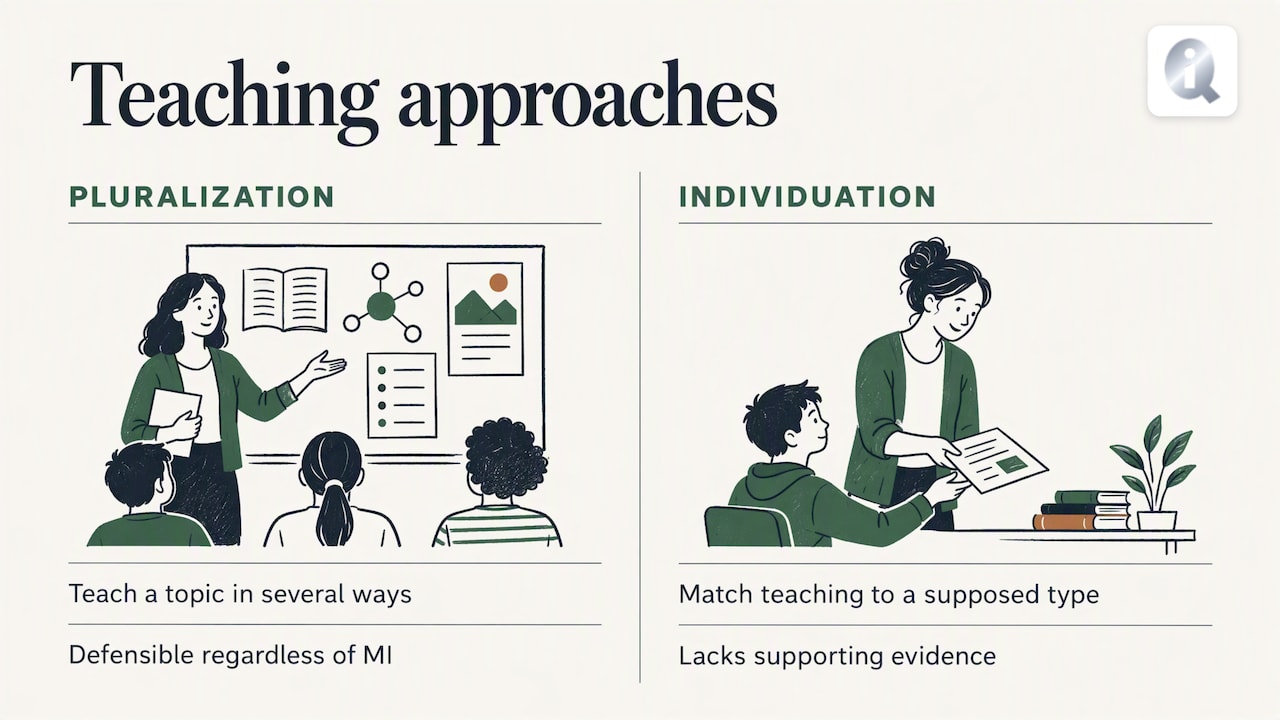
Gardner has been explicit that this was not the original purpose. He has acknowledged that the theory was not designed for educational application, and he describes it as a psychological framework for understanding intellectual diversity, not an instructional design model. Educators have nonetheless adopted two of its concepts widely: “pluralization” (teaching a topic in several ways) and “individuation” (teaching students according to their intellectual profile), as discussed in the 2021 meta-analysis.
The two practices differ in how well they hold up. Presenting material several ways is a defensible teaching habit whatever one thinks of MI. Matching instruction to a student’s supposed intelligence type is the claim that lacks supporting evidence.
The main criticisms
The psychometric objection: g does not go away
If the eight intelligences were independent, scores on tests designed for them should not correlate strongly. The study “Beyond g: Putting multiple intelligences theory to the test” examined a sample of 200 adults across the eight hypothesized domains. It reported substantial g-loadings for all of the cognitive tests used, which is inconsistent with fully independent, non-hierarchical domains. Research on cognitive tasks has repeatedly found high g-loadings, and that finding is the core of the psychometric case against MI.
This matters for how IQ scores are read. A single composite number is a useful summary precisely because tasks in different domains tend to move together. It does not follow that domain profiles are meaningless. Within the general factor, people differ in verbal, spatial and quantitative strengths, and a domain breakdown can describe that. It describes variation around a shared factor. It does not describe separate intelligences.
The falsifiability objection
Critics also argue that the constructs are hard to test. In the same peer-reviewed analysis, the contrast is drawn between proponents, who describe MI as a constructive theory of intellectual potential, and critics, who say the constructs are not defined through independent factor-analytic studies. A commonly cited example of circularity is musical intelligence: it is defined as the capacity to interpret music and then used to explain musical performance, with no independent predictive measure.
A critical review of the disputation between advocates and opponents shows that this debate has run since the theory was announced, so it is not a recent development.
The neuroscience objection
In the 1980s, the theory’s references to brain modularity implied separate neural centers for each intelligence. Contemporary cognitive neuroscience describes the brain as working through integrated, networked systems. For that reason, a 2023 paper in Frontiers in Psychology takes up the common description of MI as a neuromyth, which is a widely accepted but unscientific claim about brain function. Its title argues that MI is a neuromyth, which is one side of an active debate.
Gardner’s reply is that MI is not a neurological theory, and that critics conflate his psychological constructs with brain-based functional localization. Readers should note both positions: the neuromyth label is common in the literature, and Gardner rejects the premise on which it rests.
The educational evidence objection
The strongest evidence on classroom use comes from a 2021 meta-analysis of 39 studies involving 3,009 students across 14 countries. Its title says it plainly: a valid evaluation of the theory is not yet possible, because the intervention studies have problems of methodological quality. Reported problems included small samples and a lack of active control groups. The reported effect sizes were also remarkably larger than is usual in education, which suggests possible publication or reporting bias.
The finding is easy to misread, so we state it precisely. The meta-analysis does not show that MI-based teaching fails. It shows that the existing studies are too weak to show that it works. Without standardized evidence, the claim that tailoring instruction to intelligence types improves learning outcomes remains unsupported.
What this means for teaching and studying
A practical reading follows from the evidence:
- Vary the presentation, not the label. Explaining a concept through a diagram, a spoken example and a short exercise is sound practice. There is no need to decide beforehand that a student is “spatial” or “musical”.
- Do not use intelligence labels to limit a student. If a label becomes a reason to avoid reading or math practice, it does harm that the evidence does not justify.
- Prefer methods with a stronger evidence base. Retrieval practice is a good example. A guide to the active recall method for students explains how testing yourself on material supports study across subjects, regardless of any profile.
- Make feedback actionable. Scores that tell a student only where they ranked are less useful than comments naming the next step. The discussion of study feedback tools addresses how to replace scores with concrete next actions.
Teachers are themselves a case worth looking at. Our occupational estimates put the typical elementary teacher at an average IQ of 107 (97–117), the high school teacher at 111 (101–121), and the special education teacher at 108 (98–118). These are published estimates with wide ranges. The overlap among them shows that teaching draws on more than a single score, but it does not show that eight independent intelligences are at work.
Perspective: how we read the theory at IQ Career Lab
We build and interpret cognitive assessments, so we meet the MI question daily: visitors ask whether a test can reveal their “type” of intelligence.
Our position has three parts. First, the weight of psychometric evidence supports a general factor, and a well-calibrated assessment should report it honestly. Second, a breakdown across cognitive domains is still informative, provided it is presented as a profile of relative strengths within general ability and not as a set of separate intelligences. Our assessment covers five cognitive domains for that reason. Third, no result of ours is a clinical diagnosis or a formal employment qualification, and nothing in an MI-style profile should be used as one.
We also think the theory’s enduring contribution is a corrective. It reminds readers that school-style tasks sample a narrow slice of human ability. That is a fair point. The overreach comes when the corrective is turned into eight validated categories, and the research reviewed above does not support that step.
— Steve
From theory to a measured profile
If you want to see what a structured, norm-referenced profile looks like, you can take our 50-question IQ assessment without registering and receive an initial result range. A Full IQ Result at $9.99 (one-off) unlocks your exact score, percentile context and a cognitive domain breakdown. For traits rather than abilities, the Big Five personality test is the better-validated framework, and our article on Big Five and MBTI predictive accuracy compares the two.
If you are exploring careers, the Career-IQ Matcher relates cognitive profiles to occupations. Our results are for information and personal development only.
How to evaluate any “types of intelligence” quiz
Many online quizzes promise to reveal your dominant intelligence. Use these questions before you trust one:
- Is it normed? A score only means something relative to a reference population. Quizzes that ask what you prefer and tally the answers measure preference, not ability.
- Does it test performance? Ability is shown by solving problems under defined conditions, not by self-description.
- Does it report reliability and validity? Credible instruments publish how consistent their results are and what they predict.
- Does it avoid fixed labels? A trustworthy result describes relative strengths and uncertainty, with ranges, not a permanent type.
- Does it state its limits? Informational tools should say plainly that they are not diagnostic.
Most popular MI inventories fail the first two tests, since they are self-report checklists. That is a limitation of the format, and it is distinct from the question of whether the theory itself is correct.
Where the debate stands
The disagreement is partly about definitions. Gardner uses “intelligence” broadly, to include musical and bodily skill, while psychometricians use it for abilities that predict performance across many cognitive tasks. Under the broad definition, saying that people have many different talents is uncontroversial. Under the narrow one, the claim of eight independent intelligences conflicts with the data on g.
The fair summary is this. The theory is influential and humane, the psychometric and neuroscience critiques are substantial, and the educational evidence is too weak to confirm or refute the classroom claims. Readers who want the primary sources can start with Gardner’s own summary of the theory and then read the critical papers cited above. More articles on IQ research are in our research blog.
FAQ
What are Gardner’s eight multiple intelligences?
They are linguistic, logical-mathematical, spatial, musical, bodily-kinesthetic, naturalist, interpersonal, and intrapersonal. Gardner has speculated about existential and pedagogical intelligence as further candidates, but they are not part of the standard list. The theory says everyone has all of them in different combinations.
Is the theory of multiple intelligences scientifically proven?
No. Research on cognitive tests finds strong g-loadings across tasks, which conflicts with the claim of fully independent intelligences. Some neuroscientists classify the theory as a neuromyth, while Gardner maintains it is a psychological theory and not a neurological one. The evidence is contested and not settled in the theory’s favor.
Does teaching to multiple intelligences improve learning?
The evidence does not show it. A 2021 meta-analysis of 39 studies found methodological flaws, such as small samples and missing active control groups, so a valid evaluation was not possible. Teaching a topic in varied ways is still reasonable practice, but matching lessons to a student’s supposed intelligence type is unsupported.
Is multiple intelligences the same as learning styles?
No. Gardner treats the intelligences as distinct capacities, each a different kind of problem-solving, and not as preferred ways of receiving information. The two ideas are often confused in schools, which is one reason the theory is frequently misapplied.
Can an IQ test measure multiple intelligences?
Standard IQ tests mainly assess linguistic and logical-mathematical abilities, as Gardner himself points out. A good assessment can report a profile across cognitive domains, but that profile describes relative strengths within general ability. It does not confirm eight independent intelligences.
Sources
- APA Dictionary of Psychology: multiple intelligences theory
- The Theory of Multiple Intelligences (Davis, Christodoulou, Seider, Gardner), Project Zero
- Gardner’s FAQ on multiple intelligences, Project Zero
- The Theory of Multiple Intelligences (Gardner, 2011), Project Zero
- Theory of multiple intelligences, Wikipedia
- Gardner’s Theory of Multiple Intelligences, Simply Psychology
- Beyond g: Putting multiple intelligences theory to the test, Intelligence (2006)
- A valid evaluation of the theory of multiple intelligences is not yet possible, Intelligence (2021)
- Why multiple intelligences theory is a neuromyth, Frontiers in Psychology (2023)
- Metaanalysis of Critical Discourse on Howard Gardner’s Theory of Multiple Intelligences (2017)