Mensa IQ Requirement: The Score, Percentile and Tests

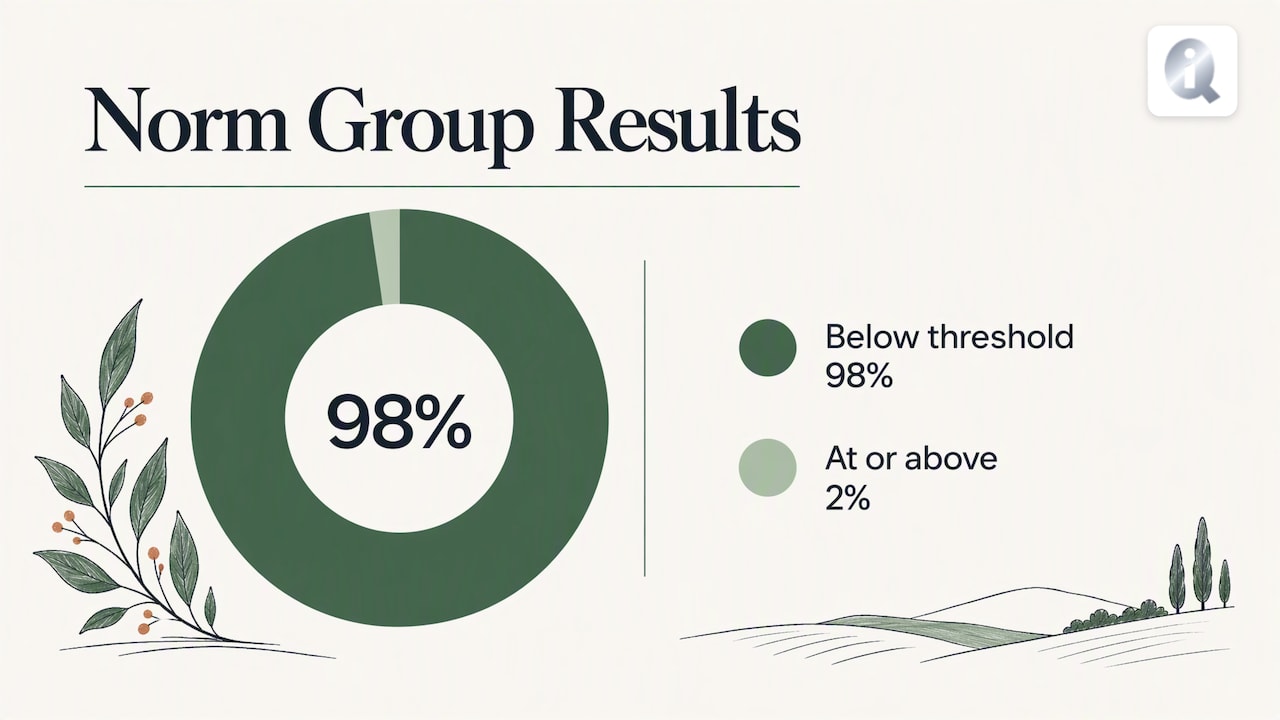
Mensa does not set one IQ number. It requires a score at or above the 98th percentile, meaning the upper 2% of the general population, on an approved and properly supervised intelligence test (Mensa International). On a scale with a mean of 100 and a standard deviation of 15, that cutoff falls at roughly 130. On other scales the equivalent number is different, and that is the part most articles skip. This guide states the requirement, shows how the cutoff converts across tests, and explains the routes American Mensa accepts.
TL;DR
- The Mensa requirement is the 98th percentile (top 2%) on an approved, supervised intelligence test, not a fixed IQ score.
- The IQ number at that percentile depends on the test’s scale: 132 on a test with a standard deviation of 16, and 148 on a test with a standard deviation of 24.
- American Mensa accepts about 200 standardized tests, but not unsupervised or internet-based testing, so online IQ quizzes (including ours) cannot be used as proof.
- You can qualify with prior documented scores or by sitting a supervised test; the date that counts is the date you took the test.
Table of Contents
- What the Mensa requirement actually says
- Mensa IQ score needed, by test scale
- Why the percentile rank is the real threshold
- Which tests American Mensa accepts
- How to qualify for Mensa in the United States
- Mensa percentile: what top 2% looks like
- Where an online IQ test fits
- Our perspective
- Common mistakes when aiming for the Mensa cutoff
- FAQ
- Sources
What the Mensa requirement actually says
Mensa International describes membership as open to people who score within the upper 2% of the general population on an approved intelligence test that has been properly administered and supervised (Mensa International FAQ). The same page explains why the organization states the rule as a percentile: IQ scores are poorly defined across tests that use different scales, so a score of 132 on one test can be the same as 148 on another.
Two terms need to be separated here:
- Percentile rank: the share of the reference population you scored above. At the 98th percentile, you outscored about 98 of every 100 people in the test’s norm group.
- IQ score: a number placed on a scale defined by a mean and a standard deviation. The number only has meaning once you know the scale.
Mensa’s own explanatory material says the 98th percentile corresponds to two standard deviations above the mean, rounded off (American Mensa, The Question of “Genius”). The rounding matters: the exact normal-curve point for the top 2% is about 2.05 standard deviations, so the “two standard deviations” shorthand is an approximation, and the test publisher’s own percentile tables decide who qualifies.
Mensa IQ score needed, by test scale
Because the requirement is a percentile, the equivalent score changes with the scale. Mensa’s published examples show the pattern (American Mensa): Stanford-Binet and many school tests use a mean of 100 and a standard deviation of 16, which gives a qualifying score of 132. The Cattell IIIB and the old form of Raven’s Advanced Progressive Matrices use a mean of 100 and a standard deviation of 24, which gives 148.
The arithmetic is the same each time: mean plus two standard deviations.
| Scale (mean / SD) | Calculation | Approximate qualifying score |
|---|---|---|
| 100 / 15 (the most common modern convention) | 100 + 2 × 15 | 130 |
| 100 / 16 (Stanford-Binet, many school tests) | 100 + 2 × 16 | 132 |
| 100 / 24 (Cattell IIIB, old-form Raven’s APM) | 100 + 2 × 24 | 148 |
The 132 and 148 values come from Mensa. The 130 row is our own calculation using the same rule on a standard deviation of 15, and it is an approximation, not an official cutoff for any named test. Always check which cutoff applies to your specific test on American Mensa’s list of qualifying scores.
If you hold a score and are unsure which scale it uses, our IQ score converter translates between scales, and the IQ percentile calculator shows the percentile attached to a given score. To see how a standard deviation changes the meaning of a number, use the IQ standard deviation calculator.
Why the percentile rank is the real threshold
A reader who sees “132 on one test, 148 on another” often assumes the second person is far more intelligent. That is not what the numbers say. Both people sit at the same position relative to their norm group. The larger figure reflects a wider scale, in which each point is a smaller step.
This has three practical consequences:
- A raw IQ figure is not portable. A result of 140 means something different on a standard deviation of 15 (about 2.7 standard deviations above the mean) than on a standard deviation of 24 (about 1.7).
- A score is only as comparable as its norms. Percentiles come from the publisher’s norm group, so tests normed on different populations or in different decades can place the same person at different ranks.
- “Mensa level” claims need a stated scale. A statement such as “an IQ of 130 qualifies” is true on some tests and wrong on others.
For wider context on how ranges and percentiles relate, see our guide to what counts as a good IQ score and our explanation of why 100 is a norm rather than a national score.
Which tests American Mensa accepts
American Mensa accepts scores from approximately 200 standardized intelligence tests, including tests administered by schools, psychologists and the military, and it appraises documentation individually (American Mensa, qualifying test scores). It also requires a Full Scale IQ (FSIQ) score where the test produces one, so every sub-test needed to calculate the FSIQ must have been given; supplemental sub-tests are not required.
The same page is explicit about what does not count: American Mensa does not accept unsupervised testing, including electronic or internet-based testing, as proof of eligibility. That excludes the free quizzes that circulate online, and it excludes self-administered assessments from any provider, ours included.
How to qualify for Mensa in the United States
There are two routes, and both depend on supervised, documented results.
Route 1: submit a previous test score
If you took a qualifying test at school, with a psychologist or in the military, you can submit that evidence. The steps, drawn from American Mensa’s instructions (Join Mensa Using My Past Test Scores):
- Create a profile with American Mensa.
- Gather the original documentation, or a notarized copy of the original.
- If the test was given by an institution, agency or clinic, make sure the document is on its letterhead, signed by the psychologist responsible for the testing, and includes that psychologist’s state license number.
- Send the evidence for appraisal.
Two details save applicants trouble. First, qualifying tests must be administered by a neutral, qualified third party in a traditional testing environment. Second, the acceptance date applies to the date the test was taken, not the date you joined.
American Mensa also notes that it cannot provide a detailed report with scores, percentile ranks or an IQ score, because Texas Psychology Board regulations prohibit practitioners from releasing that information without a detailed interpretation (Take the Mensa Admission Test). In other words, Mensa tells you whether you qualified, not your exact score. If you want a number, you need to obtain it from a psychologist.
Route 2: take a supervised test
Applicants without prior scores can take a supervised, standardized test, either with a certified member volunteer or at an approved private testing center (How to Join Mensa). Current formats, fees and session locations are set by American Mensa and its local groups, so check that page before booking.
A supervised session is a timed, proctored setting. Practicing the format of timed reasoning questions beforehand reduces the unfamiliarity effect, and a guide to psychometric test preparation covers general habits such as pacing and reading instructions carefully. Practice does not change the requirement, which remains the 98th percentile on the supervised test itself.
Mensa percentile: what top 2% looks like
At the 98th percentile, roughly 2 in every 100 people in the norm group score as high or higher. Mensa is therefore an upper-tail threshold, and scores near it are sensitive to measurement error. Every IQ test has a standard error, so a person scoring a few points below the cutoff on one occasion could land above it on another. This is why Mensa accepts any one of many approved tests: a single qualifying result is sufficient, and the cutoff is applied to each test on its own norms.
If you want to place a score on the bell curve, our IQ comparison tool and the IQ score meaning page show how a given number relates to the rest of the distribution.
Where an online IQ test fits
An unsupervised online test cannot qualify you for Mensa. It can still be useful as a first estimate of where you stand, particularly for deciding whether pursuing a supervised test is worth your time. Treat the output as an indicator with a margin of error, not as proof.
Our 50-question IQ assessment can be started without registering and returns an initial result range across five cognitive domains. An optional Full IQ Result costs a one-time $9.99 and adds the exact score, percentile context and a domain breakdown. It is intended for informational and personal-development purposes, not clinical diagnosis, formal employment qualification or Mensa admission.
Our perspective
We see the same misunderstanding in how people search for this topic: they look for a single number to beat. The requirement is a rank within a norm group, and the number depends on the instrument. That is why we publish converters and percentile tools alongside our assessments: a score without its scale and norm group is incomplete information.
We also hold a firm line on what an unsupervised assessment can claim. Ours is calibrated against established psychometric norms and gives a useful estimate and a cognitive profile, but a supervised test given by a qualified professional is a different category of evidence, and Mensa treats it that way. If Mensa membership is your goal, use an online result to decide whether to proceed, then pursue a supervised route. If your goal is understanding your strengths, a domain breakdown tells you more than a single headline number.
— Steve
Common mistakes when aiming for the Mensa cutoff
- Comparing raw numbers across scales. A 140 on one test and a 140 on another are not the same percentile.
- Relying on an online result. American Mensa does not accept unsupervised or internet-based testing.
- Submitting incomplete documents. Photocopies without notarization, missing letterhead or a missing license number can stall an application.
- Omitting sub-tests. Mensa needs the Full Scale IQ, so reports with only some sub-tests do not meet the requirement.
- Assuming the join date matters. The acceptance date applies to when you took the test.
FAQ
What IQ score do you need for Mensa?
You need a score at or above the 98th percentile on an approved, supervised test. On a scale with a standard deviation of 16 that is 132, and on a scale with a standard deviation of 24 it is 148. On a standard deviation of 15, the same rule gives about 130.
Can I join Mensa with an online IQ test?
No. American Mensa does not accept unsupervised testing, including electronic or internet-based tests, as proof of eligibility. Online tests can give you an estimate, but you would need prior supervised results or a supervised Mensa test.
Can I use old test scores to qualify?
Yes, if the test is on the accepted list and the documentation is an original or a notarized copy. Institutional reports need the letterhead, the signature of the responsible psychologist and the state license number. The acceptance date is the date you took the test.
Will Mensa tell me my exact IQ score?
Not necessarily. American Mensa says it cannot provide a detailed report with scores, percentile ranks or an IQ score, citing Texas Psychology Board regulations. To learn your exact score, ask the psychologist who administered a test.
Sources
- IQ Test – FAQs, Mensa International
- The Question of “Genius”, American Mensa
- Qualifying Test Scores for Mensa Membership, American Mensa
- Join Mensa Using My Past Test Scores, American Mensa
- Take the Mensa Admission Test, American Mensa
- How to Join Mensa, American Mensa