What Is a Good IQ Score? Ranges, Percentiles and Context

A good IQ score is any score at or above the average of 100, and most psychologists would call 110 or higher a clearly good result. A score of 120 places a person in roughly the top 9% of the population, and 130 or above is the conventional threshold for “very superior” or gifted-range performance. Those labels only hold on a standardized test with a mean of 100 and a standard deviation of 15, and they describe performance on one occasion, not worth or potential.
This guide sets out the ranges, the percentiles behind them, and the caveats that decide whether a number is “good” for your purpose.
TL;DR
- Modern IQ tests set the average at 100 with a standard deviation of 15, so about 68% of people score between 85 and 115 (APA Dictionary of Psychology).
- 110 to 119 is high average, 120 to 129 is superior, and 130 and above is very superior on the Wechsler classification (IQ classification overview).
- A score of 120 is good by any standard: it sits near the 91st percentile, meaning it exceeds about nine in ten people.
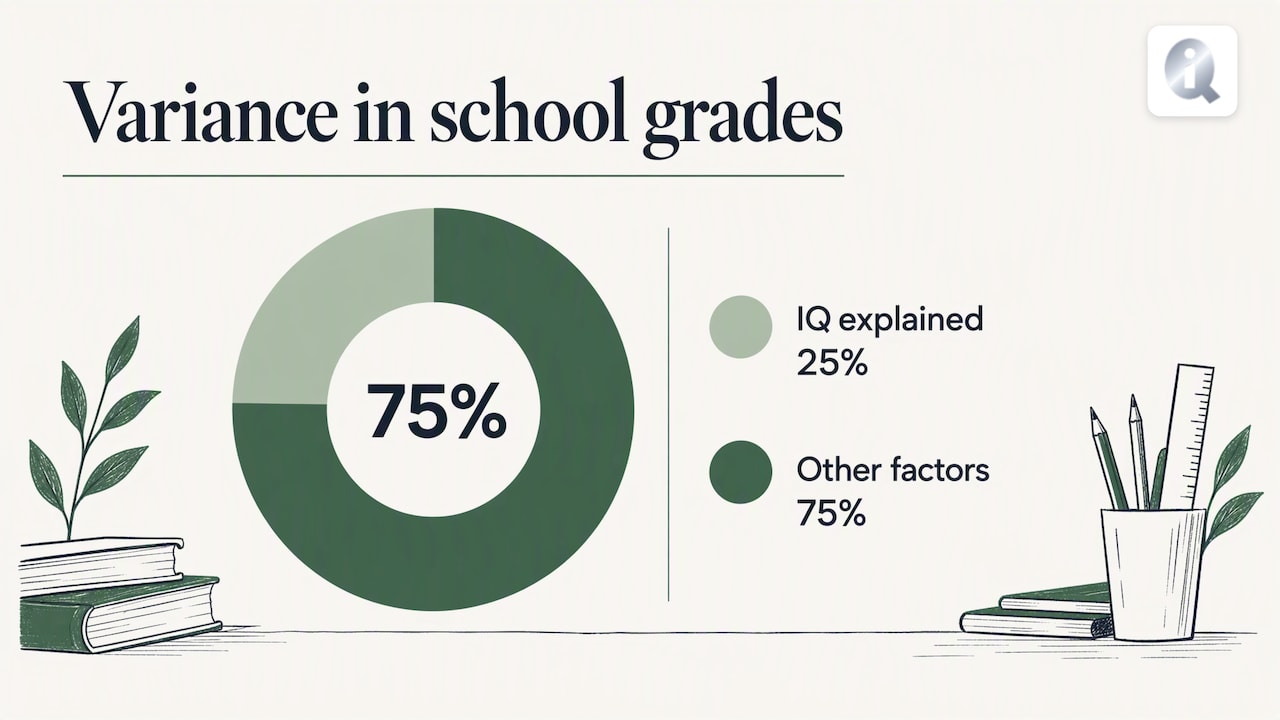
- IQ explains only part of life outcomes, roughly 25% of the variance in school grades, so a “good” score is context, not a verdict (Wikipedia: Intelligence quotient).
- Scores from different tests and different norming years are not interchangeable.
Table of Contents
- How IQ scores are built
- IQ score ranges and what they mean
- Is 120 a good IQ?
- What IQ is considered high?
- Low scores and intellectual disability
- Why the same score can mean different things
- How much does a good IQ predict?
- Our perspective
- Check your own score
- How to read your result in four steps
- FAQ
- Sources
How IQ scores are built
An IQ score is not a count of correct answers. It is a standardized score that compares your performance with a reference group, usually people of the same age. The test is calibrated so that the group’s mean is 100 and its standard deviation is 15. According to the APA Dictionary of Psychology, roughly 68% of the population falls within one standard deviation of the mean (85 to 115), and 95% falls within two (70 to 130).
This is why “good” is always relative. A score tells you where you stand among others on that test, which is a percentile statement. If you want to see how a number maps onto the bell curve, our IQ standard deviation calculator shows the distribution directly.
Three features of the scale matter for interpretation:
- The mean is fixed by design. A score of 100 is the norm of the reference sample, not a measured national average. We cover that distinction in US average IQ: why 100 is a norm, not a national score.
- Distances shrink toward the extremes. Moving from 100 to 115 passes about 34 percentile points. Moving from 130 to 145 passes only about 2.
- Every score has an error band. Professional score reports give a confidence interval alongside the number. In the sample WAIS-IV score report from Pearson, a Perceptual Reasoning index of 123 carries a 116 to 128 interval. Treat any single figure as a range of plausible values.
IQ score ranges and what they mean
The table below uses the Wechsler adult classification, the most widely cited scheme in the United States (source). The percentile column is our own calculation from the normal distribution (mean 100, standard deviation 15), rounded to the nearest whole percentile.
| IQ range | Wechsler label | Approximate percentile at the bottom of the range | Plain reading |
|---|---|---|---|
| 130 and above | Extremely high / very superior | 98th | Top 2% |
| 120 to 129 | Very high / superior | 91st | Well above average |
| 110 to 119 | High average | 75th | Above average |
| 90 to 109 | Average | 25th | Middle half of the population |
| 80 to 89 | Low average | 9th | Below average |
| 70 to 79 | Very low / borderline | 2nd | Well below average |
| 69 and below | Extremely low | Below 2nd | See the note on intellectual disability |
Two observations follow. First, the “average” band is wide: it spans the 25th to the 75th percentile, so half of all people score between 90 and 109. Second, the labels are conventions. Different test publishers use slightly different wording, and the cut points are rounded.
Where “good” begins
There is no official line at which an IQ becomes good. In practice, readers mean one of three things:
- Not below average: 100 or higher, the 50th percentile and up.
- Clearly above average: 110 or higher, roughly the top quarter.
- High: 120 or higher for strong, 130 or higher for exceptional.
Is 120 a good IQ?
Yes. An IQ of 120 is about 1.33 standard deviations above the mean, which corresponds to roughly the 91st percentile. Out of 100 people tested on the same scale, about 91 would score lower. On the Wechsler scheme it falls in the “superior” category.
What 120 does not do is guarantee any outcome. It indicates a strong capacity for the kinds of reasoning, memory and processing speed the test samples. It does not tell you how persistent, curious, creative or well-prepared you are, and those qualities shape results in school and work at least as much as the score does.
What IQ is considered high?
Most sources treat 130 as the entry to the high range. It sits two standard deviations above the mean, the same cut the APA Dictionary uses to describe the upper end of the distribution. About 2% of people score at or above it.
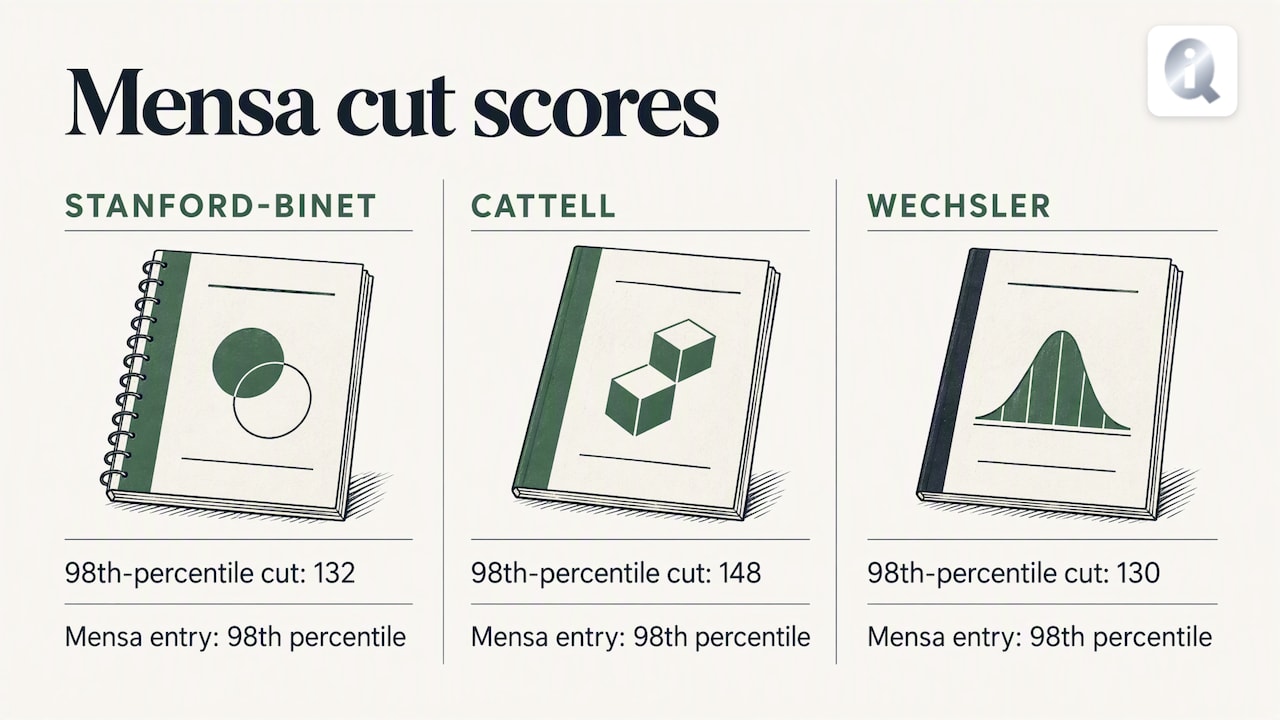
The best-known practical example is Mensa. The society admits people who score at or above the 98th percentile on an approved, supervised test. Mensa’s published cut scores are 132 on the Stanford-Binet, 148 on the Cattell, and 130 on the Wechsler scales. Note how the same percentile produces different numbers: the tests use different standard deviations, which is why scores must be converted before they are compared. Our IQ score converter handles that translation between scales.
Above 130, labels such as “profoundly gifted” appear in some online charts. Standard tests have few norming participants at those extremes, so precision falls sharply. Read any score above about 145 with caution.
Low scores and intellectual disability
Scores below 70 are often called low, but a score alone does not establish a diagnosis. Current clinical standards require both significantly below-average intellectual functioning (typically an IQ of about 70 or lower) and deficits in adaptive behavior, such as communication, social participation and independent living. A review in the peer-reviewed literature notes that someone with an IQ under 70 and strong adaptive skills may not meet the criteria, while someone above 70 who struggles significantly with daily demands may.
If you or your child scored low on an online test and you are concerned, an online result is not a clinical measure. A licensed psychologist or school psychologist can administer an individually delivered test such as a Wechsler scale and evaluate adaptive functioning.
Why the same score can mean different things
The test matters
IQ tests differ in what they sample, how long they are, how they were normed and whether a professional administered them. A supervised, individually administered Wechsler assessment and a 50-question online screening are not equivalent instruments. The first is suited to clinical and educational decisions. The second is useful for personal exploration and orientation.
The norming date matters
Average performance has risen across the twentieth century. The American Psychological Association’s Monitor reported that between 1900 and 2012 Americans’ mean IQ rose nearly 30 points, so the average person in 2012 would outscore about 95% of the 1900 population. This is the Flynn effect. A test normed long ago can therefore overstate a present-day score. For high-stakes clinical and legal uses, some experts recommend lowering older scores by about 0.3 points per year since the norms were collected, according to the same article. A 2024 analysis of the WAIS-5 examines whether the effect still shows up on the newest edition.
The reference population matters
Norms are drawn from a specific group. A study on Canadian versus American norms reports that scores calculated with Canadian norms are generally 2 to 5 points lower than with American norms on the Wechsler scales. The same raw performance can yield different numbers depending on whose norms are applied.
The score is one measurement on one day
Sleep, stress, motivation and test familiarity all move results by a few points. Retest differences within a confidence interval are expected and do not signal a change in ability.
How much does a good IQ predict?
IQ is among the better-documented predictors in psychology, and it still leaves most of the picture unexplained. The correlation between IQ and school grades is typically about .50, which accounts for about 25% of the variance in academic performance (Wikipedia summary of the research). The remaining 75% reflects effort, conscientiousness, opportunity, health, teaching quality and chance.
Professor Markus Bühner of LMU Munich makes the related point in an interview on IQ myths: intelligence tests capture a particular set of cognitive performances at one point in time, and they do not account for personality, character or the environment. That is why we pair cognitive results with a personality profile when we discuss careers.
A practical reading follows from this:
- A score of 125 with low persistence will often produce less than a score of 105 with strong persistence and good preparation.
- Occupations differ in their cognitive demands, but within any occupation people span a wide range of scores. Our IQ comparison tool shows published estimates across jobs, countries and public figures, and these are group-level figures, not entry requirements.
Our perspective
We publish IQ statistics every day, and the question we hear most is “is my number good?” Our answer is that the number is only half of a useful reading. The other half is the shape of the profile.
A single composite hides variation. Two people with an identical score of 112 can differ widely: one may be strong in verbal reasoning and weak in processing speed, the other the reverse. For study choices and careers, that pattern is usually more actionable than the composite. This is the reasoning behind the domain-level breakdown in our assessment, which reports performance across five cognitive domains rather than a lone figure.
We also hold a firm line on scope. Our assessments are for information and personal development. They are not clinical diagnoses and not formal employment qualifications. If a decision about education support, disability services or legal status depends on a score, a licensed psychologist and an individually administered test are the right route.
Finally, we advise against anchoring your self-image on a threshold. Moving from 118 to 122 crosses a label but changes very little about what you can do. Read the percentile, read the error band, and read the profile.
— Steve
Check your own score
If you want a result of your own, you can start our 50-question IQ assessment without registering and receive an initial result range. The Full IQ Result costs $9.99 as a one-time payment and adds your exact score, percentile context, the cognitive domain breakdown and a verifiable certificate. If you already have a number from another test, the free IQ percentile calculator converts it to a rank, and the IQ score meaning tool explains what it indicates.
How to read your result in four steps
- Identify the scale. Confirm that the test uses a mean of 100 and a standard deviation of 15. If it does not, convert it first.
- Convert to a percentile. The percentile tells you the share of the reference group you outscored, which is easier to interpret than the raw number.
- Apply the error band. Think of a score of 118 as roughly 112 to 124, not a point.
- Look at the profile. Compare domains, then ask what the pattern implies for your study or work choices. Our free cognitive strength finder offers a quick domain-level view.
FAQ
What is a good IQ?
Scores of 110 and above are generally considered good, since they place a person at or above roughly the 75th percentile. Scores of 120 and above are strong, and 130 and above is the conventional high range. The label always depends on the test and its norms.
Is 120 IQ good?
Yes. An IQ of 120 sits around the 91st percentile, better than about nine in ten people on the same scale, and falls in the “superior” category on the Wechsler classification. It indicates strong cognitive performance, not a guaranteed outcome.
What IQ is considered high?
An IQ of 130 or above is usually called high. It is two standard deviations above the mean, and about 2% of people reach it. Mensa, for example, uses the 98th percentile as its cutoff, which is 130 on the Wechsler scales.
Is an online IQ test as accurate as a clinical one?
No. Clinical tests are individually administered by a trained professional and normed on large samples, and they report confidence intervals. Online tests can give a useful estimate for personal insight, but they should not be used for diagnosis or formal qualification.
Sources
- APA Dictionary of Psychology: intelligence quotient
- IQ classification (Wikipedia)
- Mensa International (Wikipedia)
- Intelligence quotient (Wikipedia)
- IQ myths, LMU Munich
- Smarter than ever? APA Monitor
- Wait, Where’s the Flynn Effect on the WAIS-5?
- Canadian normative data and American tests
- Assessment of Specific Learning Disabilities and Intellectual Disabilities
- WAIS-IV score report sample, Pearson