Intelligence Heritability: What the Research Shows

Intelligence is substantially heritable, but the figure people quote (often “50%” or “80%”) is a statistic about differences among people in a population, not a share of any one person’s mind that genes “built.” Twin, family and adoption studies put the genetic contribution to IQ differences at roughly 50% across all ages, rising from about 20-30% in childhood to 70% or more in adulthood. This article explains where those numbers come from, why they change, and what they cannot tell you about your own score or your children’s.
TL;DR
- Heritability is a population statistic (h²) describing how much of the variation in a trait, within a specific group and environment, is associated with genetic differences. It is not the percentage of your intelligence that is “genetic.”
- Twin and family studies estimate about 50% across ages; estimates climb with age, from roughly 20-30% in childhood to 70% or more in adulthood, while shared family environment fades toward zero.
- Direct DNA evidence is far weaker than twin evidence: polygenic scores for intelligence predict up to about 7% of variance in independent samples, and no single gene has a major role.
- High heritability does not mean fixed. Environment, education and socioeconomic conditions still move scores, especially at the disadvantaged end.
Table of Contents
- What heritability actually measures
- How twin studies estimate it
- Heritability changes with age
- What DNA studies add, and what they do not
- Genes and environment together
- Five misreadings to avoid
- Can two parents with lower scores have a child who scores higher?
- Our perspective
- Measure your own profile, then put it in context
- FAQ
- Sources
What heritability actually measures
Heritability is expressed as h², a number between zero and one. According to MedlinePlus Genetics, a value near zero means almost all variability in a trait comes from environmental factors, while a value near one means almost all of it comes from genetic differences. The same page is explicit about two limits: heritability does not describe how much of an individual’s trait is caused by genes, and it does not indicate how easy or hard the trait is to change.
Three consequences follow, and they are the source of most public confusion.
- It describes a group, not a person. A review of the paradox of intelligence stresses that heritability reflects causes of variation among people, not what causes a trait in one individual. Saying “your IQ is 60% genetic” is a misuse of the statistic.
- It depends on the population and environment studied. An academic analysis of genes, heritability and intelligence notes that a high estimate describes variation within a specified population and environment. It does not show that intelligence is genetically fixed, nor does it explain average differences between populations.
- It is not a fixed constant. If the environment becomes more uniform, the share of variation attributable to genes rises by arithmetic alone. If the environment becomes more varied, it falls.
Some scholars go further. Robert Sternberg has argued that, because heritability depends on existing individual differences, the concept may be meaningless for individuals and says nothing about variation between populations. We treat that as a legitimate critique of how the number is used, not a reason to dismiss the underlying twin and family data.
How twin studies estimate it
The classical twin design compares two kinds of pairs. Identical (monozygotic, MZ) twins share all of their additive and non-additive genetic effects. Fraternal (dizygotic, DZ) twins share, on average, 50% of additive and 25% of non-additive effects, as described in a review of what twin studies tell us. If MZ twins resemble each other more than DZ twins do on an IQ test, the difference is attributed to genes.
The simplest estimate is Falconer’s formula, h² = 2(rMZ − rDZ), where r is the correlation between twins in each group. The same review explains that structural-equation models go further, splitting total variance into additive genetic effects (A), non-additive genetic effects (D), common environment © and non-shared environment (E), with E also absorbing measurement error.
A worked example makes the logic concrete. Suppose identical twins correlate at 0.80 on an IQ measure and fraternal twins at 0.50. Then h² = 2(0.80 − 0.50) = 0.60, and the common-environment share is 0.80 − 0.60 = 0.20. These figures are illustrative, not drawn from a specific study, but they show how twin correlations translate into the percentages reported in the literature.
Where twin estimates can mislead
Twin designs rest on assumptions, including that genetic effects are additive and that identical and fraternal twins experience similarly shared environments (the equal-environments assumption). Other documented complications:
- Maternal effects. A 1997 meta-analysis of 212 studies in Nature reported that a model including maternal effects fit IQ covariance better than a conventional family-environment model. Estimated maternal effects accounted for about 20% of covariance between twins and 5% between siblings, which reduced two heritability measures to below 50%.
- Assortative mating. Plomin and Deary’s 2014 review reports that partners resemble each other on intelligence at about 0.40, and that this increases additive genetic variance in offspring.
- Critics of the method. Some authors argue that behavioral-genetics estimates rest on questionable assumptions and that the missing-heritability gap in DNA studies is partly a twin-study problem. This is a minority position, but it explains why twin numbers and DNA numbers do not match (see below).
Heritability changes with age
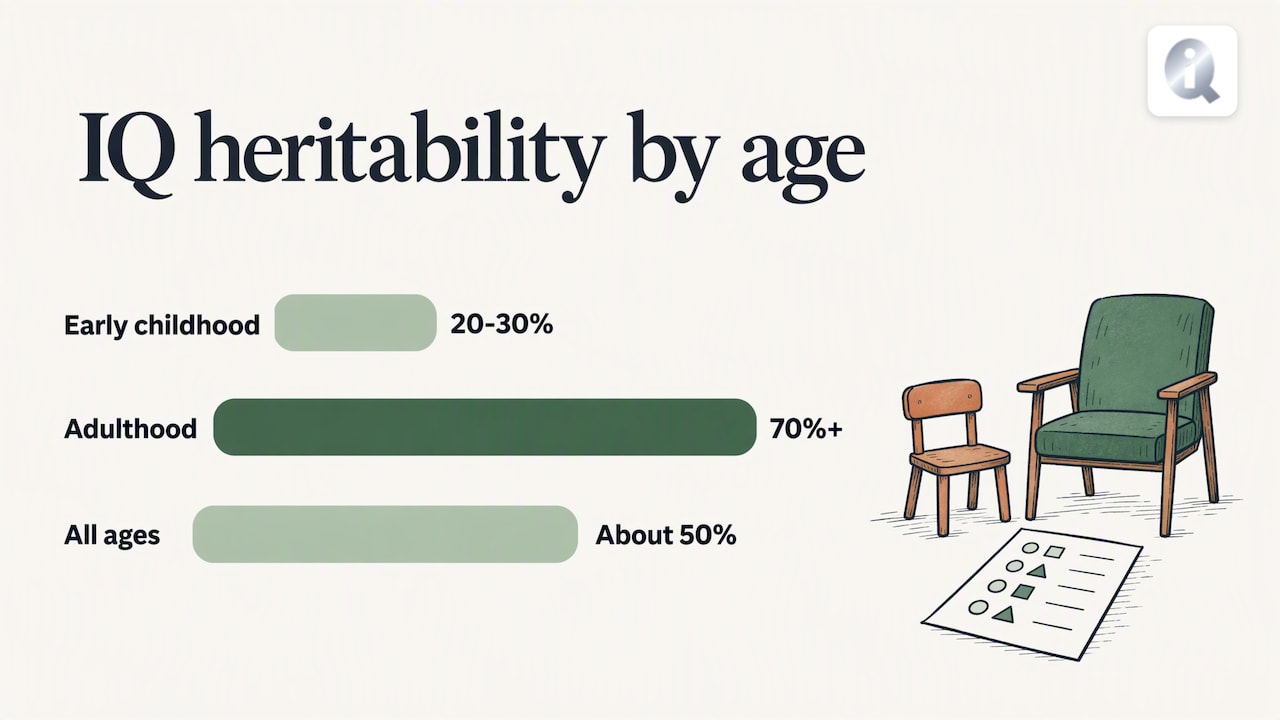
One of the most counterintuitive findings is that genetic influence on IQ grows as people get older. A 2021 review by Deary, Cox and Hill reports that across all ages, twin and family studies attribute about 50% of the variation in intelligence to genetic differences, with estimates rising from 20-30% in childhood to 70% or more in adulthood.
| Life stage | Approximate heritability of IQ | Shared family environment |
|---|---|---|
| Early childhood | About 20-30% | Significant |
| Adulthood | 70% or more | Near zero |
| All ages combined | About 50% | Varies by age |
The shared-environment column matters just as much. Research summarized in a 2009 PMC study shows that shared environmental influences, which account for a portion of IQ variance early in life, typically decline to near zero by adulthood. In plain terms: the household you grew up in explains noticeable score differences among young children and almost none among adults, who increasingly select and create environments that suit their own dispositions.
The paradox review describes the mechanism as gene-environment correlation and interaction: people actively select experiences, and those choices are shaped partly by genetic tendencies. That is one reason heritability can climb with age without any single gene “switching on.”
What DNA studies add, and what they do not
Twin studies infer genetic influence indirectly. Molecular studies try to find it directly in the genome, and here the numbers are much smaller. Intelligence is polygenic, meaning it is influenced by very many variants of tiny effect. MedlinePlus Genetics states that studies have not conclusively identified any single gene with a major role in differences in intelligence.
Polygenic scores combine thousands of small effects into one predictor. A 2025 study reports that polygenic scores for intelligence predict up to 7% of variance in independent validation samples. Compare that with 50% to 70% or more from twin designs: the gap is the “missing heritability” problem, and it means a polygenic score cannot tell you whether a particular child will score high or low.
There is a further complication. A comparison of within- and between-family polygenic prediction found that predictions for cognitive traits were on average 60% greater between families than within families, and much of that difference disappeared after controlling for family socioeconomic status. That suggests part of what a polygenic score captures is the family environment that correlated genes help create, not only direct biological effects.
Genes and environment together
The question “nature or nurture?” assumes the two add up separately. The evidence says they interact.
Socioeconomic status and the Scarr-Rowe effect
A widely cited US study by Turkheimer and colleagues, published in Psychological Science in 2003, found heritability of IQ close to zero in impoverished families and higher in affluent families. The finding is known as the Scarr-Rowe effect. Replication is mixed: it has been reported in some US samples, but it has not been found consistently in other studies, including some in Australia and Western Europe. We treat it as an important hypothesis with uneven support, not a settled law.
Turkheimer’s accompanying paper offers a way to reconcile twin and intervention research: if environmental effects are non-linear, extra enrichment adds little in an already adequate environment, but moving out of extreme poverty can matter a great deal.
Adoption evidence
Adoption designs are informative because adopted people share a rearing environment with their adoptive family but not their genes. A 2021 study of 486 adoptive and biological families with adult offspring concluded that IQ differences reflect both genetic and environmental sources.
Is it “high but malleable”?
Sauce and Matzel’s 2018 review describes a paradox: intelligence is highly heritable yet responsive to experience. They cite IQ changes associated with adoption or immigration, early education, socioeconomic change across the lifespan and broader societal development. They also argue that standard estimates can underestimate gene-environment interplay, which may inflate the apparent size of purely genetic effects.
Five misreadings to avoid
- “80% heritable means 80% of my IQ is from my genes.” No. The statistic applies to variation in a population, not to one person’s score.
- “Heritable means unchangeable.” No. MedlinePlus states that heritability does not indicate how easy it is to change a trait.
- “Heritability explains group differences.” No. Within-group heritability does not explain average differences between populations, as the 2022 academic analysis states.
- “Environment doesn’t matter in adults.” Shared family environment fades, but home, parenting, education, learning resources, healthcare and nutrition all appear in the MedlinePlus list of strong influences on intelligence.
- “A gene for intelligence has been found.” No single gene has been shown to play a major role.
Can two parents with lower scores have a child who scores higher?
Yes, and the logic follows from the findings above rather than from any special rule. Intelligence is polygenic, so a child receives a new combination of many small-effect variants, and the child’s score also reflects non-shared environmental influences and measurement error, which the twin models place in the E component. Parents’ scores therefore predict a child’s score only imperfectly. Parental similarity (assortative mating of about 0.40) raises genetic variance in offspring but does not determine any individual outcome.
The popular idea that intelligence comes from one parent, such as the mother, is also not supported by the polygenic picture described above: the evidence points to thousands of variants across the genome, none of which has a major role. We have not found a source that settles the question beyond that, and we would rather say so than repeat a folk rule.
Our perspective
We publish IQ statistics, so we see how often a heritability figure gets turned into a verdict on a person. The data do not support that. A heritability estimate tells researchers how much people in a sampled population differ because of genetic variation under the conditions of the study. It cannot tell you what a child’s score will be, what a given adult is capable of, or how much training or schooling could change an outcome.
Our practical position follows from that. An IQ score is a measurement taken at one time, with a margin of error, on a specific test. What the score means depends on how IQ scores are normed and interpreted, and the number 100 is a norm, not a national score. Cognitive ability also is not the whole of capability: Sternberg’s triarchic theory and the evidence on multiple intelligences show how contested the boundaries of the construct are. We would encourage readers to use scores as one input among several, together with interests, personality and experience.
— Steve
Measure your own profile, then put it in context
Heritability tells you about populations; a test tells you about one performance. Our 50-question IQ assessment can be completed without creating an account and returns a broad result category. If you want more, a one-time $9.99 unlock per completed result adds your exact IQ score, percentile context, a five-domain breakdown, a personalized report, a verifiable certificate and Career Matches. It is not a subscription. Details are on the pricing page.

If you are more interested in work style than in reasoning ability, the separate Big Five personality assessment requires sign-in and gives you OCEAN trait percentiles and a personality archetype for free. Personality Full Access is $14.99 once per result. To see how cognitive demands differ by occupation, browse average IQ by profession or try the Career-IQ Matcher.
FAQ
Is intelligence genetic?
Partly. Twin and family studies attribute about 50% of the variation in intelligence to genetic differences across all ages. The remainder reflects environmental influences and measurement error. The figure describes a population, so it cannot be applied as a percentage to any one person.
Is IQ 80% heritable?
Not as a general rule. Estimates of 70% or more come from adult samples, while childhood estimates are closer to 20-30%, and pooled estimates across ages are about 50%. The number also depends on the population and environment studied.
Does nature or nurture matter more for IQ?
Neither wins in isolation. Genetic differences account for more of the variation among adults, while shared family environment matters in childhood and fades toward zero by adulthood. Genes and environment also interact, because people select experiences that fit their dispositions.
Can intelligence change if it is highly heritable?
Yes. High heritability describes variation within a population, not immutability. Reviews describe IQ changes associated with adoption or immigration, early education and socioeconomic change, with the largest environmental effects appearing when people leave extreme poverty.
Can polygenic scores predict a child’s IQ?
Not reliably. Current polygenic scores predict up to about 7% of variance in independent samples, far below twin-study estimates. They also partly reflect family environment, so they are not a precise individual forecast.
Sources
- What is heritability? MedlinePlus Genetics
- Is intelligence determined by genetics? MedlinePlus Genetics
- The Paradox of Intelligence: Heritability and Malleability (2018)
- Genes, Heritability, ‘Race’, and Intelligence (2022)
- Intelligence, Sternberg (2012)
- What Twin Studies Tell Us About the Heritability of Brain Development (2015)
- The heritability of IQ, Nature (1997)
- Genetics and intelligence differences: five special findings (2014)
- Genetic variation, brain, and intelligence differences (2021)
- Genetic and Environmental Transactions Underlying Educational Attainment (2009)
- Electrophysiological resting-state signatures study (2025)
- Comparing Within- and Between-Family Polygenic Score Prediction (2019)
- Turkheimer et al., Psychological Science (2003)
- Turkheimer (2003) research article
- Genetic and environmental contributions to IQ in adoptive and biological families (2021)