Careers for Extraverts: Where Sociability Predicts Success

The best careers for extraverts are those in which daily work depends on talking, persuading, coordinating, and leading other people: sales, management, event and client-facing roles, teaching, and parts of healthcare and communications. Research supports this, but with a qualification that most job lists omit. Extraversion predicts performance in occupations that demand social interaction, and it adds little in roles built around solitary or purely analytical work. A good fit therefore depends on the content of the day-to-day tasks, not on the job title. This guide (updated 20 October 2026) explains how to judge that fit and which occupations deserve a closer look. It also covers the cognitive skills that hiring processes test for in these roles.
TL;DR
- Extraversion is a contextual predictor of job performance. It is most useful in roles with high social demands, such as sales and management, and offers little extra in solitary roles.
- Management occupations had a median annual wage of $145,260 in May 2025, against $69,770 for all occupations.
- Check the daily activities of a role (client contact versus administrative coordination), not only its title.
- Many of these roles screen candidates with verbal reasoning tests, which measure logic applied to written text, not social fluency.
Table of Contents
- What the research says about extraversion and work
- How to tell whether a social job fits you
- Occupations that reward extraversion
- The cognitive side of extraverted careers
- Our perspective: personality sets the direction, cognition sets the ceiling
- Matching your profile to real openings
- A practical plan for choosing a path
- FAQ
- Sources
What the research says about extraversion and work
Extraversion is the Big Five dimension describing sociability, assertiveness, and a tendency to be energized by contact with others. A common assumption is that it helps in every job. The evidence does not support that.
An early and widely cited meta-analysis of the Big Five and job performance by Barrick and Mount found that conscientiousness was a valid predictor across occupational groups, while extraversion mattered for particular groups, notably managers and sales staff. A more recent set of second-order meta-analyses by Michael Wilmot and Deniz Ones, summarized by ScienceDaily, examined how the predictive value of the five traits differs across jobs. The published abstract frames the central point: occupational characteristics moderate the relationship between personality and performance.
Two practical conclusions follow.
- Social demand matters. Extraversion pays off most where the job requires persuasion, frequent face-to-face coordination, and visible leadership. In roles dominated by solitary or analytical concentration, it provides minimal incremental validity.
- Complexity matters too. The same research describes an inverse-U pattern: personality has its largest effect at moderate levels of occupational complexity. In very simple roles, procedures constrain how personality shows up. In extremely complex roles, cognitive requirements can override personality influences.
The second point is often missed. An extravert aiming for a highly complex leadership or technical role should not assume that sociability will carry the performance. Cognitive ability and personality work together, and we return to that below.
How to tell whether a social job fits you
The U.S. Department of Labor’s O*NET database lists a work style called Social Orientation, defined as a tendency to seek out, enjoy, and be energized by social interaction at work. Its occupation list shows how strongly each job requires this trait. Advertising sales agents, for instance, appear with an impact score of 94 (Job Zone 3).
Use a short checklist before you commit to a direction:
- Who do you talk to, and how often? Direct client or customer engagement drains and energizes people differently than internal coordination does.
- Is the interaction live? Meetings, calls, site visits, and floor work suit extraverts better than long stretches of email or reporting.
- How much of the day is uninterrupted solo work? Even sociable roles contain paperwork, and a role with more than half of its hours in documentation may not deliver the stimulation you expect.
- How is success measured? Revenue, relationships, and team outcomes reward extraversion directly. Error-free output in isolation usually does not.
- Can you sustain the pace? Practitioners using O*NET data caution that choosing a role that merely sounds social, without examining its daily activities, is a route to burnout.
The Big Five itself is a more reliable instrument than most informal quizzes. Our analysis in Personality Test Accuracy: Big Five Nearly Twice as Predictive as MBTI explains why we recommend it when you want to measure extraversion rather than guess at it.
Occupations that reward extraversion
The table groups common options by the type of social demand they place on you. It is a starting framework, not a ranking, and pay and demand vary by region and employer.
| Role family | Typical social demand | What to verify before applying |
|---|---|---|
| Sales (advertising, pharmaceutical, B2B) | Persuasion, relationship building, frequent live contact | Quota structure, share of time spent prospecting versus closing |
| Marketing and sales management | Leading teams, negotiating, presenting | Team size, travel, reporting lines |
| General and operations management | Coordination, decision communication, staff leadership | Span of control, balance of meetings and analysis |
| Event planning and hospitality management | Vendor and client contact, on-site coordination | Weekend and evening schedule, seasonal intensity |
| Teaching and training | Daily group interaction, presentation | Class size, grading and preparation load |
| Nursing, dental hygiene, counseling | Sustained one-to-one contact with patients or students | Emotional demands, shift patterns, licensing |
| Human resources and recruiting | Interviewing, mediation, employee relations | Share of compliance paperwork |
| Public relations and communications | Media contact, stakeholder management, speaking | Agency versus in-house pace |
Popular lists of jobs for extroverts tend to feature these same families: sales representatives, event planners, teachers, mediators, flight attendants, and human resources specialists. The overlap is not accidental, since each puts conversation at the center of the work.
Sales and management: the strongest evidence
These two groups are where the research is clearest. In the Wilmot and Ones analysis, extraversion ranks among the most predictive traits for sales and management, consistent with O*NET expert ratings of how social those jobs are.
The labor market data shows the payoff for people who move into leadership. According to the Bureau of Labor Statistics’ May 2025 wage table:
- Management occupations: median annual wage of $145,260.
- Marketing and sales managers: median annual wage of $169,490, with roughly 1,032,320 people employed.
- All occupations: median annual wage of $69,770.
The BLS Occupational Outlook Handbook projects management employment to grow faster than the average for all occupations over 2025 to 2035. These figures describe the occupations, not extraverts specifically. Extraversion does not guarantee entry or success, and the wage premium reflects experience, responsibility, and often long hours as well.
Roles in care, education, and communication
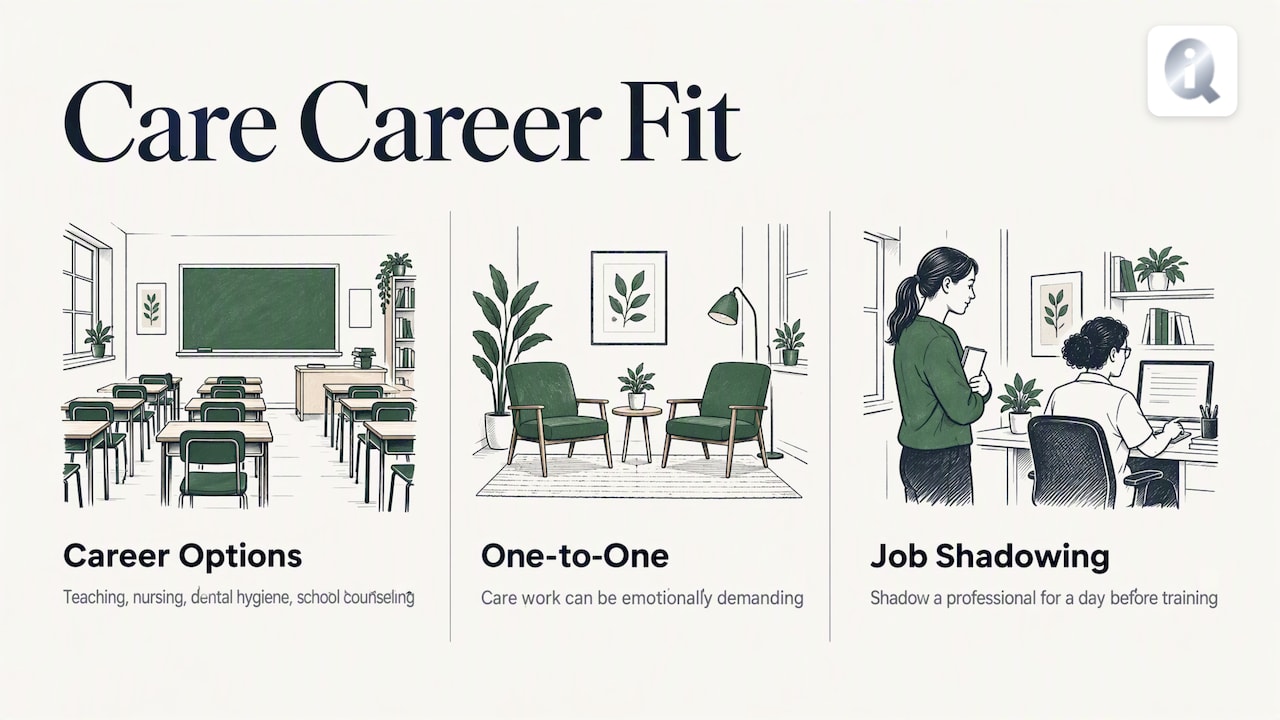
Not every extraverted career is commercial. Teaching, nursing, dental hygiene, and school counseling appear regularly on lists for outgoing people because they involve continuous interaction. The caution from the O*NET-based analyses applies here more than anywhere: one-to-one care work can be emotionally demanding, and an extravert who enjoys groups may find sustained individual contact differently tiring. Shadow a professional for a day, if you can, before choosing a training path.
Roles to approach carefully
Highly technical, research-heavy, or risk-driven jobs can still suit an extravert, but the personality advantage largely disappears. In those fields, differences in performance come mainly from cognitive ability and domain skill. If your pull toward such a role is strong, treat extraversion as a bonus for collaboration and communication, not as the reason to enter.
The cognitive side of extraverted careers
Self-description as a “people person” does not predict how you will do in the hiring process. Many graduate and management-track employers use aptitude screening, and verbal reasoning is a standard component for roles requiring communication and leadership.
A cross-provider guide to verbal reasoning tests reports that, as of 2026, most graduate-level tests from major publishers use a True/False/Cannot Say format. It also reports that SHL Verify tests impose a strict time limit, with candidates evaluating 30 items in 17 to 19 minutes. Practice platforms exist for each publisher, and some are paid.
The point most relevant to extraverts concerns a common misconception. A review of practice tools notes that high-performing extraverts often underestimate these tests, assuming natural communication strengths equal a high score. The tests measure logic and adherence to the written passage, not social fluency.
The typical errors are consistent:
- Using outside knowledge. The answer must rest only on the passage, even when you know the real-world facts.
- Confusing False with Cannot Say. A statement is False when the text contradicts it. It is Cannot Say when the text does not address it. The testing guide identifies this distinction as responsible for most failures.
- Running out of time. Speed on dense text is a skill that improves with timed drills.
An untimed read-through of a passage often feels easy and hides these weaknesses. If you want to see where you stand before a real assessment, our guide to verbal reasoning IQ, what a score of 100 means, and sample questions walks through the scoring and includes practice items.
Our perspective: personality sets the direction, cognition sets the ceiling
We build assessments of both cognitive ability and personality, and the pattern we see in the published research is consistent. Extraversion is informative about which environment will energize you. It is a weak basis for predicting whether you will succeed in a specific role once the role is complex.
For that reason we advise extraverts to look at three layers together. The first is temperament: how much social stimulation you want. The second is cognitive profile: whether your strengths lie in verbal, numerical, spatial, or reasoning tasks, because the roles that reward sociability still differ greatly in their analytical load. A regional sales director, a hospital administrator, and a trial lawyer are all social jobs, and they ask for different cognitive strengths. The third is the actual task mix of the job, which is where O*NET descriptors and conversations with current employees help most.
We also want to be explicit about limits. Our assessments are for informational and personal-development use. They are not clinical diagnoses or formal employment qualifications, and a single score or trait level should not decide a career. Used as one input among several, a Big Five profile and a domain-level cognitive breakdown can make a shortlist of careers more specific than any generic list.
— Steve
Matching your profile to real openings
If you want to move from general lists to a concrete shortlist, our Big Five personality test measures extraversion alongside the other four dimensions, and our Full IQ Assessment covers five cognitive domains. You can start either without registering. The free result gives an initial range, and the paid unlock adds the detail.
The published prices are $9.99 one-off for the Full IQ Result and $14.99 one-off for Personality Full Access; both are listed on our pricing page. The Career-IQ Matcher shows how occupations line up with a cognitive profile, and the Career Matches report connects results to live job listings. Browse the rest of our research blog for occupational comparisons.
A practical plan for choosing a path
- Measure, do not guess. Take a Big Five assessment and note your extraversion level relative to the norm, including its facets (for example, assertiveness and sociability), since a role may need one more than the other.
- List the tasks you want to do every day. Write them as activities: presenting, negotiating, teaching, coordinating a team, visiting clients.
- Compare against O*NET. Look up the occupations you are considering and read the work context and work styles, not only the summary.
- Check the numbers. Use the BLS Occupational Outlook Handbook for median pay and projected growth for each candidate occupation.
- Prepare for screening. If the employer uses verbal reasoning or similar tests, practice under timed conditions, focusing on the Cannot Say category.
- Test the role in practice. An informational interview, job shadowing, or a short project reveals the proportion of interaction to paperwork.
FAQ
What are the best jobs for extraverts?
Sales, marketing and sales management, general management, event planning, teaching, nursing, human resources, and public relations are common fits. Research supports sales and management most strongly, because those roles rely on persuasion and frequent interaction. Compare specific job duties, not only titles.
Do extraverts earn more?
Not by default. Management occupations show a median annual wage of $145,260 against $69,770 for all occupations (BLS, May 2025), but that reflects the occupations, not personality. Extraversion helps performance in socially demanding roles, and pay follows from role, experience, and results.
Can an extravert succeed in a technical or analytical job?
Yes. Extraversion simply provides less of a performance advantage there, because task concentration and cognitive demands dominate. Extraverts in these fields often add value in collaboration, client communication, and team leadership.
Do extraverts need to prepare for verbal reasoning tests?
Yes. These tests assess logical reading of a passage, not conversational skill. Practice the True/False/Cannot Say format under time pressure, and answer only from the text provided.
Sources
- Occupational characteristics moderate personality–performance relations in major occupational groups (Experts@Minnesota)
- Personality traits predict performance differently across different jobs (ScienceDaily)
- The Big Five Personality Dimensions and Job Performance: A Meta-Analysis (Barrick and Mount)
- Work Styles: Social Orientation (O*NET OnLine)
- National employment and wage data, May 2025 (U.S. Bureau of Labor Statistics)
- Management Occupations (BLS Occupational Outlook Handbook)
- Verbal Reasoning Test 2026: Complete Cross-Provider Guide (TestSolve)
- 10 Best Verbal Reasoning Test Practice Tools in 2026 (Learnist)