Timed vs Untimed IQ Tests: What the Clock Changes

A timed IQ test gives you a fixed response period, so your score reflects how correctly and how quickly you work. An untimed test removes or minimizes that limit, so the score leans on the difficulty of the problems you can solve. The two formats often correlate, but research shows they are not interchangeable, and a score from one should not be read as a score from the other.
This guide explains the definitions used in testing standards, what the best available studies found about score differences and reliability, and how to interpret a result from an online test of either type.
TL;DR
- A timed test has a prescribed response period, so scores depend on work rate as well as correctness. An untimed (power) test minimizes the speed demand.
- In one 2023 Raven’s matrices experiment, removing the time limit raised accuracy by a modest margin (Cohen’s d = 0.35 versus a 20-minute limit).
- Timed and untimed versions can correlate well without measuring identical processes, so compare scores only within the same format.
- Most real intelligence tests are hybrids with item difficulty and practical time limits, so treat any single online result as an estimate, not a verdict.
Table of Contents
- What the two formats are
- Why IQ tests impose a time limit
- What a timed test measures besides reasoning
- Do people score higher when the test is untimed?
- Reliability and validity: what the studies show
- Can timed and untimed scores be compared?
- Timed and untimed side by side
- How to read a score from an online timed IQ test
- Perspective: why format transparency matters
- See your own profile
- FAQ
- Sources
What the two formats are
The AERA, APA and NCME Standards define a timed test as one with a prescribed response period. They define speededness as the extent to which scores depend on work rate as well as correctness. Speededness is not the same as simply testing speed: a test can have a time limit and still be only mildly speeded.
The literature separates three ideas:
- Speed tests use relatively easy items and a restrictive window. The score is largely determined by how many accurate responses a person can produce in that period.
- Power tests remove the speed constraint, or make it negligible. They emphasize accuracy and the difficulty of the problems the examinee can solve, as a 2020 review describes.
- Hybrids are the most common case. Most real intelligence tests mix items of varying difficulty with practical time limits, so both ability and speed can contribute to a score.
In practice, “timed” and “untimed” are the ends of a continuum. A 50-question test with a generous limit sits much closer to the untimed end than a ten-minute sprint through the same item types.
Why IQ tests impose a time limit
The reasons are often practical: a fixed session length makes testing feasible, standardizes conditions across people, and keeps administration costs predictable. A 2023 review of speeded and unspeeded intelligence tests notes that time limits are often chosen for practical reasons, and that whether they are appropriate depends on their effect on the construct the test intends to measure.
The Standards set out what a developer owes the user. Developers of time-limited tests are expected to examine the speed component, including completion and omission rates, and to justify whether speed belongs to the intended construct. When speed is not part of the target construct, limits should allow examinees adequate time to demonstrate the intended knowledge or skill, because insufficient time can underrepresent ability.
That gives you a practical question to ask of any test: is speed part of what the test claims to measure? If a publisher describes a test as a measure of reasoning, the time limit should be generous enough that finishing is not the main obstacle. If it describes a test as measuring processing speed or performance under pressure, a tight limit is the point.
For how limits work in practice, see our guide to IQ test time limits and the breakdown of how long each type of IQ test takes.
What a timed test measures besides reasoning
Timed reasoning tests can capture reasoning ability together with processing speed, pace, strategy selection, working-memory demands, attention and reactions to pressure. The 2023 review states that the exact mixture depends on the limit and the item design.
Two consequences follow:
- Two people with the same score can have different profiles. One may solve fewer items but get most of them right. Another may attempt everything and guess more under pressure.
- The speed-accuracy tradeoff is not fixed. Research on response times shows it varies across tasks and people, and response time is influenced by multiple factors. A single total score hides how a person traded one for the other.
If pressure affects you strongly, this matters. Our article on IQ test anxiety covers what the research shows and how to manage it. For timed reasoning in particular, a meta-analysis of exam anxiety strategies summarizes evidence-backed approaches that students can practice before a timed session.
Do people score higher when the test is untimed?
Often, yes, but the size of the effect depends on the test and the limit. The best-documented example in our research is a 2023 experiment using Raven’s matrices. Even mild time pressure reduced accuracy, confidence and constructive strategy use. The accuracy difference between an unlimited condition and a 20-minute condition was Cohen’s d = 0.35, which is a small-to-moderate effect by common conventions.
The same experiment reported that time pressure did not differentially affect ability estimates. In plain terms, people’s relative standing was not reshuffled in a way that the study could detect, even though raw accuracy dropped. That is why the headline for readers is cautious:
- Raw accuracy tends to be higher without a limit.
- Rank order across people can stay similar.
- The cognitive processes used to reach the answers can still differ.
The third point matters most when you compare scores, which the next sections cover.
Reliability and validity: what the studies show
The evidence does not support a blanket claim that untimed tests are always better, or that timed tests are always better. It supports a narrower reading.
The educational-testing argument. Gernsbacher, Soicher and Becker-Blease’s 2020 review argues that time-limited tests can be less valid, because pace is not necessarily a valid indicator of knowledge or mastery. The authors favor untimed power tests in educational settings. That is an argument about classroom assessment, and it should not be stretched into a verdict on every cognitive test.
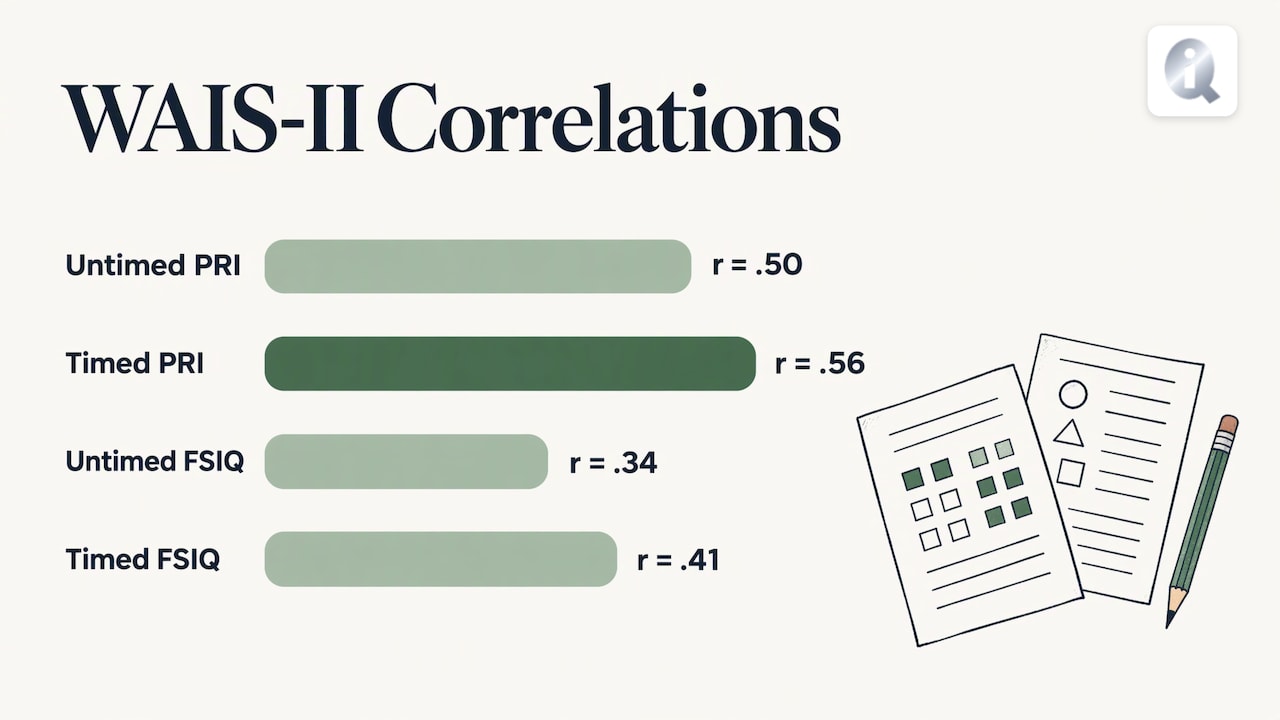
The brief online-matrices study. Poulton and colleagues compared abridged online forms of Raven’s matrices, using 608 participants for an untimed version and 479 for a timed version. Test-retest reliability was .65 for the untimed form and .69 for the timed form. Against the WAIS-II, the two forms behaved as follows:
| Measure | Untimed form | Timed form |
|---|---|---|
| Participants | 608 | 479 |
| Test-retest reliability | .65 | .69 |
| Correlation with WAIS-II Perceptual Reasoning Index | r = .50 | r = .56 |
| Correlation with WAIS-II Full-Scale IQ | r = .34 | r = .41 |
The timed form was slightly higher on every line. The differences are small, and the forms were short, so the result shows that a timed format can be at least as reliable as an untimed one for a brief test. It does not settle the broader question. It also illustrates a general point: for short online forms, reliability in the .60s signals real uncertainty around any single score.
Can timed and untimed scores be compared?
Not directly. Timed and untimed versions may correlate well without being equivalent, because time pressure can change the response processes behind performance.
The strongest evidence is a meta-analysis by Tatel and colleagues. It combined 142 studies and 26,848 participants and found that speeded or abbreviated versions of Raven’s Advanced Progressive Matrices changed the test’s relations with spatial visualization, memory and perceptual-speed abilities. The largest reported differences were ρ = 0.26, 0.08 and 0.34 respectively. The implication is that similar total scores, or a strong correlation between formats, do not prove that both formats measure the same psychological process.
For a reader, the rule is simple:
- Compare a timed score with other timed scores of the same design.
- Compare an untimed score with other untimed scores.
- Treat a cross-format comparison as approximate.
This is also why clinically administered tests and online tests are not interchangeable. Our comparison of WAIS, Stanford-Binet and online IQ tests explains the differences in design and norming.
Timed and untimed side by side
| Feature | Timed test | Untimed (power) test |
|---|---|---|
| Response period | Prescribed limit | None, or negligible |
| What drives the score | Correctness and work rate | Correctness and item difficulty solved |
| Other factors involved | Pace, strategy, attention, pressure | Persistence, strategy, available effort |
| Typical use | Standardized batteries, employer screening, practice sprints | Research, educational assessment, self-paced online forms |
| Main caution | Insufficient time can underrepresent ability | Scores are not directly comparable with timed norms |
Employer screening tests are the most common timed encounter for adults. Our overview of employer cognitive tests explains how those formats work. Students sometimes ask how timed college-entrance scores relate to IQ, which we cover in IQ and SAT.
How to read a score from an online timed IQ test
The research above gives a framework, even without a rule that is specific to one website.
- Find out what the limit is, and whether you finished. If you ran out of time with many items unanswered, the score reflects speed more heavily than if you completed everything with time to spare.
- Read the result as a range. Brief online forms show test-retest reliability in the .60s in the study above. A single number is a point estimate inside a wider band.
- Check the format of any benchmark. Percentile tables are only meaningful when your conditions match the ones used to build them. A ten-minute sprint cannot be placed on norms built for a long, self-paced test.
- Allow for practice effects. Taking similar items again changes how you approach them. See our explanation of retaking an IQ test and practice effects.
- Be careful with extreme scores. A single sitting is a weak basis for claiming a very high result. Our article on whether a gifted IQ score is reliable covers why.
- Know the structure. Question types and timing shape what the score means. The IQ test format guide and the list of 20 IQ test question types help you see what a given item is asking for.
A practical habit for anyone preparing for a timed test: practice the item types untimed first to learn the logic, then add a limit to build pace. The sequence separates the two skills, so you can see which one is holding your score back.
Perspective: why format transparency matters
We read the timed-versus-untimed literature as a case for transparency, not for choosing a winner. The studies show that a time limit changes accuracy, strategy and the abilities a score draws on, so a number without its conditions is incomplete.
That is the reasoning behind how we present results. Our 50-question IQ assessment can be completed without creating an account, and it returns a broad result category first. If you want more, you can unlock your exact IQ score, percentile context, five-domain breakdown, personalized report, verifiable certificate and Career Matches for $9.99 once per completed result. It is not a subscription.
The five-domain breakdown is the part we consider most useful for this topic. A single total hides whether your strengths lie in reasoning, memory or other areas, and a domain profile gives you something to interpret across conditions rather than a bare number.
Our advice is to treat any online result as an informed estimate, keep the conditions of each sitting in mind, and use the percentile context and domain detail to see the pattern.
Steve
See your own profile
If you want to see how your reasoning looks across domains, you can take our 50-question IQ assessment without an account and receive a broad result category. Unlocking the Full IQ Result for $9.99 once per completed result adds your exact score, percentile context, domain breakdown, personalized report, verifiable certificate and Career Matches.
If you are also curious about work style, our separate Big Five personality assessment is free and shows OCEAN trait percentiles and a personality archetype. Personality Full Access costs $14.99 once per result.
FAQ
Is an untimed IQ test valid?
Yes, it can be, provided it was designed and norm-referenced as an untimed or power test. The testing Standards ask developers to justify whether speed belongs to the construct. Where it does not, adequate time is the more defensible design. The issue is comparing an untimed score with timed norms, which is not like for like.
Do you score higher on an untimed IQ test?
Usually accuracy is higher. In a 2023 Raven’s matrices experiment, the unlimited-versus-20-minute accuracy difference was Cohen’s d = 0.35. Rank order among people may stay similar, but the raw result is not directly interchangeable between formats.
Are timed IQ tests more reliable?
Not necessarily. In a study of brief online Raven’s forms, test-retest reliability was .69 for the timed version and .65 for the untimed one, a small gap. Reliability depends on test length, item quality and conditions more than on the clock alone.
Can I compare a timed result with an untimed one?
Only roughly. A meta-analysis of 142 studies found that speeded or shortened matrices changed how scores related to other abilities. Similar totals or strong correlations do not prove the same processes were measured, so compare within one format.
Sources
- AERA, APA and NCME Standards for Educational and Psychological Testing (2014)
- Four Empirically Based Reasons Not to Administer Time-Limited Tests (2020)
- Measuring Ability, Speed, or Both? Challenges, Psychometric Solutions (2015)
- Should Intelligence Tests Be Speeded or Unspeeded? (2023)
- Use of Response Time for Measuring Cognitive Ability (2016)
- Evaluating untimed and timed abridged versions of Raven’s matrices (2022)
- Process differences as a function of test modifications: Raven’s meta-analysis (2021)