Pattern Recognition IQ: What It Measures and How to Train It

Pattern recognition on an IQ test means finding a rule in an unfamiliar arrangement of shapes, numbers or figures and using it to predict what comes next. It is the main skill behind matrix, series and abstract reasoning items, and it is one component of IQ, not the whole of it. Below we explain what these items measure, how Raven-style matrices work, how spatial reasoning differs, how to interpret a score, and how to practice without distorting your result.
TL;DR
- Pattern recognition items (matrices, series, odd-one-out) mainly tap fluid reasoning: solving new problems without relying on learned knowledge.
- Abstract reasoning and pattern recognition overlap heavily; spatial reasoning is a related but separate ability, and the two correlate through general ability (g).
- A raw score is the number of correct answers. It becomes an IQ or percentile only through the norms of the specific test that produced it.
- Practice strategy (rows, columns, diagonals, elimination) helps. Repeating identical items inflates scores without raising general reasoning.
- A single pattern test is a partial picture. A multi-domain assessment gives a more complete profile.
Table of Contents
- What pattern recognition means in an IQ test
- Is intelligence based on pattern recognition?
- Abstract reasoning vs. pattern recognition
- How Raven matrices work
- Spatial reasoning and its link to IQ
- Can a pattern recognition test determine your IQ?
- How to practice pattern recognition
- Perspective: why one score is not enough
- Take the next step: see your own profile
- FAQ
- Sources
What pattern recognition means in an IQ test
In everyday language, pattern recognition is noticing regularities. In psychometrics the term is narrower. A test presents a set of elements that follow a hidden rule, and the test-taker must infer the rule from the examples alone. No vocabulary, school knowledge or cultural reference is required, which is why these items are placed in the “fluid” category of cognitive abilities.
The OECD’s taxonomy of cognitive abilities lists progressive matrices, matrix reasoning, figural analogies and abstract reasoning under fluid ability. The same chapter describes broad visual perception, which includes spatial ability, as a separate ability. That distinction matters for the rest of this article: the items look similar on screen (both use shapes), but they are classified as different constructs.
Common item formats
Pattern recognition questions generally take one of four forms:
| Format | What you see | What you must do |
|---|---|---|
| Matrix | A grid of figures with one cell missing | Infer the rule across rows and columns, choose the missing figure |
| Series | A sequence of shapes, letters or numbers | Identify the progression and give the next element |
| Odd one out | A set of figures where one breaks the rule | Find the shared property and spot the exception |
| Analogy | A pair of figures related by a transformation | Apply the same transformation to a third figure |
For a closer look at how a complete test is organized, including timing and question types, see our guide to the IQ test format.
Is intelligence based on pattern recognition?
Not entirely. Pattern recognition is a strong indicator of fluid reasoning, but intelligence as measured by IQ tests covers more than one kind of problem solving. A review of strategies in matrix-reasoning tasks in Psychonomic Bulletin & Review states that fluid reasoning shows up in abstract reasoning, including inferential and relational reasoning. It also notes that matrix reasoning depends on several processes at once: inductive reasoning, deductive reasoning, spatial visualization and non-verbal reasoning.
Two consequences follow:
- A matrix item is not a pure measure of “seeing patterns.” Working memory, visualization and logical deduction all contribute.
- A person can be strong at matrices and comparatively weaker on verbal or numerical items, or the reverse. That is why professional batteries sample several domains.
Other theories also argue that analytic problem solving is only one part of intelligent behavior. Our overview of Sternberg’s triarchic theory covers the practical and creative dimensions that pattern tests do not capture.
Abstract reasoning vs. pattern recognition
Readers often search for “abstract reasoning IQ” as though it were a different test. In practice the terms describe the same family of items from two angles. “Pattern recognition” names the act (noticing a regularity). “Abstract reasoning” names the ability (working with relations among symbols that have no real-world meaning).
The distinction that does matter is between abstract (inductive) reasoning and the other reasoning types:
- Inductive reasoning moves from examples to a rule. Matrices and series are the classic case. We cover how to prepare for this in Inductive Reasoning IQ: Four Weeks of Practice for Job Applicants.
- Deductive reasoning applies a stated rule to reach a conclusion.
- Verbal reasoning works with language relations. See Verbal Reasoning IQ for what a score of 100 means there and sample questions.
How Raven matrices work
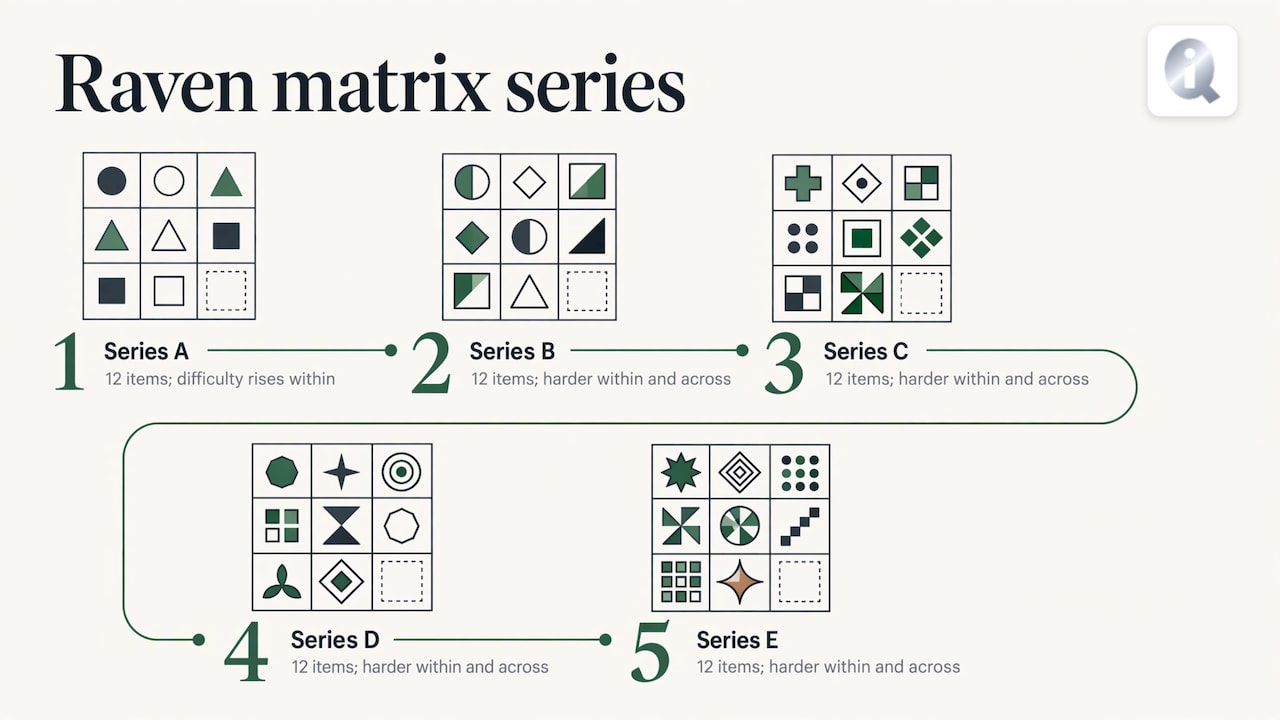
The Raven’s Progressive Matrices family is the best-known pattern recognition test. The University of Munich’s test database describes the Standard Progressive Matrices as presenting incomplete geometric figures or patterns, with the test-taker selecting the option that continues the construction. According to the same description, it has five series, A through E, with 12 items in each, and difficulty rises within and across series.
Scoring and norms
The raw score is the number of items answered correctly. By itself it says little. It is interpreted through percentile norms, and the Munich page discusses age-related norms and the limits of the test’s precision. A research paper on error classification hosted by Vanderbilt University makes the same point: scores may be converted into an IQ score or percentile ranking using normative data.
What the errors reveal
Total score hides how a person arrived at an answer. The same Vanderbilt paper shows that response time and error patterns can reveal whether someone missed the governing relation, fixated on a figure near the gap, or captured only part of the solution. In other words, two people with an identical raw score may have reasoned differently.
Two solving strategies
The matrix-reasoning review cited above describes multiple strategies, including constructive matching (building the missing figure mentally from the rule, then looking for it among the options) and response elimination (comparing the options with the matrix and discarding those that fail). Constructive matching is generally the more reliable approach on harder items, because it does not depend on the answer options being well separated. Elimination is a useful fallback when you can identify one rule but not all of them.
Spatial reasoning and its link to IQ
Spatial reasoning is the second keyword readers pair with this topic. Kell and Lubinski’s review, Spatial Ability: A Neglected Talent in Educational and Occupational Settings, defines spatial ability as the mental capacity to manipulate visual patterns, including rotating, folding and combining figures. The review also lists common test formats: assembly, block counting, mental rotation, surface development and mechanical movement.
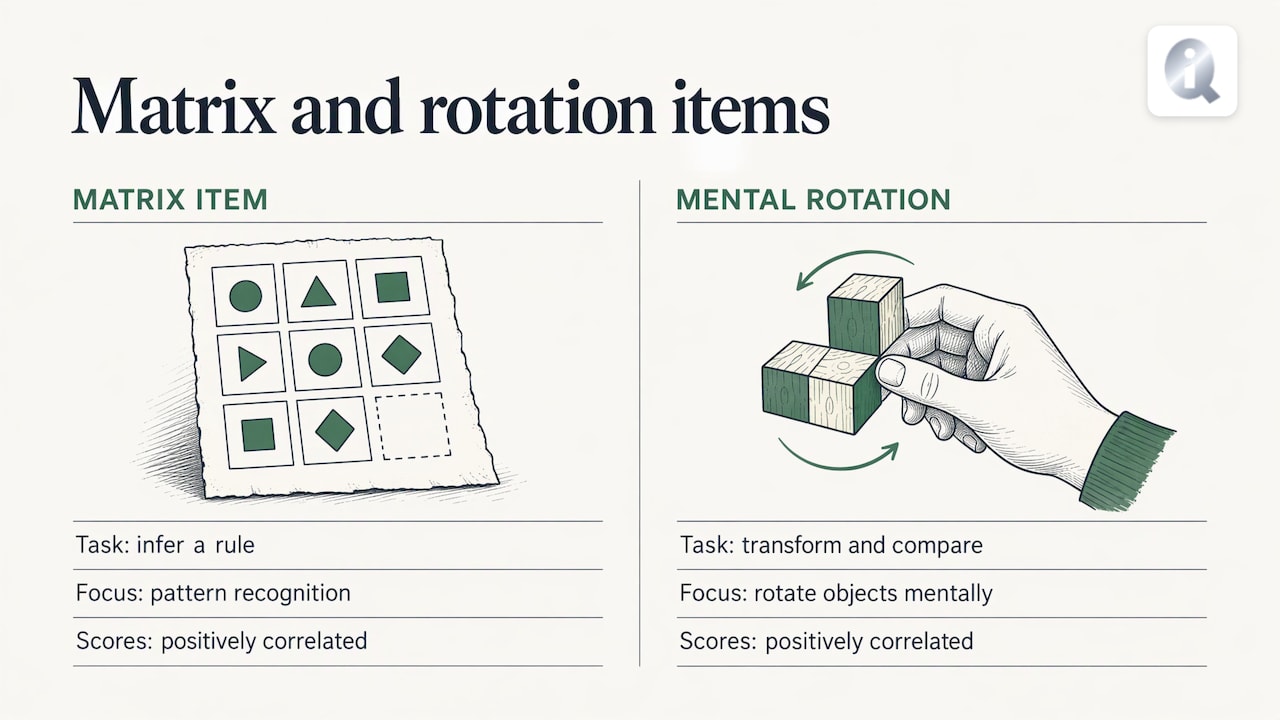
The same review reports that spatial, mathematical and verbal tests are positively correlated because they share an underlying general ability dimension, g. So spatial and pattern recognition scores tend to move together, but they are not interchangeable. A matrix asks you to infer a rule. A mental rotation item asks you to transform an object in your head and compare it to another.
If you want to see what a spatial item feels like, our mental rotation test with mirror-trap items includes practice questions and a training routine.
Spatial skills at work
Spatial and pattern-based reasoning matter in occupations that involve visual models and structured information. Our profession pages show how estimated average IQ varies by occupation, for example architects at 118 (range 108 to 128), intelligence analysts at 121 (111 to 131), AI researchers at 127 (117 to 137) and interior designers at 107 (97 to 117). These are population-level estimates with wide ranges, not thresholds for entering a field.
Can a pattern recognition test determine your IQ?
A pattern test can estimate one component of IQ, and it can be converted to an IQ-style number if the test has norms. Whether that number is meaningful depends on the test.
A US high-IQ society’s guidance on the topic states that qualifying performance is the 98th percentile on a standardized, supervised intelligence test or equivalent, and stresses that an IQ number means something only when the test that produced it is identified. This reflects a basic psychometric principle: the same percentile can correspond to different IQ numbers on tests with different norms and standard deviations. A score of 130 on one scale and a score of 132 on another can describe a similar rank.
When you read any result, ask four questions:
- Which test produced it, and how many items did it have?
- Which abilities did it sample (one domain or several)?
- What norm group was used to convert the raw score?
- Was it taken under supervised, timed conditions?
An unsupervised online practice puzzle set can be informative and enjoyable, but it should not be read as a clinical or admissions-grade score.
How to practice pattern recognition
Practice helps with format familiarity and strategy. It has a boundary, though: the matrix-reasoning review discusses strategy and learning effects, and repeating identical items can produce practice effects, meaning a higher score on those items without an increase in general reasoning. To keep practice honest, use fresh items rather than the same set again.
A method for matrix items
- Isolate components. Look at one feature at a time: shape, count, shading, position, size.
- Check rows, then columns, then diagonals. A rule may run in only one direction.
- Track transformations. Note rotations, reflections, additions and removals of features.
- Predict before you look. Form the missing figure in your head, then scan the options (constructive matching).
- Eliminate. Remove options that break any rule you have confirmed.
- Use the full time allowance. If you finish early, recheck the items where you eliminated by feel.
A four-week outline
| Week | Focus | Session length |
|---|---|---|
| 1 | Series and odd-one-out items; learn to name features | 15 to 20 minutes, 4 days |
| 2 | Matrices with one rule; row and column checks | 20 minutes, 4 days |
| 3 | Matrices with two or more rules; diagonals and transformations | 20 to 25 minutes, 4 days |
| 4 | Timed mixed sets with new items; review every error | 25 to 30 minutes, 3 days |
The review step in week 4 matters most. Following the logic of the error-classification research, ask why you were wrong: did you miss the governing rule, anchor on a nearby figure, or solve only part of the pattern? The answer tells you what to practice next.
Improving spatial reasoning
For the spatial side, use activities that force mental transformation: mental rotation exercises, paper folding problems, and assembling or disassembling figures. These map onto the formats in the Kell and Lubinski review. Short, regular sessions with new items are better than one long block.
Perspective: why one score is not enough
We built IQ Career Lab around a simple observation: a pattern recognition result is informative, but it answers only part of the question people actually bring to us. Most readers want to know where their reasoning is strongest, how that compares with a reference population, and what to do with the answer.
That is why our 50-question IQ assessment is designed to report across five cognitive domains rather than a single puzzle type. The free result gives a broad category without an account. The paid unlock adds the exact score, percentile context, the five-domain breakdown, a personalized report, a verifiable certificate and Career Matches, for $9.99 once per completed result, with no subscription.
We also think a cognitive profile reads better next to a personality profile. Fluid reasoning describes how you solve unfamiliar problems. The Big Five describes how you prefer to work. Used together, they give a more complete basis for career exploration than either one alone.
Our rule for interpretation is the same one we recommend to readers: always state which test produced a number, and read it as a percentile before reading it as a label.
Steve
Take the next step: see your own profile
If you want to know how your pattern recognition sits within a broader cognitive profile, you can take our 50-question IQ assessment without creating an account and see a broad result category. To see your exact score, percentile context and five-domain breakdown, the Full IQ Result is $9.99, one time per completed result.

The unlock also includes a personalized report, a verifiable IQ certificate and Career Matches based on your cognitive profile. For the personality side, the Big Five assessment is free with sign-in and returns OCEAN trait percentiles and an archetype. To compare your number with reference groups, use the IQ comparison tool, and browse more guides on the IQ & Career research blog.
FAQ
Is pattern recognition the same as IQ?
No. Pattern recognition is one ability that IQ tests sample, mainly under fluid reasoning. Full IQ batteries combine several domains, so a pattern-only score describes a part of the profile rather than the whole.
What is the difference between abstract reasoning and spatial reasoning?
Abstract reasoning means inferring rules from unfamiliar patterns, as in matrices and series. Spatial reasoning means mentally manipulating shapes by rotating, folding or combining them. The two correlate because both reflect general ability, but they are classified as separate abilities.
Can I improve my pattern recognition score?
Yes, within limits. Learning the item formats and a systematic method (rows, columns, diagonals, transformations, elimination) typically helps. Repeating the same items mostly builds familiarity with those items, so use new questions and review every mistake.
How are Raven matrix scores interpreted?
The raw score is the number of correct answers out of the total items. It is then compared with normative data for the relevant age group and expressed as a percentile or an IQ-style score. The result is only as meaningful as the norms behind it.
Sources
- Cognitive strategies in matrix-reasoning tasks: State of the art (Psychonomic Bulletin & Review)
- Taxonomy of cognitive abilities and measures for assessing artificial intelligence and robotics capabilities (OECD)
- Spatial Ability: A Neglected Talent in Educational and Occupational Settings (Kell and Lubinski)
- Raven Standard Progressive Matrices (TDB2Online, University of Munich)
- Methods for Classifying Errors on the Raven’s Standard Progressive Matrices Test (Kunda et al., 2013)
- The Question of “Genius” (American Mensa)