Jobs for Introverts: How to Match Work to Temperament

The best jobs for introverts are those where the work itself rewards sustained focus, written or one-on-one communication, and control over interruptions. Job titles matter less than working conditions. A software developer on a noisy, meeting-heavy team can be drained, while a social worker who thrives in structured one-on-one sessions may not be. This guide lists roles that commonly suit introverts, explains why, and shows how to check the fit against your own profile.
TL;DR
- Introversion is a preference for lower-stimulation settings and deep focus. It is not shyness, and it is not social anxiety.
- Judge a job by its conditions: interruption frequency, meeting load, written versus verbal communication, and autonomy. The title alone tells you little.
- Roles that often fit include software development, archival and library work, analysis, writing, and counseling-type work built on one-on-one conversation.
- Introverts can lead well. Research links introverted leaders with active listening and with empowering self-motivated teams.
- A Big Five profile gives a more reliable picture of your fit than a single “introvert” label.
Table of Contents
- What introversion means in a work context
- Five conditions that make a job introvert-friendly
- Jobs for introverts by type of work
- Can introverts lead? What the research says
- What about jobs for extroverts, and what does “personality and careers” really predict?
- Careers for analytical thinkers and high-IQ introverts
- Our perspective
- A practical process for finding your fit
- Find out where your profile fits
- FAQ
- Sources
What introversion means in a work context
Introversion is one pole of extraversion, one of the Big Five personality traits. The trait describes how strongly a person is drawn toward social stimulation and reward. An APA-reported cross-cultural study found that extraverts find social situations more rewarding than introverts do, and that the difference is tied to reward sensitivity more than to sheer sociability. For job seekers, this shifts the question. You are not looking for a job with no people. You are looking for a job where the social demands match your energy and where your reward comes from the work itself.
Two clarifications keep the search honest.
Introversion is not social anxiety. Social phobia is the most common anxiety disorder in the general population, and the clinical literature describes significant distress and occupational maladjustment in people who have it. A healthy preference for quiet work is a different thing. If fear of social situations, rather than preference, is steering your career choices, a licensed clinician or counselor is the right person to speak with. Our assessments are for informational and personal-development purposes, not clinical diagnosis.
Introverts do not need zero contact. A Journal of Personality and Social Psychology paper indicates that introverts’ satisfaction is tied to the quality of interactions and their fit with personal goals, not to the volume of contact. A job with a few meaningful conversations a day can suit an introvert better than one with total isolation.
Five conditions that make a job introvert-friendly
Before reading any list of roles, score the job on these five conditions. The same title can score very differently at two employers.
- Interruption rate. Can you work for 60 to 90 minutes without being pulled into a call or a chat thread?
- Meeting load. How many recurring group meetings, and is attendance expected or optional?
- Communication channel. Is most coordination written (tickets, documents, email) or verbal and real-time?
- Autonomy. Do you control how and when the work gets done?
- Interaction depth. Are interactions mostly one-on-one or in small groups, where depth is possible, or mostly large and performative?
A role that scores well on at least four of five is likely to feel sustainable. A role that scores poorly on three or more will probably be draining regardless of how well it pays.
Jobs for introverts by type of work
The groupings below reflect the working conditions above. They are illustrative, not exhaustive, and none is a guarantee of fit. Where we cite pay or growth, the figure comes from the U.S. Bureau of Labor Statistics (BLS).
| Work type | Example roles | Why it often fits | Watch for |
|---|---|---|---|
| Technical and analytical | Software developer, data analyst, actuary | Long focus blocks, written communication, measurable output | Open offices, daily stand-ups, on-call rotations |
| Collections and information | Archivist, librarian, curator | Detailed, methodical work, low interruption | Public-facing duties at some institutions |
| Written and creative | Technical writer, editor, designer | Autonomy and asynchronous feedback | Client-facing revision cycles |
| One-on-one helping | School counselor, social worker | Depth over breadth, structured conversations | Emotional load, caseload pressure |
| Skilled trades and craft | Carpenter, baker, machinist | Hands-on focus, tangible results | Customer contact, shared worksites |
Technical and analytical roles
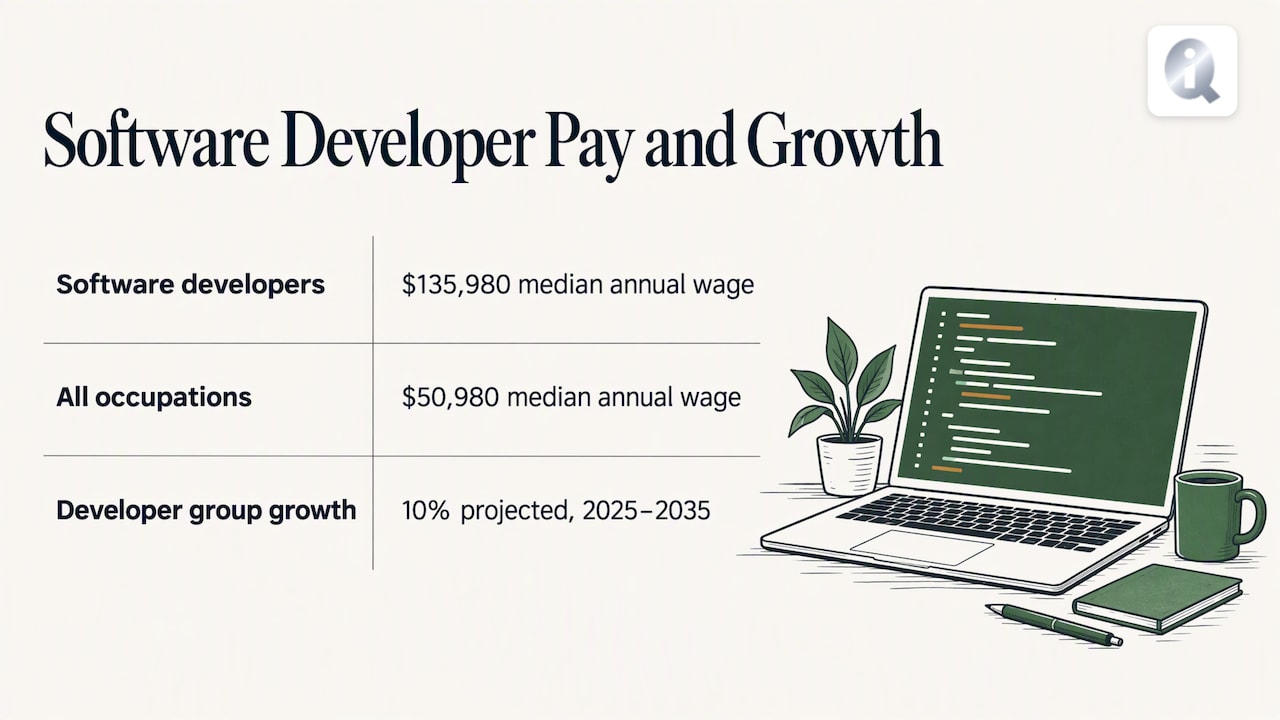
Software development is the most commonly named role for introverts, and the labor data explain part of the appeal. The BLS reports a median annual wage of $135,980 for software developers in May 2025, against $50,980 for all occupations, with a projected 10% employment growth for 2025 to 2035 across the broader software developer, QA analyst, and tester group. Data analysis and actuarial work share the same profile: concentrated attention, quantitative reasoning, and output that is judged on accuracy.
These roles are not automatically quiet. Agile teams run frequent meetings, and product-facing developers talk to stakeholders. Ask during interviews how many recurring meetings a typical week contains and whether written updates can replace some of them.
Collections and information roles
Archival work is a good example of a quiet, detail-oriented field. The BLS lists a 2024 median pay of $57,100 per year ($27.45 per hour) for archivists, curators, and museum workers, with employment projected to grow 6% from 2024 to 2034, faster than the average for all occupations. Pay is lower than in technical fields, so the trade-off is real: you are paying for calm with some salary.
If you are curious about the cognitive side of this path, our published estimate for the profession is an average IQ of 113 (range 103 to 123) for archivists, and you can run a comparison with Am I Smart Enough to Be an Archivist?. Treat such figures as population-level estimates, not entry requirements.
Writing, design, and creative work
Technical writing, editing, illustration, and UX design usually allow you to receive feedback in writing and work in long uninterrupted stretches. Freelance arrangements add autonomy but also add sales and client communication, which some introverts find more tiring than a salaried role with a fixed team. Consider which type of social demand you tolerate better: a steady small team, or intermittent client negotiation.
One-on-one helping roles
This category surprises people. Counseling and social work involve a lot of talking, yet the talking is structured, private, and focused on a single person. That is the interaction depth many introverts prefer. Our profession pages estimate an average IQ of 110 (100 to 120) for social workers, and we offer comparison pages for social work and school counseling. The main risk is emotional load rather than social stimulation, so weigh caseload size and supervision structure carefully.
Skilled trades and craft work
Carpentry, baking, machining, and similar trades give tangible output and long hands-on focus. Customer contact varies widely: a solo remodeler talks to clients constantly, while a production shop floor may involve almost none.

Can introverts lead? What the research says
A frequent worry is that quiet temperament caps career growth. The evidence is more nuanced than the stereotype.
Trait extraversion has historically been viewed as a strong predictor of emergent leadership, meaning who gets noticed as a leader in a group. Emergence is not effectiveness. Research from Queensland University of Technology on introverted leaders and role-congruent behavior found that enacting leader-like behavior predicts greater thriving for all leaders, regardless of their level of extraversion.
Other work points to specific strengths. A faceted analysis in PubMed Central discusses associations between introversion and empowering leadership, such as one-on-one communication, active listening, and technical precision, which suit teams of self-motivated employees. A 2025 Academy of Management abstract hypothesizes that introverts may be better equipped in uncertain, high-stress conditions because they experience less depletion from rumination. That is a hypothesis, not a settled finding, and we present it as such. A 2024 study on workplace communication also notes that good listening is common among introverts and helps employees feel heard. Note that this study was conducted in Saudi Arabia, so its direct transfer to U.S. workplaces is not guaranteed.
The practical conclusion: management and leadership are open to introverts, particularly in technical, research, and small-team settings. Mimicking extraverted behavior all day is not required.
What about jobs for extroverts, and what does “personality and careers” really predict?
The mirror question is common: which jobs suit extraverts? Roles with constant interaction, persuasion, and public visibility, such as sales, event work, and some management positions, tend to offer more social reward. But personality is only one input. Cognitive ability, interests, and skills matter, and the extraversion scale is a continuum. Most people sit somewhere in the middle, and a person can be an “ambivert” in practice.
Two cautions apply to any “careers by personality” list:
- A single trait is a weak filter. Conscientiousness, which covers organization, reliability, and follow-through, is a separate Big Five trait and matters at work in almost every occupation. An introvert high in conscientiousness and an introvert low in it will experience the same job very differently.
- The instrument matters. We compared the predictive value of common personality frameworks in our analysis of personality test accuracy, which examines why the Big Five is generally preferred to type-based tools for career questions.
Careers for analytical thinkers and high-IQ introverts
Many readers searching this topic are also asking about analytical or gifted-adult careers. Cognitive ability and introversion are independent dimensions: knowing one tells you very little about the other. What they can do jointly is define the kind of problem you enjoy. Someone with strong quantitative reasoning and low sensitivity to social reward may find research, engineering, data science, or actuarial work satisfying, because those roles pay off for sustained abstract thinking.
A caution on interpretation: an average IQ for a profession is a descriptive statistic of the people working in it, not a threshold. Overlap between professions is large, and interest and persistence predict success in ways a single score cannot.
To see how your own cognitive profile lines up with occupations, the Career-IQ Matcher compares careers against an IQ profile, and the IQ comparison tool places published estimates for jobs side by side.
Our perspective
We build cognitive and personality assessments, so we see one pattern repeatedly in how people use career advice: they treat a label as a verdict. “Introvert” becomes a reason to rule out entire fields, or “extravert” becomes a reason to avoid analysis. Neither inference is supported by the data we work with.
Our view is that the useful unit of analysis is the profile, not the label. Extraversion is one of five broad traits, and each has facets. Conscientiousness, openness, agreeableness, and emotional stability will interact with extraversion in determining how a job feels. Cognitive domain strengths, such as verbal reasoning or pattern recognition, add a second axis. A person who combines high conscientiousness, strong pattern recognition, and low extraversion has a different best-fit set from one who combines high openness with the same extraversion level.
We also think career pages should be explicit about uncertainty. Our profession-level IQ figures are published estimates with ranges, not selection criteria. Our assessments are for informational and personal-development purposes. They are not clinical tools and not formal employment qualifications. If you use a result, use it to generate questions to test in the real world: shadow someone, ask about the meeting load, try a short project.
— Steve
A practical process for finding your fit
- Measure the trait, do not guess it. Take a Big Five assessment and look at extraversion alongside the other four traits and their facets.
- List your non-negotiable conditions. Use the five conditions above: interruptions, meetings, channel, autonomy, interaction depth.
- Shortlist roles by conditions, not titles. A quiet developer role and a loud one are different jobs.
- Test the conditions in interviews. Ask: How many recurring meetings per week? Is the team mostly remote, hybrid, or in an open office? How is work reviewed, in writing or live?
- Run a small experiment. A short freelance task, a volunteer shift in a library or archive, or an informational interview costs little and reveals a lot.
- Revisit after six months. Preferences can shift with experience, and so can the job.
Find out where your profile fits
Our Big Five personality test can be started without registering. An optional Personality Full Access unlock costs $14.99, one-time, and adds a deeper trait breakdown. If you also want the cognitive side, the IQ assessment covers five cognitive domains, and the Full IQ Result unlock is $9.99, one-time. To see how work settings suit your profile, look at Workplace Fit. Coaches and teams can review our tools for coaches.
FAQ
What are the best jobs for introverts?
Roles with long focus periods, written communication, and high autonomy tend to fit best, such as software development, data analysis, archival work, writing, and one-on-one counseling. The right choice still depends on your full personality and skills. Score the specific job against interruption rate, meeting load, and communication style before applying.
Are introverts successful in life and at work?
Yes. Research on leadership finds that enacting leader-like behavior predicts thriving regardless of extraversion level. Extraversion may help people get noticed early in groups, but it does not determine effectiveness. Success depends on fit, skills, and persistence.
Is introversion the same as social anxiety?
No. Introversion is a normal personality preference for lower-stimulation settings, while social phobia is a clinical anxiety disorder associated with distress and occupational difficulty. If fear is limiting your work or relationships, speak with a licensed mental health professional.
Do introverts have to avoid people-facing jobs?
Not necessarily. Evidence suggests introverts’ satisfaction relates to the quality of interactions rather than their quantity. Structured one-on-one roles, such as counseling, can fit well, while large, unstructured group demands may be more tiring.
Sources
- APA: Sensitivity to rewards may distinguish extraverts from introverts
- Shy Children, Phobic Adults: Nature and Treatment of Social Phobia (APA PsycNet)
- Journal of Personality and Social Psychology (APA PsycNet manuscript)
- BLS: Software Developers, Quality Assurance Analysts, and Testers
- BLS: Archivists, Curators, and Museum Workers
- State extraversion and emergent leadership (ScienceDirect)
- Introversion in Leaders: Role-Congruent Leader Behavior and Thriving (QUT ePrints)
- Introverted and yet effective? (PubMed Central)
- Extraversion vs. Introversion: Leadership Strengths in Uncertain Times (Academy of Management)
- Introvert and Extrovert Differences in Workplace Communication (SCIRP)