IQ vs EQ: How They Differ, Relate and Matter at Work

IQ and EQ describe two different sets of abilities. IQ (intelligence quotient) summarizes cognitive ability: reasoning about new problems, processing information, working with language and applying knowledge. EQ (emotional quotient, also called emotional intelligence or EI) describes the ability to perceive, understand, use and regulate emotion. Research treats them as related but distinct, so a high score on one tells you little about the other, and neither works as a universal predictor of success.
TL;DR
- IQ measures cognitive ability; EQ (EI) measures emotional abilities such as perceiving, understanding and managing emotion.
- High EQ does not imply high IQ, and high IQ does not imply high EQ. The two are correlated at most modestly and are measured differently.
- Popular claims that EQ is “twice as important” as IQ are rejected by the APA review of the evidence; both relate to work and leadership outcomes.
- EQ results depend heavily on the test type: ability tests with right and wrong answers and self-report questionnaires often disagree.
- Emotional skills can be developed with training and practice, while an IQ score should be read as a partial snapshot, not a verdict on potential.
Table of Contents
- What IQ, EQ and EI Mean
- IQ vs EQ: Side-by-Side Comparison
- Does High EQ Mean High IQ?
- How IQ Tests and EQ Tests Are Built
- IQ vs EQ at Work, in School and in Leadership
- Can You Improve IQ or EQ?
- What About the “Four Types of Intelligence”?
- Our Perspective
- Taking an IQ Assessment and Reading the Result
- Where IQ Career Lab Fits
- FAQ
- Sources
What IQ, EQ and EI Mean
IQ stands for intelligence quotient. Checa and Fernández-Berrocal describe it as a measure of cognitive ability, and they distinguish two components: fluid intelligence, which is solving novel problems, and crystallized intelligence, which draws on acquired knowledge and experience.
EQ and EI are two labels for the same idea. “EQ” borrows the quotient format from IQ, while “EI” (emotional intelligence) is the term most researchers use. A 2019 critical review defines EI as the ability to monitor one’s own and others’ feelings, discriminate among emotions, and use that information to guide thinking and actions. A 2024 review of ability-related EI condenses this into identifying, understanding, using and regulating emotions.
The same 2024 introduction reports an emerging consensus that ability EI contains three separable but correlated skill sets: perceiving emotion, understanding emotion and managing emotion.
A practical consequence of these definitions: IQ is about how well you think through a problem, while EQ is about how well you read and handle the emotional information inside it, in yourself and in other people.
IQ vs EQ: Side-by-Side Comparison
| Feature | IQ | EQ (emotional intelligence) |
|---|---|---|
| What it describes | Reasoning, information processing, language, applied knowledge | Perceiving, understanding, using and regulating emotion |
| Typical test format | Timed problem-solving items with right and wrong answers | Ability tasks with scored answers, or self-report questionnaires |
| Result format | Standardized score, usually interpreted with percentiles | Varies by instrument; no single agreed scale |
| Maturity of the field | Long-established psychometric tradition | Newer; researchers still debate materials and scoring |
| What a score leaves out | Socio-emotional and interpersonal capabilities | Cognitive reasoning ability |
| Can it be developed? | Scores are relatively stable as a trait estimate | Some emotional skills can be developed through training and practice |
The APA review frames the two as complementary rather than interchangeable: cognitive ability concerns learning and reasoning, whereas emotional ability concerns learning and applying emotional skills.
Does High EQ Mean High IQ?
No, and the reverse is also false. Boyatzis and colleagues examined this directly and found EI competencies to be related to, but distinct from, cognitive ability. The size of the relationship depended partly on how EI was measured and on who provided the rating.
Three details from that study are worth keeping in mind:
- Cognitive competencies were more strongly related to GMAT scores than EI competencies were, as you would expect from a test of reasoning and quantitative skill.
- The relationship between EI and cognitive ability varied by observer type (for example, self versus others) and, in some analyses, by sex.
- The measurement method matters: in the cognitive-control study by Checa and Fernández-Berrocal, the managing-emotions ability measured by the MSCEIT, but not self-reported EI, was related to an impulsivity index.
That third point also supports a complementary view: the capacity to manage emotion can help people regulate impulses and sustain cognitive control, which is one way EQ may support the use of whatever IQ a person has.
How IQ Tests and EQ Tests Are Built
How IQ tests work
An IQ test presents problems with defined correct answers across several cognitive domains and converts the raw performance into a standardized score. A 2019 review of IQ testing argues that these tests index cognitive functioning in selected domains rather than total mental functioning, and that real-world interpretations often inflate what the scores show. It also notes that IQ tests generally omit socio-emotional and interpersonal capabilities, so a score should not be read as a complete measure of a person’s intelligence, potential or worth.
How EQ tests work
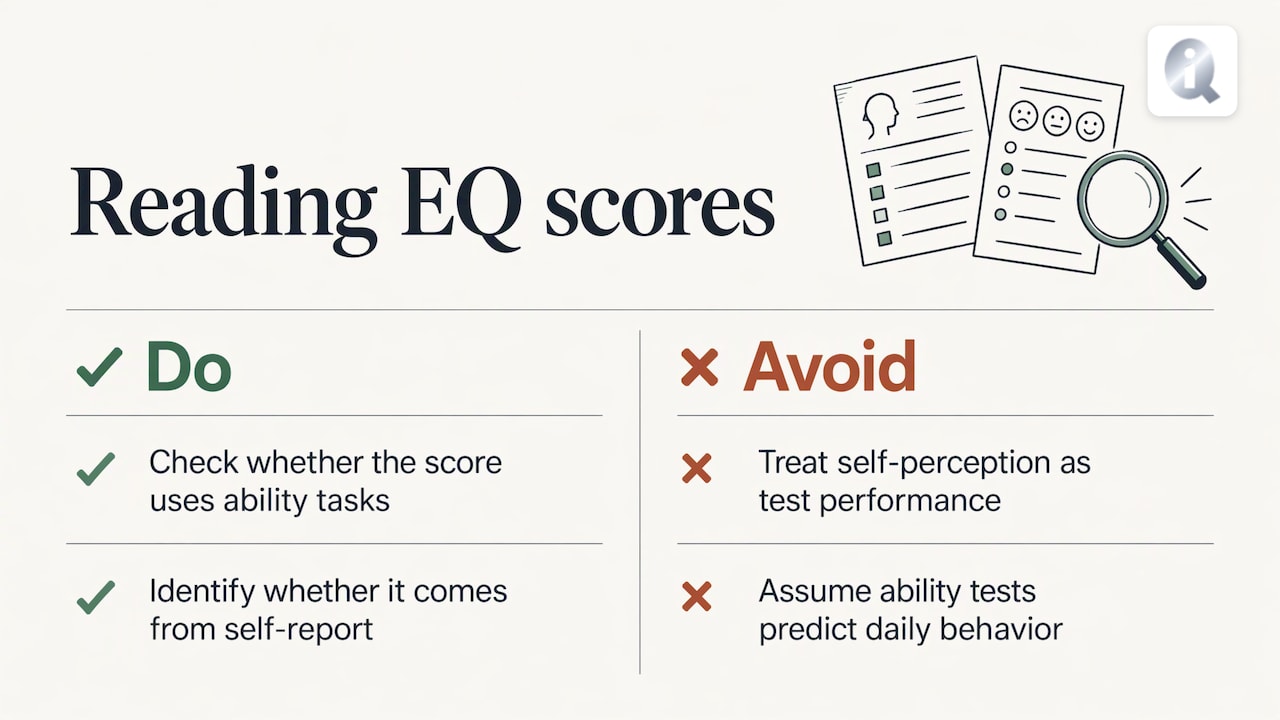
There are two families of EQ measures, and confusing them is the most common error in popular articles on this topic.
- Ability EI tests present emotion-related problems and treat answers as correct or incorrect. The MSCEIT is the best-known example. According to the APA review, it was designed to measure emotional ability analogously to an IQ test measuring cognitive ability, through tasks covering perception and expression, understanding and analysis, and reflective regulation of emotion.
- Trait EI measures generally use self-report: you rate how you typically think, feel and behave. The 2019 critical review distinguishes these from ability tests on exactly this basis. The EQ-i 2.0 is an example that can be given as a self-report or as a 360 assessment, where others rate you.
Why the two EQ families disagree
The 2024 review states that self-report EI measures rarely correlate highly with ability-based EI assessments, so your self-perception and your performance on an ability test can diverge. It also notes that ability EI tests are not interchangeable, because researchers still lack agreement about the exact materials and scoring procedures for each emotional skill set. The 2019 review adds a caution: ability tests capture maximal emotion-related ability, so they do not predict typical everyday behavior as well as trait-based measures.
The same logic applies to any questionnaire where you describe yourself. Self-assessment tools have clear limits on what they can and cannot tell you, and an EQ quiz built from self-ratings reflects how you see yourself, which is not the same as how you perform under emotional pressure.
Practical reading rule: when you see an “EQ score,” first ask whether it came from scored ability tasks or from a self-report scale. Only then compare it with anything else.
IQ vs EQ at Work, in School and in Leadership
Both abilities relate to outcomes, and neither is a master predictor. The APA review reports that research supports EI as contributing to the prediction of job performance and leadership effectiveness, and that some trait-EI measures show approximate performance correlations comparable to those of IQ. The same review explicitly rejects the popular claims that EI is twice as important as IQ or explains 85% of high performance.
On the IQ side, the 2019 review reports weak-to-moderate associations between IQ-test performance and education, job performance, income and well-being, with contextual factors such as socioeconomic status shaping those relationships.
What this means for leadership
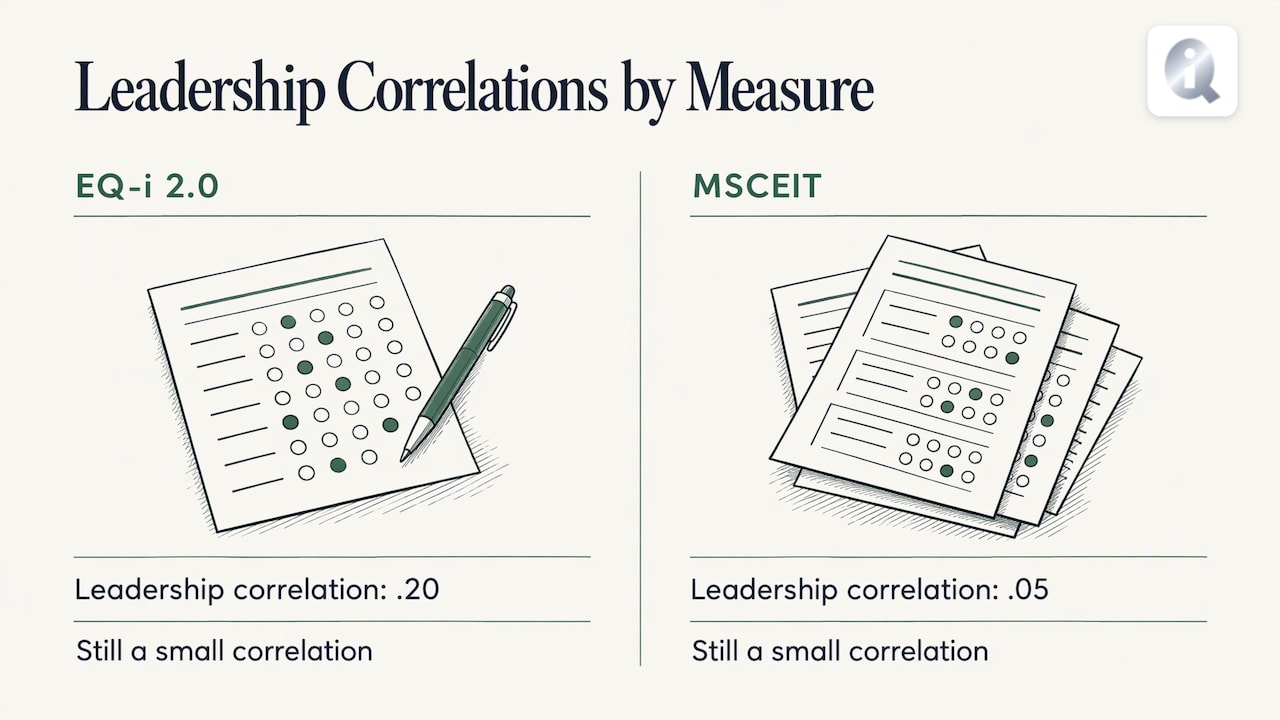
Measurement choices change the answer. In the APA review, coworker-rated transformational leadership correlated more strongly with the EQ-i 2.0 than with the MSCEIT (.20 versus .05). Both figures are small, which is itself a useful reminder: no single score explains how well someone leads. Leadership roles typically combine heavy cognitive demands with heavy interpersonal demands. For context on the cognitive side, our data show a School Principal average IQ of 115 (105 to 125), while elementary teachers average 107 (97 to 117) and special education teachers 108 (98 to 118). Those ranges are wide, and in people-facing roles such as teaching, emotional skills plausibly contribute to performance in ways an IQ score does not capture.
What this means for learning
In education, IQ relates to how efficiently someone handles new material, and emotional regulation relates to how someone copes with frustration, impulses and attention. Checa and Fernández-Berrocal’s cognitive-control perspective is that emotion-management capacity complements IQ. Students who look similar on a cognitive test can therefore differ in how they handle pressure.
Can You Improve IQ or EQ?
The APA review indicates that some emotional skills can be developed through training and practice, though EI is measured in many ways, so claims about the size of any improvement depend on which instrument is used. For IQ, the more useful goal is accurate interpretation: knowing which domains are strong, which are average, and how a score fits the population distribution.
What About the “Four Types of Intelligence”?
You will often see IQ, EQ, SQ and AQ presented as four intelligences. A 2024 King’s College London review of the discussion indicates that there is no universally accepted scientific classification of exactly four intelligences. In the commonly used framework, cognitive or intellectual intelligence corresponds to IQ and emotional intelligence to EQ, while the remaining two are usually described as social and practical intelligence. Treat the four-part model as a teaching frame, not as a settled psychometric taxonomy.
Our Perspective
We build cognitive assessments, so we are careful about what an IQ score can and cannot claim. The research above is consistent: an IQ result describes performance in selected cognitive domains, and it should be read alongside other information about a person, not instead of it.
That is why our IQ assessment reports a five-domain breakdown rather than a single number alone, and why we pair it with a separate Big Five personality assessment. Cognitive strengths describe how you process problems. Personality traits describe how you typically behave, including at work. Together they give a more informative picture than either alone, and they are better inputs for thinking about career fit.
We want readers to compare like with like. A free, no-account 50-question IQ assessment gives you a broad result category. If you want the exact score, percentile context and domain profile, the one-time unlock exists for that. For emotional skills, we point readers to the research on ability and self-report measures, and we recommend treating any quick EQ quiz as a prompt for reflection rather than a diagnosis.
Steve
Taking an IQ Assessment and Reading the Result
If your question is practical (“where do I stand cognitively?”), the useful steps are:
- Take a structured assessment with scored items, not a self-rating quiz.
- Look at the percentile, not just the number. A score is meaningful only relative to a reference population.
- Check the domain profile. Two people with the same overall score can have very different strengths.
- Hold the result lightly. The 2019 review’s warning about inflated interpretations applies to every score, including a high one.
- Add context. Compare your score with typical ranges for roles you are considering using our average IQ by profession tool or the IQ comparison tool, and remember that ranges within each job are wide.
For the cost side of testing, see our guide to IQ test costs, and browse the full set of free IQ tools and calculators.
Where IQ Career Lab Fits
Our 50-question IQ assessment needs no account. You see a broad result category first, and you can optionally unlock your exact IQ score, percentile context, five-domain breakdown, personalized report, verifiable certificate and Career Matches for $9.99, once per completed result. It is not a subscription.
If you want the personality side, the separate Big Five personality assessment requires sign-in and provides your OCEAN trait percentiles and a personality archetype for free. Personality Full Access is $14.99 once per result and adds a detailed personality profile, workplace-fit insights and a verifiable certificate. See the pricing page for what each unlock includes, or try the Career-IQ Matcher to explore careers against your cognitive profile.
FAQ
Which matters more, IQ or EQ?
Neither is a universal winner. The APA review finds that emotional intelligence contributes to predicting job performance and leadership effectiveness, but it rejects claims that EI is twice as important as IQ. IQ also shows weak-to-moderate associations with education, job performance, income and well-being, so the answer depends on the role and the outcome.
Does high EQ mean high IQ?
No. Research finds emotional intelligence competencies to be related to, but distinct from, cognitive ability, and the strength of the link depends on how EI is measured and who rates it. A person can score high on one and average on the other.
What does EQ stand for?
EQ stands for emotional quotient, and it is used interchangeably with EI, emotional intelligence. It refers to abilities in perceiving, understanding, using and regulating emotions, in yourself and in others.
Can an online EQ test be trusted?
It depends on the type. Ability tests with scored right and wrong answers and self-report questionnaires measure different things and rarely correlate highly. A quick self-rating quiz tells you how you see yourself, so use it as a starting point for reflection rather than a verdict.
How do you compare an IQ test and an EQ test?
Compare their format first. IQ tests use timed problems with defined correct answers and report standardized scores. EQ tests vary: some score emotional tasks as correct or incorrect, others rely on self-report, and there is no single agreed scale across instruments.
Sources
- The Measurement of Emotional Intelligence: A Critical Review (2019)
- The Role of Intelligence Quotient and Emotional Intelligence in Cognitive Control (2015)
- Ability-Related Emotional Intelligence: An Introduction (2024)
- Emotional Intelligence: A Practical Review of Models, Measures and Applications (APA, 2016)
- The Looking Glass for Intelligence Quotient Tests (2019)
- EI competencies as a related but different characteristic than intelligence (2015)
- IQ, EQ, and Multiple Intelligences: A Brief Review of the Discussion
- Neurodivergence Self-Assessment Guide: What It Can and Can’t Tell You