IQ Test Length: How Long Each Type Takes

An IQ test can take anywhere from about 15 minutes to a couple of hours. Length depends on the kind of test: a clinician-administered battery runs longest, a validated short form runs shorter, and an online screening instrument sits between a quick quiz and a full clinical evaluation. This guide sets out the typical durations by test type, explains why length affects the precision of a score, and shows how to choose a test that fits your purpose. It also covers how to prepare so that the time you spend produces a meaningful result.
TL;DR
- Clinician-administered intelligence batteries, such as the Wechsler scales, are individually administered and are commonly reported to take roughly one to two hours, depending on the version and age group.
- Short forms using only a handful of subtests can estimate Full Scale IQ with acceptable validity, but researchers caution that they do not replace comprehensive batteries when formal or high-stakes decisions are involved.
- Online tests vary widely. A 50-question, five-domain assessment like ours is built to give a stable result range without the time commitment of a clinical session.
- A longer test is not automatically a better test. Norming, item quality and standardized conditions matter as much as minutes.
- Plan for uninterrupted time, a quiet setting and no outside help. Interruptions distort the score more than a few extra minutes do.
Table of Contents
- How long an IQ test takes, by type
- Why length affects the score
- What the score means after the test
- Matching test length to your purpose
- Our perspective on length
- How to prepare for a test of any length
- Taking our IQ assessment
- Common misconceptions about test duration
- FAQ
- Sources
How long an IQ test takes, by type
The phrase “IQ test” covers instruments that differ in purpose, format and administration. The table below groups them by type. Durations are approximate ranges, not guarantees, and individual testing time varies with age, pace and the examiner’s procedures.
| Test type | Who administers it | Typical duration | Typical use |
|---|---|---|---|
| Comprehensive clinical battery (for example, a Wechsler scale) | Licensed psychologist, one-on-one | Roughly 1 to 2 hours of testing, plus scoring and a feedback session | Clinical evaluation, educational placement, formal documentation |
| Abbreviated or short-form battery | Psychologist or trained examiner | Often 15 to 30 minutes | Screening, research, quick estimates |
| Matrix-reasoning style test (for example, Raven’s-type items) | Examiner or computer | Varies; abridged versions exist to shorten it | Research, clinical screening of reasoning |
| Supervised group admission test | Proctor in a group setting | Varies by organization; check the provider | Membership in high-IQ societies |
| Online screening test | Self-administered | Commonly 10 to 45 minutes | Personal insight, education, career exploration |
| Short online quiz | Self-administered | Under 15 minutes | Entertainment, rough indication only |
The central point is that duration tracks the number of cognitive domains sampled and the number of items per domain. More items reduce measurement error. Fewer items trade some precision for convenience.
Clinical batteries: the longest format
Individually administered batteries are the reference standard for formal assessment. A psychologist presents tasks one at a time, covering areas such as verbal comprehension, visual-spatial reasoning, working memory and processing speed. Many subtests are timed, some are open-ended and scored by the examiner, and the session often includes breaks.
Published timings from test publishers and clinical references commonly place the core subtests of the adult Wechsler scale at about an hour to an hour and a half, with the children’s version somewhat shorter for its core subtests. Because publishers revise their materials, confirm the current figure with the psychologist or clinic that will administer the test. The scheduled appointment is usually longer than the test itself, because it includes an intake interview, scoring and a results discussion.
Short forms: fewer subtests, shorter sessions
Researchers have spent decades building abbreviated versions of long instruments. A 2023 study on developing a short form of the Wechsler Adult Intelligence Scale, Fourth Edition notes that the Wechsler scales are widely used but time consuming to administer, which is the reason short forms are explored. Psychometricians generally report that forms of roughly four to twelve items can give valid estimates of Full Scale IQ, but they are designed to balance efficiency against measurement error.
The same logic applies to single-domain tests. The Raven’s Advanced Progressive Matrices are described in a PubMed-indexed study of untimed and timed abridged versions as a relatively long assessment, which is why abridged versions have been proposed. Likewise, a paper on the Judgment of Line Orientation test examined eight short forms because the full test is long.
The practical reading for you: a short form is a legitimate tool for a quick estimate, and an estimate is what it provides.
Online tests: wide variation
Online tests have no regulator setting their length, so the range is large. Some are brief quizzes. Others are full-length instruments with dozens of items across several domains. Mensa’s UK site, for instance, describes an online workout that offers up to 15 minutes of questions and states that it will not provide an IQ score, only an indication of how you might do in a real test. That distinction is worth carrying into any evaluation of an online test: ask whether it produces a score, how that score was normed, and what it claims to be.
Why length affects the score
Test length is a question of reliability, which is the consistency of a measurement. Each item is a small, imperfect sample of ability. With few items, a lucky guess or a misread question moves the total noticeably. With many items, individual errors average out.
Three consequences follow.
- Short tests give wider uncertainty. A reported score of 110 from a very short test may reasonably correspond to a true range that is wider than the range from a longer battery. This is why many careful providers report a range first.
- Breadth matters as much as count. Fifty items from one domain, such as pattern matrices, tell you less about overall ability than fifty items spread across several domains.
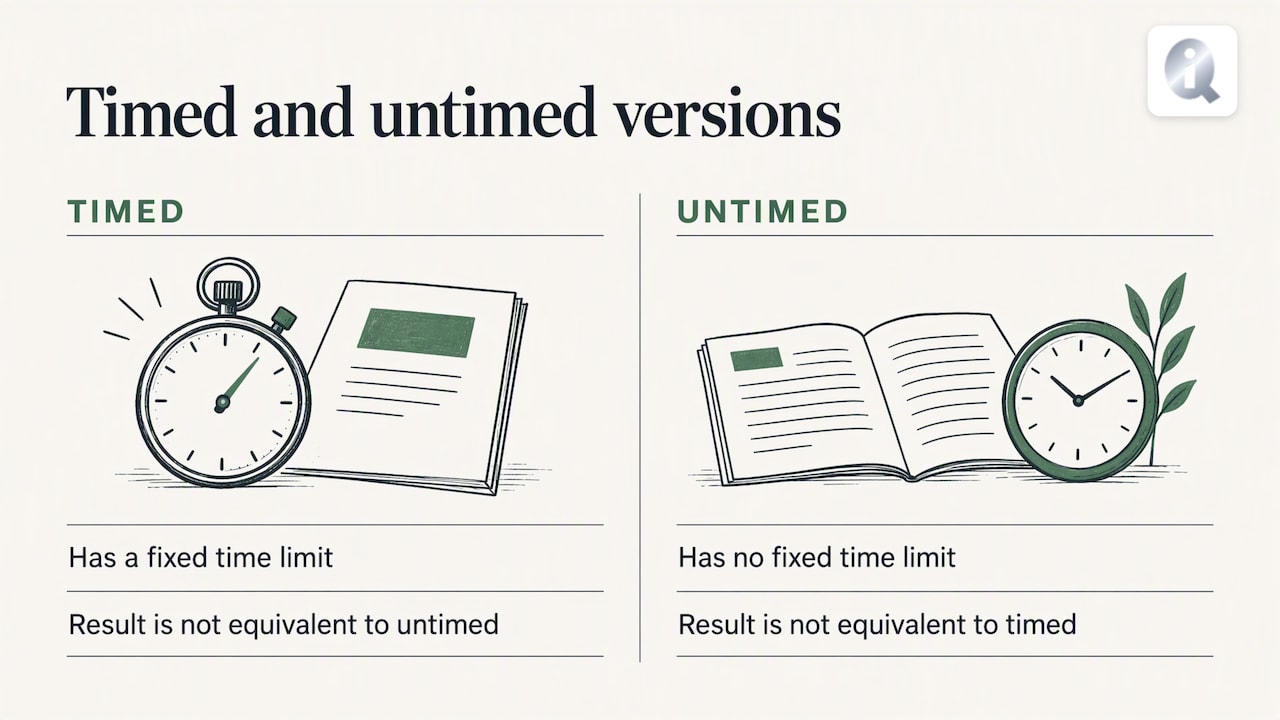
- Timing is part of the construct. Many subtests measure speed as well as accuracy. If a test is timed, its norms assume the time limit was enforced. Pausing the clock or taking extra minutes changes what is being measured.
Timed versus untimed
Most IQ instruments include time-constrained elements, and norms are built on the assumption that everyone worked under the same limit. The abridged Raven’s study cited above compares untimed and timed versions, which shows that researchers treat time as a variable in its own right. For you as a test taker, the rule is simple: follow the stated time limits exactly, and do not compare a timed result with an untimed one as though they were equivalent.
What the score means after the test
Whatever the duration, the output is normally a deviation IQ. According to the APA Dictionary of Psychology, the mean IQ is customarily 100, with slightly more than two thirds of scores falling within 15 points of that mean, which is one standard deviation. In practice, about two thirds of people score between 85 and 115.
That definition gives you a quick way to place a result:
- 100: the population mean by construction.
- 115: one standard deviation above the mean.
- 130: two standard deviations above the mean.
- 70 to 72: around two standard deviations below the mean, a range that clinicians interpret only in a wider context.
To see how a score of your own maps to a percentile or to another scale, our IQ Score Converter compares scales instantly, and the IQ Standard Deviation Calculator shows where a score sits on the bell curve. For context on the population baseline, see our article on the US average IQ.
Comparing across tests and editions
Scores from different tests are not interchangeable, even when each is labeled an IQ score. Norm samples differ, standard deviations can differ, and test editions are periodically renormed. The APA’s article Smarter than ever? discusses the Flynn effect, the long-run rise in raw scores, and reports increases of roughly six points per decade on culturally reduced tests such as Raven’s, with smaller gains on Wechsler performance and verbal tests. This is why a newer edition of a test is normed against a more recent sample, and why comparing a score from one edition with a score from another can mislead.
Matching test length to your purpose
The right duration depends on what you will do with the number. Use these criteria.
| Your goal | Reasonable format | Why |
|---|---|---|
| Curiosity or general self-knowledge | Online assessment with a result range | Low cost, no appointment, adequate for informal use |
| Career exploration or personal development | Multi-domain online assessment with a domain breakdown | A profile of strengths is more useful than a single total |
| Understanding score scales and percentiles | Free calculators and converters | No test needed for interpretation |
| School placement, accommodations, or a clinical question | Licensed psychologist, full battery | Formal decisions require a standardized, supervised evaluation |
| Applying to a high-IQ society | The society’s own supervised or approved test | Membership bodies set their own admission rules |
No online test, ours included, is a clinical diagnosis or a formal employment qualification. If you are concerned about learning difficulties, attention, or a decline in cognitive function, see a licensed psychologist or your physician. If a child needs an evaluation, ask the school district or a pediatric psychologist about the process and timing, since children with special needs can find long sessions hard and examiners adapt for that.
Our perspective on length
We design our assessments around a question that is easy to state and hard to answer well: how much testing time is enough for the purpose? Our answer is that a test should be long enough to sample several cognitive domains with more than a token number of items, and short enough that a person at a desk can stay focused from the first item to the last. Fatigue and boredom are sources of error too.
That is the reasoning behind a 50-question assessment across five cognitive domains. It is intended for informational and personal-development use. It is not a substitute for a clinician-administered battery, and we say so plainly. You can start it without registering and receive an initial result range. The range is deliberate. Any test of this length carries measurement error, and a range communicates that honestly, where a single exact figure would overstate the precision.
We also encourage readers to treat a score as one data point. A domain breakdown often says more than the total, for example when verbal and spatial results diverge sharply. And we recommend reading the norms and methodology behind any score, ours included, before comparing it with another provider’s number.
— Steve
How to prepare for a test of any length
Preparation affects the quality of the result more than most people expect. Familiarity with the format is a recognized factor: the APA Dictionary notes that critics of IQ testing point out that performance partly depends on familiarity with the test’s demands. A few practical steps reduce that effect.
- Block out the full time plus a buffer. If a test is expected to take 30 minutes, reserve 45 so that you never feel rushed or tempted to pause.
- Choose a quiet location. Turn off notifications and close other tabs.
- Use a full-size screen if the test has visual puzzles. Small screens make matrices and spatial items harder to read.
- Sleep and eat normally. Fatigue lowers performance on speeded tasks.
- Do not look anything up. Outside help invalidates the norm comparison.
- Read the instructions once, carefully. Misreading a rule is a common, avoidable error.
- Take it once, then wait. Repeating the same test shortly afterward produces practice effects.
Test anxiety and unfamiliarity can depress a score. If your result is unexpectedly low, consider whether any of these conditions applied before you draw conclusions. A single low result from an unsupervised test does not describe your ability, and only a qualified professional can interpret a score clinically.
Taking our IQ assessment
If you want a multi-domain estimate without scheduling an appointment, you can take the Full IQ Assessment with no sign-up. You receive an initial result range when you finish. If you want the exact score, percentile context and a cognitive domain breakdown, the Full IQ Result is a one-off $9.99 unlock. Our Big Five personality assessment is available separately for readers who want a profile of traits alongside cognitive results, and the free tools and calculators need no purchase at all.
Common misconceptions about test duration
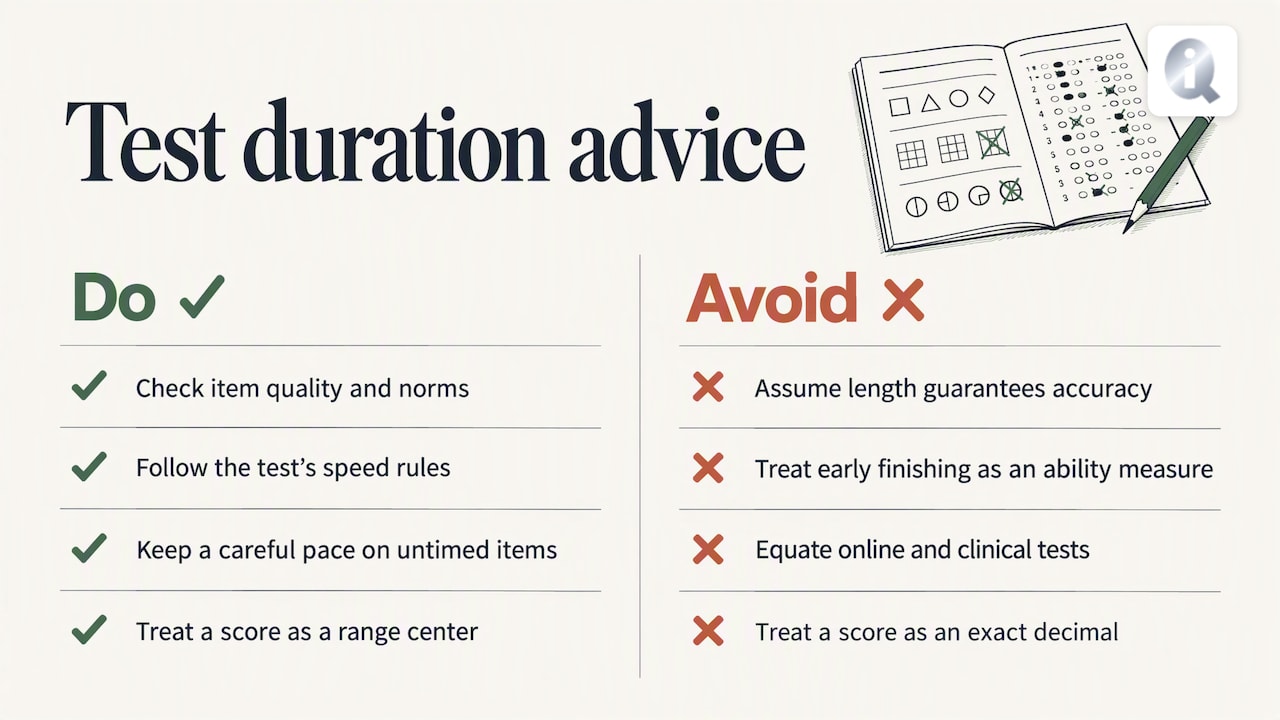
“A longer test is always more accurate.” Length helps reliability only when the items are well constructed and the norms are sound. A long test built on weak items or an outdated norm sample can be less trustworthy than a shorter, well-normed one.
“A fast finish means a high IQ.” Finishing early is not a measure of ability. On timed tests, speed can contribute to the score, but only in the way the test defines it. On untimed items, a careful pace usually helps.
“Any online test is equivalent to the clinical one.” Online and clinical formats differ in supervision, item type and purpose. Individually administered tests allow an examiner to observe behavior, clarify instructions and score open responses. A self-administered online test cannot do that.
“My score is fixed to the decimal.” Every score has a margin of error. The shorter the instrument, the larger it tends to be. Treat a single number as the center of a range.
FAQ
How long is an IQ test usually?
It depends on the type. A clinician-administered battery commonly takes about one to two hours, short forms and screening tests can take 15 to 30 minutes, and online assessments typically fall between 10 and 45 minutes. Check the provider’s stated duration before you begin.
Is there a time limit on an IQ test?
Many IQ tests include timed sections, and the norms assume those limits were enforced. Some subtests are untimed or have generous limits. Always read the instructions for the specific test, and do not pause a timed section.
Does a shorter IQ test give a less accurate score?
Often it gives a less precise one. Research on short forms indicates they can provide valid estimates of Full Scale IQ, but they balance efficiency against measurement error and do not replace a full battery for formal decisions. A result range is the honest way to report that uncertainty.
Can I take an IQ test in under 15 minutes?
You can take a quick quiz in that time, but it will be a rough indication at best. A test limited to about 15 minutes of questions, like the Mensa online workout, is explicitly described as not producing an IQ score. For an estimate across several domains, plan for more time.
Is a score of 72 a bad result?
A score of 72 is about two standard deviations below the mean of 100, based on the APA definition of the deviation IQ. It should not be read in isolation: test anxiety, unfamiliarity with the format and outside stress can all lower a result. If you are concerned, speak with a licensed psychologist, who can evaluate the result in context.
Sources
- APA Dictionary of Psychology: IQ
- Smarter than ever? (APA Monitor, March 2013)
- The Development of a Short Form of the Indonesian Version of the WAIS-IV (PMC, 2023)
- Evaluating untimed and timed abridged versions of Raven’s Advanced Progressive Matrices (PubMed)
- Judgment of Line Orientation: An Examination of Eight Short Forms (PMC)
- IQ testing and puzzles (Mensa UK)