IQ Test Anxiety: What the Research Shows and How to Manage It

Anxiety can lower performance on cognitive tests, but the effect is usually small to moderate, and it is not guaranteed. Some studies find a clear drop on specific tasks. Others find no measurable change in total IQ. What matters most is how high the stakes feel, how much your mind fills with distracting thoughts, and how well you prepare. This article sets out what the evidence says, how anxiety interferes with problem-solving, and what you can do before and during a test.
TL;DR
- Test anxiety is linked to lower scores on IQ, aptitude, memory and problem-solving tests, but the associations in the research are generally small to moderate, not dramatic.
- A 2025 laboratory study found no significant effect of test anxiety or induced stress on total IQ, so nerves do not automatically cost points.
- Intrusive, off-task thoughts and low confidence appear to matter more than physical arousal.
- Preparation, a steady routine, breathing, and refocusing on the current question are the best-supported coping steps.
- An IQ test does not diagnose anxiety. If anxiety or a learning difference regularly affects your performance, speak with a qualified professional.
Table of Contents
- What the research says about anxiety and IQ scores
- Why anxiety interferes with attention and problem-solving
- Can an IQ test detect or diagnose anxiety?
- Before the test: preparation that reduces anxiety
- During the test: staying on the task
- Our perspective
- When to retake a test or speak with a professional
- Take the assessment on your terms
- FAQ
- Sources
What the research says about anxiety and IQ scores
The literature is mixed, and the most accurate summary is that anxiety is associated with lower performance in many settings, with effect sizes that depend on the measure, the sample and the stakes.
Evidence that anxiety lowers performance
A study of 80 undergraduates found that testing anxiety uniquely predicted lower WAIS-III performance IQ, particularly on the Block Design and Picture Arrangement subtests. The authors also described the wider literature as equivocal and methodologically limited, which is a useful reminder not to read one result as a rule.
Broader reviews point the same direction. A 1990 meta-analysis of 126 studies and 36,626 participants reported an overall correlation of r = −.21 between anxiety and academic performance. Cognitively focused and test-specific anxiety measures were more strongly related to performance than general or primarily emotional measures. In plain terms, worrying about the test itself matters more than being an anxious person in general.
A 30-year meta-analytic review published in 2018 found that test anxiety was significantly and negatively related to standardized-test, university-entrance-exam and GPA outcomes. The associations were small to moderate. Perceived test difficulty and high stakes were related to higher test anxiety.
Evidence that anxiety may not change total IQ
A 2025 study of 40 male participants used the German I-S-T 2000 R and found no significant effect of trait test anxiety, experimentally induced acute stress, or their interaction on total IQ performance. The authors cautioned that the sample, setting and test context limit how far the result generalizes.
They also offered an explanation. Participants may have viewed the IQ test as less consequential than a high-stakes examination, so lower perceived importance and compensatory effort may help explain the missing anxiety effect. Taken together, the findings suggest that a stressful moment does not necessarily depress IQ, especially when the stakes feel modest and the person keeps trying.
Correlation is not the same as causation
A 2008 cognitive-ability study concluded that the test did not show measurement bias caused by test anxiety. Anxiety accompanied lower ability in that sample, but the study could not determine whether anxiety caused the lower performance. Both could stem from a third factor, such as less practice with the test format.
There is a second complication: practice itself. In the 2025 study above, IQ scores increased significantly on the second testing day after a 28-day interval. Repeat-testing gains can therefore change how you read two scores, independently of anxiety.
What this means for your score
The studies measure different things (performance IQ, academic grades, entrance exams), so no single number for “points lost to anxiety” is supported by the evidence above. A sensible reading is this: if you feel moderately nervous on a low-stakes online test, your result probably reflects your ability reasonably well. If you were overwhelmed by worry, were blanking on questions, or were rushing from panic, treat that result with more caution than usual.
Why anxiety interferes with attention and problem-solving
Researchers have proposed several mechanisms. They are not mutually exclusive.
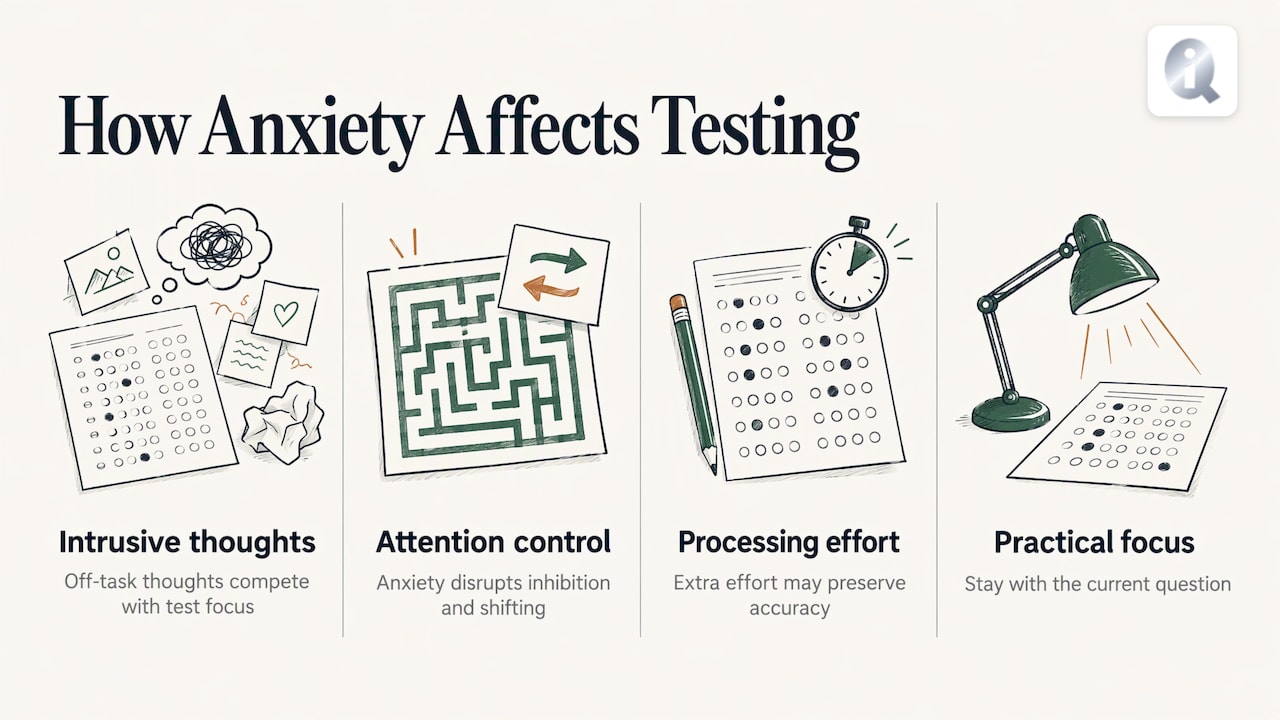
Intrusive, off-task thoughts. In a study of 730 university students, interference by test-irrelevant thoughts and lack of confidence, but not worry or arousal, explained unique variance in test performance. Earlier work on reactions to tests also described intrusive, task-irrelevant thoughts as an important link between anxiety and poorer performance, and found that a task-focusing condition could reduce self-preoccupying intrusive thinking.
Reduced attentional control. Attentional Control Theory, described by Eysenck and colleagues, proposes that anxiety reduces goal-directed attention, increases attention to perceived threat, and particularly disrupts inhibition (ignoring distractions) and shifting (switching between tasks or rules). Many IQ items depend on exactly those skills: holding a rule in mind, ignoring tempting wrong answers, and switching strategy when the first one fails.
Efficiency versus accuracy. The same theory notes that anxiety may reduce processing efficiency without necessarily lowering accuracy or score, because anxious examinees can compensate with more effort or additional resources. This helps explain why some people feel exhausted after a test yet score as expected. It also suggests that timed sections, where there is little room to compensate, are where anxiety is most likely to show up. Our guide to IQ test time limits explains how timing works across test types.
The practical lesson from these mechanisms is consistent: the most useful target is not “feeling calm” but “staying on the current question.”
Can an IQ test detect or diagnose anxiety?
No. An IQ test measures cognitive abilities. It is not a screening tool for anxiety, and a low or uneven result does not show that you have an anxiety disorder.
The American Psychological Association’s assessment guidelines say psychologists should interpret scores in relation to the purpose of the assessment, the examinee’s characteristics, the context, the validity evidence, and potential sources of error or bias, rather than treating a score as self-interpreting. The same guidelines recommend integrating standardized-test results with interviews, collateral information, behavioral checklists, prior assessments and other relevant data, especially for diagnostic or high-stakes decisions.
The American Psychiatric Association makes a related point about intellectual disability: cognitive testing is only part of an evaluation, and IQ must be considered alongside broader mental abilities and adaptive functioning. If you are worried about anxiety, attention or learning, a licensed psychologist or physician is the right person to assess it. An online result cannot do that job.
Before the test: preparation that reduces anxiety
The guidance from clinical and university sources is consistent and practical.
- Prepare early and in similar conditions. Mayo Clinic advises preparing ahead, studying in places similar to where you will be tested, and keeping a consistent routine. For an IQ test, “preparing” means learning the format and question types so nothing is a surprise. Our pages on IQ test format and IQ test length cover what to expect.
- Look after the basics. Sleep, exercise, food and hydration all appear in the guidance. The UNC Learning Center also suggests limiting excessive caffeine, which can intensify jitters.
- Space out your preparation. The same UNC guidance recommends spaced practice and having your materials ready in advance, so the test day is not a scramble.
- Practice a relaxation technique in advance. Mayo Clinic names deep breathing, sequential muscle tension and release, and positive visualization as techniques to practice before and during testing. A technique you have rehearsed is easier to use under pressure than one you try for the first time mid-test.
- Build a reliable study system. Test anxiety is often tied to feeling unprepared. Education-focused approaches, such as fixing your study system, reduce distraction and keep attention on the task, a principle that applies to any timed test.
- Keep the stakes in proportion. High stakes and perceived difficulty are both linked to higher anxiety. For many readers, an online IQ test is a low-stakes snapshot. Treating it that way is accurate, and it lowers the pressure. If you are weighing the role of testing in bigger decisions, this overview of standardized testing in college admissions places test anxiety in its wider educational context.
During the test: staying on the task
The UNC guidance for the exam itself is concrete, and it matches the research on intrusive thoughts.
- Arrive early and choose a low-distraction spot. For an online test, that means a quiet room, notifications off, and your device charged before you start.
- Use grounding and present-focused self-talk. Redirect attention to the item in front of you rather than to past preparation or future consequences.
- Move on when stuck. UNC recommends moving to another question instead of dwelling. On most timed items, one stubborn question should not consume the time of several others.
- Avoid perfectionistic readings of a single test. A single result is one sample of performance on one day, not a verdict on your ability.
- Breathe on purpose. A few slow breaths between sections take seconds and are among the techniques Mayo Clinic lists.
A short worked example: suppose you notice the thought “I’m running out of time and I’ll get a terrible score.” That is an off-task thought of the kind the research describes. The step that fits the evidence is to label it, take one breath, and read the current question again from the beginning. You are not trying to remove the worry, only to stop it from taking over working memory.
Structured programs for persistent anxiety
If anxiety around tests is a recurring problem, structured help exists. A 2022 chapter reported that test-anxiety interventions generally reduce anxiety, with cognitive approaches combined with study-skills training producing the largest reductions among students in later secondary education. The STEPS program it describes used six sessions of about 40 minutes each, covering triggers, challenging cognitive biases, relaxation, study skills, visualization, review, and practice of diaphragmatic breathing. Mayo Clinic also advises seeking counseling when self-help is not enough.
Our perspective
We design our assessments with one principle in mind: a score is only useful if you can interpret it in context. That is why we describe anxiety as a factor to manage, not a reason to avoid measuring your cognitive profile.
Our 50-question IQ assessment can be completed without creating an account, which removes one common source of pressure: there is no sign-up, no commitment, and no audience. You see a broad result category first. If you want more, you can choose to unlock your exact score, percentile context and five-domain breakdown, so you can see whether performance is even across domains or uneven.
Because the research shows that attention, not intelligence, is what anxiety disrupts most directly, we encourage readers to treat a first attempt as a calm, low-stakes baseline. Learn the format, settle your environment, and focus on one question at a time. A five-domain breakdown is particularly informative here, since it shows where your strengths sit rather than reducing your cognitive profile to a single number.
We also encourage interpreting any score with its limits in mind: the test is a snapshot, not a diagnosis, and it is designed to complement, never replace, professional evaluation.
Steve
When to retake a test or speak with a professional
Three situations are worth separating.
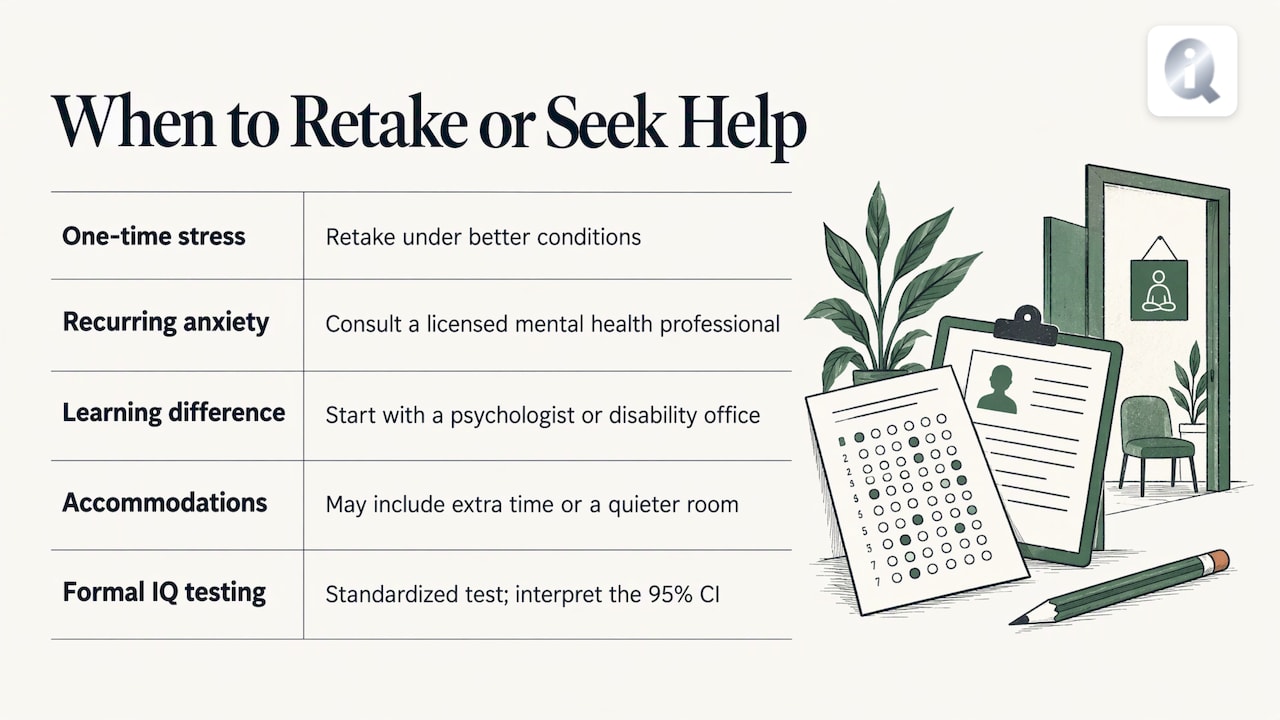
You were unusually stressed on one occasion. If a specific event disrupted a low-stakes test (a noisy room, a time crunch, a sleepless night), a retake under better conditions is reasonable. Keep in mind the repeat-testing gains described above: a higher second score may partly reflect familiarity with the format, so compare results with that in mind.
Anxiety is a pattern. If worry regularly interferes with exams, work tasks or daily functioning, a licensed mental health professional can assess it and offer evidence-based treatment, including cognitive-behavioral approaches.
You suspect a learning or attention difference. Mayo Clinic notes that underlying ADHD, dyslexia or learning disabilities can worsen test performance, and that professionally identified conditions may support accommodations such as extra time, a less distracting room or having questions read aloud, depending on the testing context. A psychologist or your school or employer’s disability office is the right place to start.
For formal purposes, the standard is different from an online test. The American Association on Intellectual and Developmental Disabilities states that assessing intellectual functioning requires a reliable, valid, individually administered, comprehensive standardized test normed on the general population, with scores interpreted using the test’s 95% confidence interval and clinical judgment. That confidence interval is itself a reminder that every IQ score is a range, not a single fixed point.
Take the assessment on your terms
If you would like to see where you stand, our 50-question IQ assessment needs no account and gives you a broad result category right away. You can then decide whether to unlock more. The Full IQ Result costs $9.99 once per completed result, with no subscription, and adds your exact IQ score, percentile context, five-domain breakdown, a personalized report, a verifiable certificate and Career Matches.
If you want to understand how your work style interacts with pressure, the separate Big Five personality assessment is free and provides OCEAN trait percentiles and a personality archetype. Personality Full Access is $14.99 once per result. To place a score in context, you can also use our IQ comparison tool, or browse the IQ and career research blog.
FAQ
Can anxiety lower my IQ score?
It can lower performance on a given day, especially on timed, attention-heavy tasks, but the evidence is mixed. One study linked testing anxiety to lower performance IQ, while a 2025 experiment found no significant effect on total IQ. Your underlying ability does not change, but a test result is influenced by how well you could focus.
Does an IQ test show that I have anxiety?
No. IQ tests measure cognitive abilities and are not designed to diagnose anxiety or any other condition. Diagnosis requires a qualified clinician who integrates interviews, history and other information. If you are concerned, speak with a licensed psychologist or physician.
What is the best way to calm down before an IQ test?
Prepare early, learn the format, sleep well, and practice a technique such as deep breathing, muscle relaxation or positive visualization ahead of time. On the day, choose a quiet setting and limit excess caffeine. During the test, move on from difficult questions and return to the present item.
Should I retake the test if I was nervous?
If a clear disruption affected a low-stakes test, a retake in better conditions is reasonable. Remember that repeat testing can raise scores through familiarity alone, so interpret the second result with that in mind. If anxiety is a recurring problem, consider professional support first.
Sources
- The impact of anxiety on performance IQ
- Anxiety and academic performance: A meta-analysis
- Test anxiety effects, predictors, and correlates: A 30-year meta-analytic review
- The Reassuring Absence of Acute Stress Effects on IQ Test Performance (PMC)
- The Reassuring Absence of Acute Stress Effects on IQ Test Performance (MDPI)
- Does test anxiety induce measurement bias in cognitive ability tests?
- Revisiting the Role of Worries in Explaining the Link Between Test Anxiety and Test Performance
- Anxiety and Cognitive Performance: Attentional Control Theory
- Stress, anxiety, and cognitive interference: reactions to tests
- APA Guidelines for Psychological Assessment and Evaluation
- Expert Q&A: Intellectual Disability, American Psychiatric Association
- Test anxiety: Can it be treated? Mayo Clinic
- Test Anxiety, UNC Learning Center
- Cognitive-Behavioural Intervention for Test Anxiety: the STEPS program
- Twenty Questions and Answers Regarding the 12th Edition, AAIDD
- Test Anxiety: Fix Your Medical School Study System
- The Role of Standardized Testing in College Admissions