IQ of Lawyers: What the Research Says About Attorney Intelligence

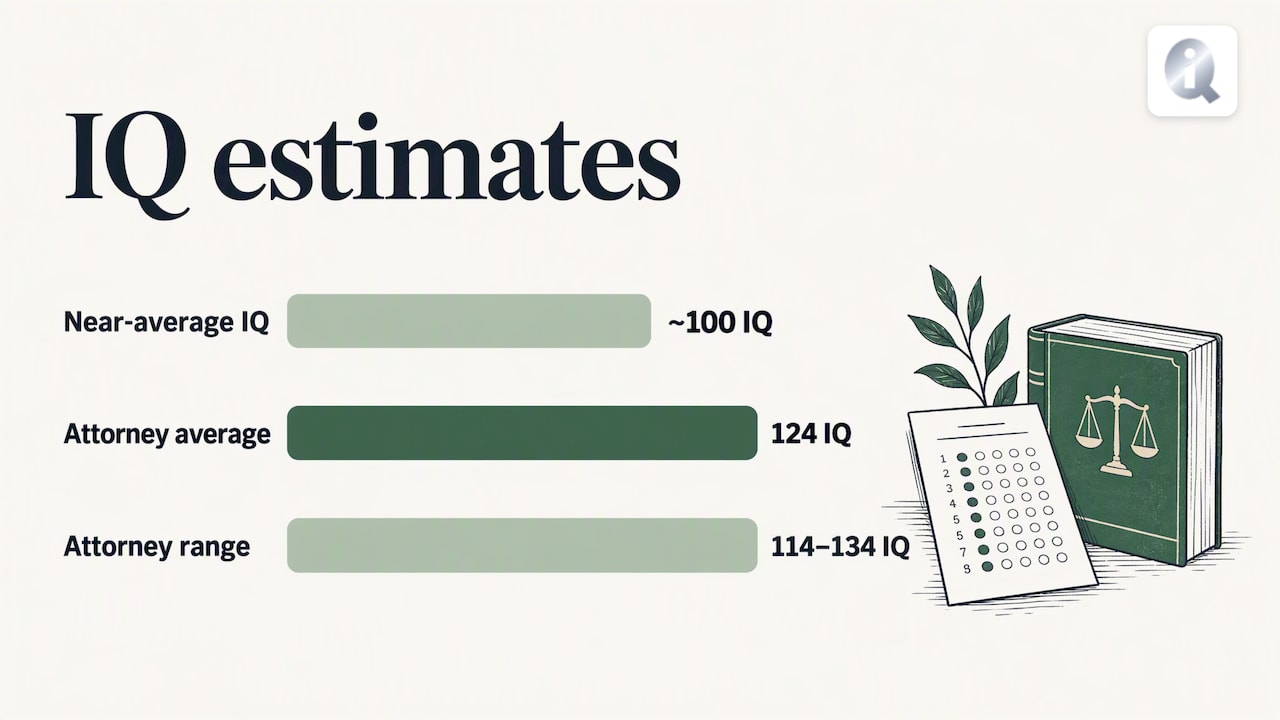
The average IQ of lawyers is above the general population mean of 100, but no single authoritative US figure exists. Our profession estimate for attorneys is 124, with a range of 114 to 134. That is a modeled estimate, not a census of working lawyers. Below we explain how to read the number, what published research supports, and why IQ alone says little about who becomes a good attorney.
TL;DR
- Our estimate for attorneys and lawyers is an average IQ of 124 (range 114 to 134), roughly one standard deviation and a half above the population mean of 100.
- No US study has tested a representative sample of practicing lawyers, so any single figure should be read as an estimate with a wide range.
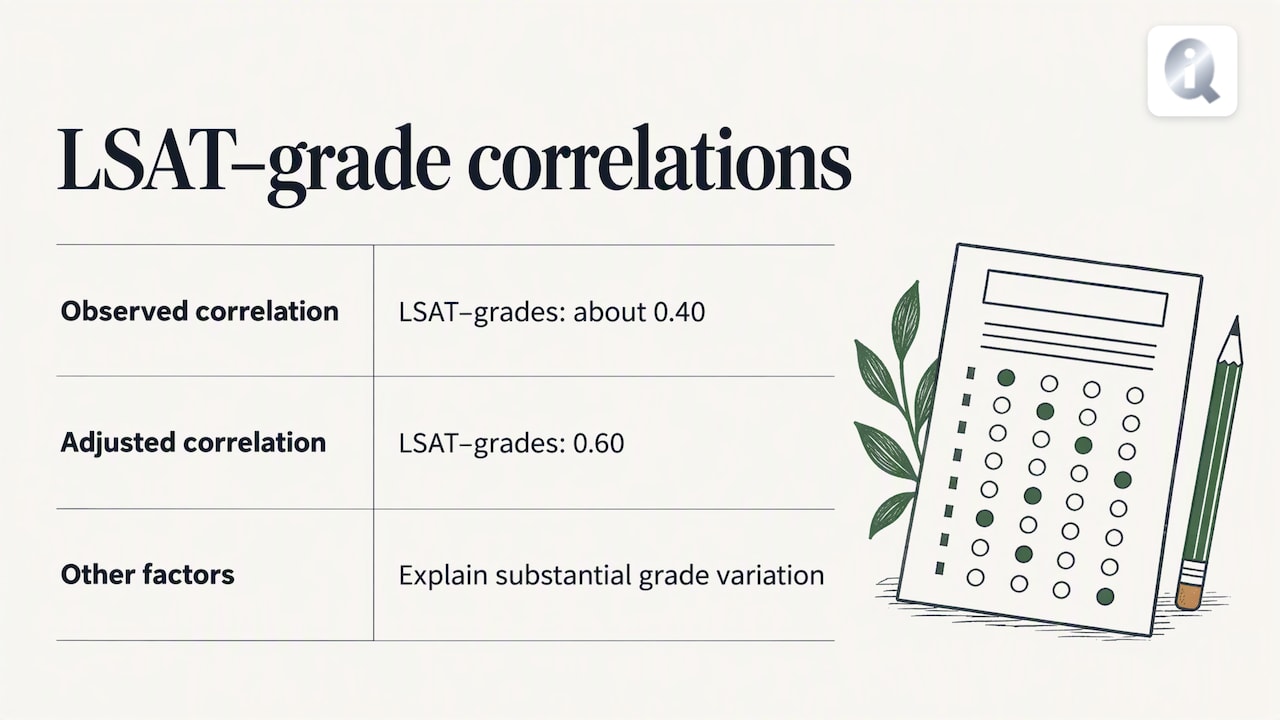
- The LSAT, a proxy for the reasoning skills law school rewards, correlates with first-year grades at about 0.40 (0.60 after statistical adjustment), which leaves much unexplained.
- Research at UC Berkeley found that judgment-based and personality measures predicted lawyering effectiveness better than the LSAT did.
- Someone with an average IQ is not barred from the profession, but the demands of law school and the bar exam make strong reasoning and sustained effort necessary.
Table of Contents
- What the average IQ of lawyers is, and how to read it
- Is there reliable research on lawyers’ IQ?
- Why a high average does not make every lawyer a genius
- What cognitive skills legal work uses
- What predicts lawyering effectiveness better than IQ
- Can someone with average intelligence become a lawyer?
- Emotional skills and the shy lawyer
- Take the assessment and compare your profile
- How to use these numbers well
- FAQ
- Sources
What the average IQ of lawyers is, and how to read it
IQ is a standardized score in which 100 is the population mean and about two thirds of people fall between 85 and 115. The APA Dictionary of Psychology defines it as a standard measure of an individual’s intelligence level based on psychological tests. A profession’s “average IQ” is therefore a statement about the center of a distribution, not a threshold.
Here is how our profession figures for the legal field compare, as listed on our profession tools:
| Role | Estimated average IQ | Range |
|---|---|---|
| Paralegal | 108 | 98 to 118 |
| Attorney / lawyer | 124 | 114 to 134 |
| Judge | 125 | 115 to 135 |
| Patent attorney | 126 | 116 to 136 |
Three points matter when you read this table.
- The range is the message. A range of 114 to 134 spans 20 points. Individual lawyers sit below and above the center, so the average cannot tell you whether a particular person will succeed.
- These are estimates. Occupation-level IQ figures are built from indirect evidence, because lawyers are not routinely given IQ tests as a condition of licensing. Treat them as comparative guides, not measurements.
- Selection explains much of the gap. Law schools admit on test scores and grades, and the bar exam filters further. A profession that selects on reasoning ability will, on average, sit above the mean.
The internet also circulates larger claims, such as a judge average of 150. We have found no published research behind those numbers, and we do not use them.
Is there reliable research on lawyers’ IQ?
Short answer: only partial. Direct IQ testing of large, representative groups of US attorneys is not part of the public record. What exists is adjacent evidence.
One of the better-known studies comes from the UK. Research on the 1970 birth cohort, analyzed by the Centre for Market and Public Organisation, suggested that the relative intelligence of people entering the legal profession has moved closer to the population mean over time. That finding concerns British entrants and a particular generation, so it should not be transferred to the United States as a measured American average. It does illustrate a useful principle: as access to a profession widens, the average of its entrants can shift.
The second kind of evidence is LSAT validity research. The Law School Admission Council reports that the correlation between LSAT scores and first-year law school grades is about 0.40, and 0.60 when adjusted for restriction of range. Restriction of range means that admitted students are already a narrow slice of test takers, which compresses the observed correlation. Even the adjusted figure of 0.60 means a large share of grade variation is explained by other factors.
The LSAT is not an IQ test, and we do not claim it converts to one. It does measure reading, reasoning and analytical skills that overlap with general cognitive ability.
Why a high average does not make every lawyer a genius
Psychologists describe general intelligence through Spearman’s g, the shared variance across different cognitive tasks. An academic paper on the concept found g across many cultures and described it as resistant to training. The same paper explains that many cognitive tasks draw on general cognitive ability, which helps explain why g correlates with many life outcomes.
“Correlates with” is the operative phrase. A correlation describes a tendency across groups, and individual outcomes scatter widely around it. The APA also notes that critics see IQ tests as measuring previously learned skills and knowledge and requiring test takers to sit still and follow directions. Those are issues of interpretation, and they are the reason we advise reading a score as one data point about reasoning, not a verdict on someone’s talent.
This answers the common question of whether lawyers are smart. As a group, attorneys are selected on skills that overlap heavily with measured intelligence, so the group average is high. Individual lawyers vary, and professional quality depends on far more than a test score.
What cognitive skills legal work uses
Legal work draws on several abilities that IQ-style tests capture partially:
- Verbal reasoning: reading dense statutes, contracts and case law, and extracting what matters.
- Logical and analytical reasoning: building an argument, spotting a flaw in an opposing one, and applying a rule to new facts.
- Working memory and attention to detail: holding several clauses, dates and precedents in mind while drafting.
- Processing of data: a 2024 American Bar Association article says lawyers will need to analyze data, manage complex technology, develop strategies, and use judgment, empathy and adaptability.
The fifth category sits outside what an IQ test covers: professional judgment. ABA Model Rule 1.1 states that competent representation requires legal knowledge, skill, thoroughness and preparation reasonably necessary for the representation. Notice that the rule names thoroughness and preparation, which are habits, not scores. The relevant factors include matter complexity, experience, training and preparation.
If you want to see how a reasoning profile maps across several cognitive domains, rather than a single number, our Career-IQ Matcher compares a cognitive profile with occupations.
What predicts lawyering effectiveness better than IQ
The most useful study for this question is the Berkeley Law research project on identifying and validating predictors of lawyer effectiveness. Its report found that the LSAT, undergraduate GPA and index scores were not particularly useful for predicting most lawyering effectiveness factors, whereas situational judgment tests, biographical inventories and some personality measures predicted many of them. The researchers argued for broader performance predictors, because narrow admissions metrics can limit the diversity and balance of law graduates.
Translated into practical terms:
- Situational judgment: how you choose to act when a client, colleague or opponent presents a realistic dilemma.
- Biographical history: the pattern of experiences, such as sustained work, leadership and responsibility, that tends to precede strong performance.
- Personality: traits like conscientiousness and openness that relate to preparation, curiosity and persistence. You can explore these through a Big Five personality assessment, which is free to take with sign-in.
Practitioners say something similar. In an ABA piece on core professional qualities, attorneys note that good lawyers are good at figuring things out, and that curiosity helps them learn and explore unfamiliar problems. That is an attitude toward problems, not a number.
Can someone with average intelligence become a lawyer?
It is a frequent question, and many ranked forum threads revolve around it, often with a score like 84 or 117 in the title. Our answer is measured.
Law school and the bar exam are demanding in reading volume, abstract reasoning and time pressure. Because our estimated attorney average is 124, an IQ near 100 places a person below the typical center of the profession. That does not rule out success: the estimated range runs from 114 to 134, which indicates real spread, and preparation, study methods and persistence affect outcomes substantially.
An attorney quoted in the ABA’s guidance says competence is not about being average. In her view it requires time, effort, practice and a commitment to constant improvement and excellence. We read that as a fair summary: ability sets part of the starting line, and work determines much of the rest.
If you are not sure where you stand, two steps help more than speculation:
- Take a timed reasoning assessment under quiet conditions, so that the result reflects your reasoning and not distractions. Our guides explain how long IQ tests run and how time limits work.
- Take a practice section of the LSAT or a comparable reasoning test, since that measures the specific skills law schools weigh most.
Our “Am I smart enough to be an attorney?” page lays out the comparison in more detail, and the paralegal version does the same for a related role.
Emotional skills and the shy lawyer
Readers also ask whether a shy person can practice law. The ABA article on the future of the profession lists empathy and adaptability among the human skills that complement analytical ability. Many areas of legal work, including research, drafting, appellate writing and transactional work, rely heavily on written analysis. Introversion and shyness are different things, and neither is a measure of intelligence or competence. A personality profile can show where you sit on extraversion and related traits, which helps you pick a practice area that fits.
Our perspective
At IQ Career Lab we look at the figure for lawyers as a starting point for a question, not an answer to one. An average of 124 tells you where a profession’s center sits. It does not tell you whether you can do the work, and it says nothing about the judgment, curiosity and preparation that the research above associates with effective practice.
That is why we separate the two assessments we offer. The 50-question IQ assessment gives a view of reasoning across five cognitive domains, and the Big Five assessment describes the personality traits that relate to work style. Together they give a more complete picture than either alone, and both can be compared against the profession pages on our site.
Our approach is to publish ranges and state what an estimate can and cannot support. We would rather you leave with a calibrated view than a flattering or discouraging number.
Steve
Take the assessment and compare your profile
If you want a personal reference point instead of a profession average, you can take our 50-question IQ assessment without creating an account. You see a broad result category first. You can then optionally unlock your exact IQ score, percentile context, five-domain breakdown, personalized report, verifiable certificate and Career Matches with the Full IQ Result for $9.99, paid once per completed result. It is not a subscription.

The Big Five personality assessment is separate, requires sign-in and gives OCEAN trait percentiles and a personality archetype for free. Personality Full Access costs $14.99 once per result and adds a detailed personality profile, workplace-fit insights and a verifiable certificate. For broader context, our IQ comparison tool places jobs, countries and well-known figures side by side, and our research blog covers score interpretation in more depth.
How to use these numbers well
A few rules keep profession averages useful.
- Compare ranges, not midpoints. If your score falls within 114 to 134, it falls within our estimated range for attorneys.
- Pair a cognitive score with a skills check. Reading speed, writing quality and comfort with ambiguity matter in practice, and the Berkeley findings point to judgment and personality as predictors.
- Do not stack inferences. A forum claim that the average lawyer is 115, another that it is 150, and our estimate of 124 cannot all be right. Ask what each is based on.
- Consider the adjacent roles. Paralegal work, with an estimated average of 108, uses many of the same reading and organization skills at a different entry point, as does work in related information professions such as librarianship, estimated at 112.
FAQ
What is the average IQ of a lawyer?
Our estimate for attorneys and lawyers in the United States is 124, with a range of 114 to 134. It is a modeled figure, since no representative IQ census of practicing attorneys exists. Treat it as a comparison point, not a requirement.
Are lawyers smart?
As a group, yes, in the sense that law school admission and the bar exam select for strong reasoning and reading skills, and so the group average is above 100. Individuals vary widely, and the Berkeley research found that judgment and personality also predict who practices effectively.
Do you need a high IQ to get through law school?
Strong reasoning helps, because law school rewards analytical and verbal skills. The LSAT correlates with first-year grades at about 0.40 (0.60 adjusted), so a large part of performance depends on other factors such as preparation and study habits.
Do judges have a higher IQ than lawyers?
Our profession estimates are close: 125 for judges and 124 for attorneys, and their ranges overlap almost entirely. Claims of far higher judicial averages are not backed by research we could find.
Sources
- Study reveals lawyers’ IQs are more in line with mere mortals (The Lawyer)
- Evidence to Support Validity Claims for Using LSAT Scores (LSAC)
- Spearman’s g study (APA PsycNet)
- IQ entry (APA Dictionary of Psychology)
- Identification, Development, and Validation of Predictors for Successful Lawyering (UC Berkeley Law)
- Back to Basics: the 5 Cs (American Bar Association)
- Transforming the Legal Profession Through Technology and Entrepreneurship (American Bar Association)