IQ and SAT: How the Two Scores Relate and What They Mean

SAT scores and IQ scores are strongly related, but they are not interchangeable. Research places the correlation between the SAT and general cognitive ability anywhere from about .5 to .9, depending on the sample and on how intelligence is measured. That is high enough to treat the SAT as a rough proxy for general cognitive ability. It is too loose to turn a specific SAT total, such as 1460 or 1530, into one exact IQ number. Below, we set out what the studies found, why a precise conversion is not possible, and how to estimate a defensible IQ range from your own score.
TL;DR
- The SAT is not an IQ test, but it is strongly g-loaded: a 2004 study reported a correlation of .82 between SAT scores and a general ability factor (g) derived from the ASVAB.
- Across later research, correlations range from roughly .5 to .9, so any SAT-to-IQ conversion is an estimate with a wide margin of error.
- The College Board describes the SAT as a measure of high-school math, reading, and writing skills, so schooling, preparation, and test anxiety also move the score.
- The most transparent method is percentile matching: find your SAT percentile, then read off the IQ at the same percentile on a mean-100, SD-15 scale.
- An IQ test measures reasoning across several cognitive domains directly. The SAT measures developed academic skills.
Table of Contents
- Is the SAT an IQ test?
- What the research says about the correlation
- Where the SAT and an IQ test differ
- Can you convert an SAT score to an IQ score?
- A transparent way to estimate an IQ range from your SAT
- What can move an SAT score without moving IQ
- Which one should you use to learn about yourself?
- Take a direct measure of your cognitive profile
- FAQ
- Sources
Is the SAT an IQ test?
No. The SAT is an achievement-oriented admissions exam, and the College Board states that it measures the math, reading, and writing skills students need for success in college and career. An IQ test is built to estimate general cognitive ability, usually through tasks such as pattern reasoning, working memory, and processing speed, and it reports the result on a standardized scale with a mean of 100.
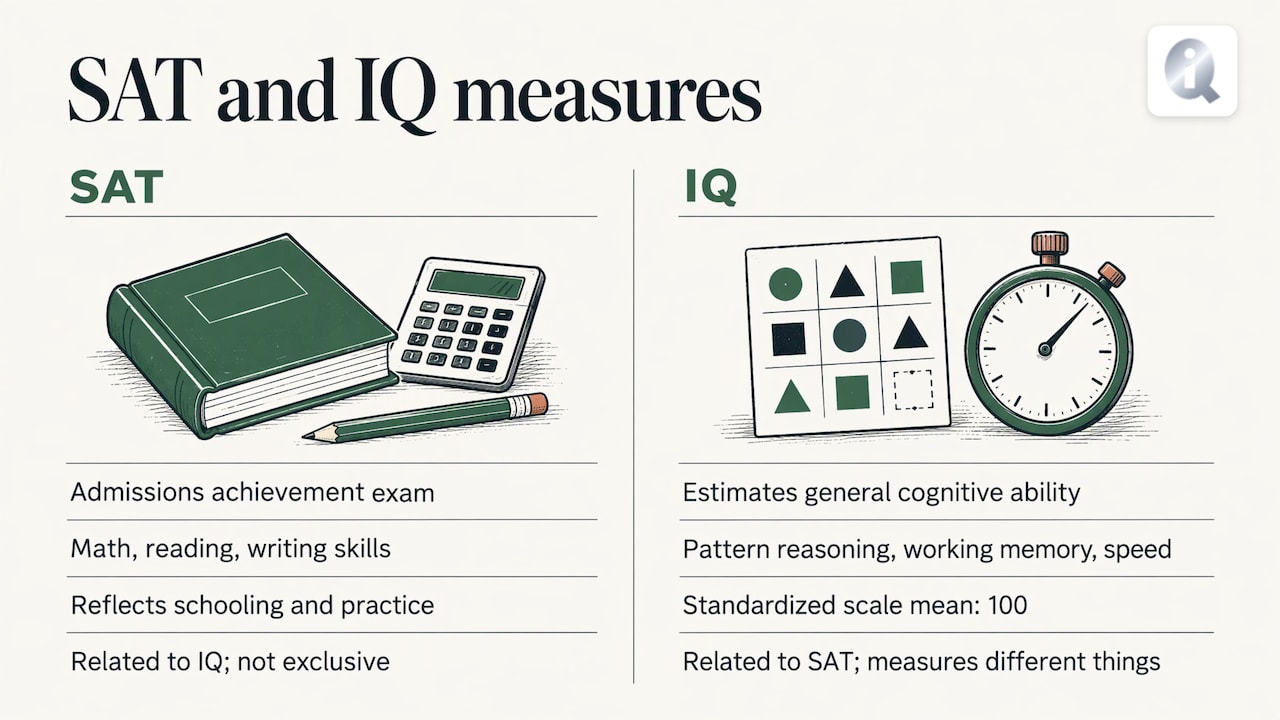
The two are nonetheless related, and the psychometric literature is direct about it. Frey and Detterman’s central finding was that the SAT is strongly g-loaded: performance on a college-admissions test reflects general cognitive ability substantially, even though the test is framed as academic. In a 2019 review, Frey concludes that the SAT measures intelligence and is a good measure of it, while also noting that it is neither perfect nor exclusive.
In practical terms: a high SAT score is evidence of strong general cognitive ability, but it is also evidence of schooling, practice, and motivation. A low SAT score is weaker evidence of low ability, because many non-cognitive factors can depress it.
What the research says about the correlation
The figure most often quoted comes from a single paper, so it helps to know exactly what it contained.
| Study | Sample | Comparison measure | Correlation |
|---|---|---|---|
| Frey and Detterman, 2004, Study 1 | 917 participants | g derived from the ASVAB | .82 (.86 corrected for nonlinearity) |
| Frey and Detterman, 2004, Study 2 | 104 undergraduates | Raven’s Progressive Matrices | .483 (.72 corrected for restricted range) |
| Frey, 2019 review of later research | Various samples | Various definitions of intelligence | Roughly .5 to .9 |
Source for the first two rows: the 2004 Psychological Science paper. Source for the third: the 2019 review by Frey.
Three points of interpretation follow from the table.
- The comparison measure matters. The .82 compares the SAT with a g factor built from a broad battery. The .483 compares it with a single matrix-reasoning test, which captures only part of general ability. Corrected for restricted range (the undergraduates were already a high-scoring group), that figure rises to .72.
- Corrections change the number. Restricted range and nonlinearity are real statistical issues, but corrected values are estimates of what a broader sample would show, not what was observed.
- A correlation of .8 is not identity. If two measures correlate at .8, they share about 64% of their variance (.8 squared). The remaining 36% is test-specific content, measurement error, and other influences.
An education-policy review reaches a similar conclusion: SAT and ACT scores are reasonably good proxies for general cognitive ability, and it notes SAT correlations of .75 to .86 with GRE scores. The same review stresses that standardized tests and intelligence tests overlap strongly but are not interchangeable, because academic achievement, schooling, and cognitive ability contribute jointly.
Where the SAT and an IQ test differ
| Feature | SAT | IQ assessment |
|---|---|---|
| Stated purpose | Measures math, reading, and writing skills for college and career | Estimates general cognitive ability |
| Content | School-based academic content | Reasoning across cognitive domains, often less dependent on schooling |
| Score scale | Section scores plus a total | Standardized scale, mean 100, SD 15 |
| Influenced by coaching and coursework | Yes, as a developed ability | Less so, though not immune to practice |
| Typical use | College admissions and scholarships | Cognitive profiling, clinical and educational assessment, self-assessment |
The 2018 policy review explains the overlap in these terms: SAT scores include test-specific variance and reflect developed abilities that education can affect. That is the core reason the two cannot be swapped one for one. A student who spends a year on focused preparation can raise an SAT score. The underlying general ability has not necessarily changed by the same amount.
Can you convert an SAT score to an IQ score?
You can estimate, but you cannot convert. A conversion implies a fixed table, like Fahrenheit to Celsius. SAT-to-IQ figures are regression-style estimates, and the uncertainty around them is wide.
Frey and Detterman themselves provided equations for this purpose. Their abstract states the equations could be useful for estimating premorbid IQ or for individual-difference research with college students. That is a research use, applied to groups and to specific populations, and not a way for an individual to learn a certified IQ.
There are three reasons any single-number answer should be treated with caution:
- Regression to the mean. When the correlation is below 1, the best prediction of IQ for a person with an extreme SAT score is closer to the average than their SAT percentile suggests. A very high SAT percentile predicts a high, but somewhat lower, IQ percentile.
- Different SAT versions. The SAT has been redesigned and rescaled over the decades, so formulas built on older score scales do not transfer to a current score without adjustment.
- Population differences. The people who take the SAT are not a random sample of the population. They are a self-selected group, which affects how SAT percentiles line up with population IQ percentiles.
This is why we do not publish a lookup chart claiming that a given SAT total equals a given IQ. If you see a table that says a particular score “is” an IQ of 130, it is presenting an estimate as a measurement.
A transparent way to estimate an IQ range from your SAT
Percentile matching is the method we consider easiest to reproduce and to check. It assumes that a given rank among test takers corresponds to the same rank on the IQ scale.
- Find your SAT percentile. Use the percentile tables on the official score report or on the College Board’s published score information for the test year you took.
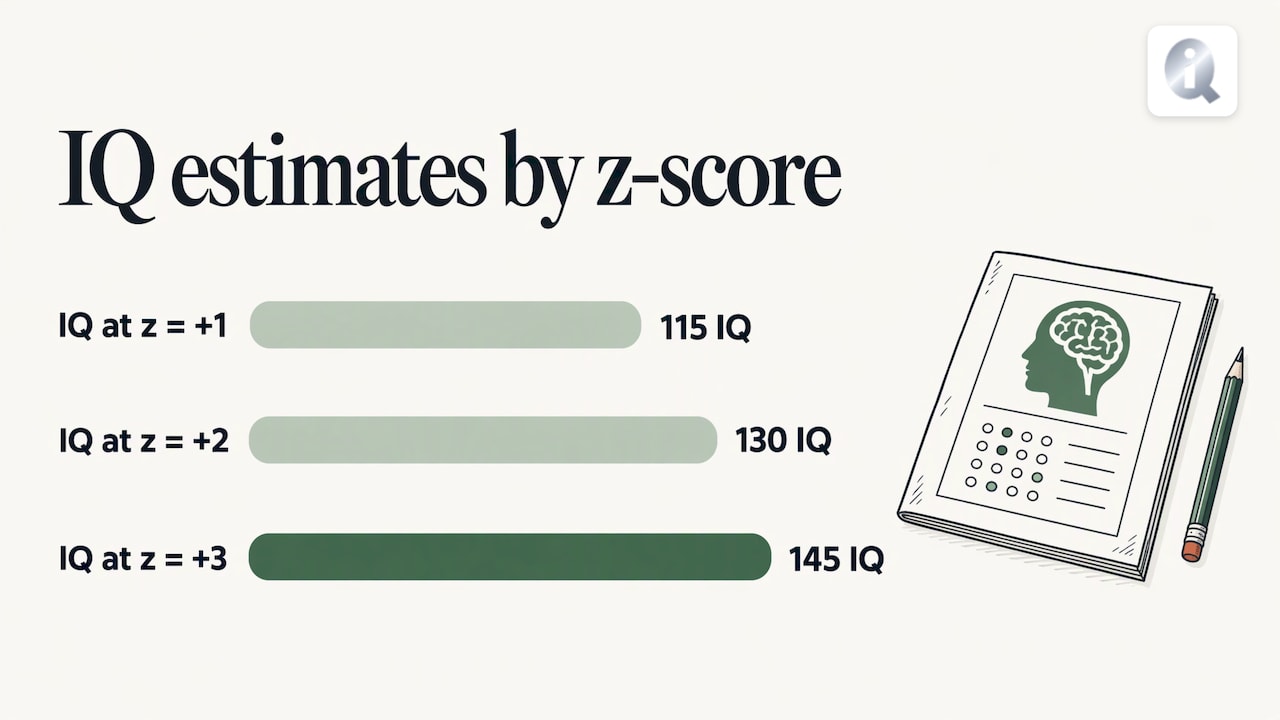
- Convert the percentile to a z-score. A percentile of 84.1 corresponds to z = +1, 97.7 to z = +2, and 99.9 to about z = +3, using the normal distribution.
- Convert the z-score to IQ. IQ = 100 + 15 × z. A z of +1 gives 115, +2 gives 130, and +3 gives 145.
- Widen the answer into a range. Because the correlation is not perfect, report a band of roughly 10 to 15 points around the estimate instead of a single figure.
Here is a worked example with deliberately round numbers. If a score sat at the 97.7th percentile among SAT takers, the matched IQ would be 130. Because SAT takers are a self-selected group that skews toward people who plan to attend college, the same rank in the general population would sit higher, so 130 is a floor for this reasoning and not a midpoint. Given the .5 to .9 range of correlations, a reasonable statement is that the person’s IQ is probably above average and quite possibly well above it, not that it is exactly 130.
If you already have an IQ score on one scale and need it on another (for example, an SD-15 versus an SD-24 scale), our IQ score converter handles that part. For context on where 100 sits relative to the national population, see our explainer on the US average IQ.
What about specific scores such as 1460 or 1530?
Readers often ask what IQ a particular total corresponds to. The honest answer is the same for each: look up the percentile for that total in the score year you took the test, then apply the steps above. A total in the upper range of the scale implies a high percentile among SAT takers, and therefore a likely above-average IQ. Which exact number you would get depends on the percentile table, the regression assumptions, and the sample. We would not quote one figure as authoritative.
What can move an SAT score without moving IQ
The SAT is a measure of developed ability under test conditions, so several things can shift it independently of general cognitive ability.
- Test anxiety and self-efficacy. The 2019 review reports that test anxiety and self-efficacy influence SAT scores, although Frey characterizes intelligence as having the larger influence overall.
- Coursework and content familiarity. Because the SAT assesses school-based skills, students with stronger preparation in algebra or reading analysis tend to be advantaged on content, not only on reasoning.
- Preparation time. Structured practice can close a gap between your current score and your target. If you want to size that gap, a SAT study plan that maps score gaps to hours is a practical way to turn a target score into a weekly schedule.
- Non-cognitive factors. The same review notes that noncognitive factors can explain some group differences, which is another reason to avoid reading one student’s score as a verdict on ability.
In short, a low SAT score should not be read as a low IQ, and a high one is a good sign but not a certificate.
Which one should you use to learn about yourself?
It depends on the question.
- “Am I ready for college-level work?” The SAT is built for this, and its content is aligned to that purpose.
- “What is my general cognitive ability compared with the population?” A dedicated IQ assessment, which reports on a standardized scale across several cognitive domains, is the more direct instrument.
- “Which cognitive strengths do I have?” A domain-level breakdown is more informative than any single total, SAT or IQ.
- “What careers fit my profile?” Neither number is enough alone. Cognitive profile and personality both matter, and occupational data helps tie them to specific jobs.
If you want a broader view of what high scores mean, our guide to the Mensa IQ requirement lays out the score, the percentile, and which tests qualify. Our overview of Sternberg’s triarchic theory explains why analytical test performance covers only part of what people call intelligence.
Our perspective
We read the SAT-IQ literature as supportive of one conclusion: the two measures share a large common core, and each adds something the other lacks. That is exactly why we do not offer a single-number “SAT to IQ” lookup. A figure like that hides the uncertainty that the research itself reports.
Our approach is to measure the cognitive abilities directly. The IQ assessment has 50 questions across five cognitive domains, takes no account to start, and gives a broad result category first. If you want the exact score, percentile context, the five-domain breakdown, and a verifiable certificate, you can unlock them once per result. We think a domain breakdown tells a student or a professional more than a single total, because it shows where strengths sit and where a gap between ability and academic preparation may lie.
If you already have an SAT score, treat it as one data point, then test the same question from a different angle.
Steve
Take a direct measure of your cognitive profile
If the SAT left you wondering where your general reasoning sits, our 50-question IQ assessment is a direct way to find out. You can complete it without creating an account and see a broad result category. Unlocking the exact IQ score, percentile context, five-domain breakdown, personalized report, verifiable certificate, and Career Matches is a one-time payment of $9.99 per completed result, and it is not a subscription.

You can see what is included on the pricing page, or browse the free IQ tools and calculators first. If you are weighing how your cognitive profile fits specific occupations, the Career-IQ Matcher is a good next step.
FAQ
Is a high SAT score proof of a high IQ?
Not proof, but good evidence. The 2004 study found a correlation of .82 between SAT scores and a general ability factor in a large sample. Because other influences such as schooling, preparation, and test anxiety also shape the score, a high SAT is best read as a strong indicator and not a measurement of IQ.
Can a low SAT score mean my IQ is low?
Not reliably. The SAT measures developed academic skills, and research notes that test anxiety and self-efficacy influence scores. A low result can reflect limited preparation or testing conditions. If you want a direct read on reasoning ability, a standardized IQ assessment is more informative.
Why do online SAT-to-IQ charts disagree with each other?
They rest on different formulas, different SAT score scales, and different assumptions about the test-taking population. The underlying correlation is between about .5 and .9 depending on the sample, so each chart is an estimate. Percentile matching with a stated range is more transparent than a single-number chart.
Is the SAT or an IQ test better for predicting college success?
The SAT is designed around college-readiness skills, which is its stated purpose. Policy research treats general cognitive ability as an important contributor to educational outcomes and views SAT scores as useful proxies for it. An IQ test and the SAT answer related but different questions.
Sources
- What We Know, Are Still Getting Wrong, and Have Yet to Learn about the Relationships among the SAT, Intelligence and Achievement (Frey, 2019)
- Using Standardized Test Scores to Include General Cognitive Ability in Education Research and Policy (2018)
- Scholastic Assessment or g? Frey and Detterman, Psychological Science (2004)
- Scholastic Assessment or g? The relationship between the SAT and general cognitive ability (PubMed abstract)
- SAT Myths vs Facts for Counselors, College Board
- SAT study plan: map your score gap to hours and timeline