The History of IQ Testing: From Binet to Modern Scores

IQ testing began in Paris in 1905, when Alfred Binet and Théodore Simon built a scale to identify children who needed extra help in school. The Binet-Simon scale was designed for special education placement, not for ranking people. The single “IQ” number came later, in the United States, and it was then stretched far beyond its original purpose. Understanding that path explains what a modern IQ score does and does not tell you.
TL;DR
- The first practical intelligence test was the Binet-Simon scale of 1905, created to find children who needed educational support.
- The IQ as a ratio of mental age to chronological age was devised by William Stern in 1912 and became standard in the US through Lewis Terman’s 1916 Stanford revision.
- World War I group testing (Army Alpha and Beta) made mass testing normal, and early American testing became entangled with eugenics and discriminatory policy.
- Modern tests such as the Wechsler scales report several index scores plus a Full Scale IQ, compared with same-age norms, with a mean of 100 and a standard deviation of 15.
Table of Contents
- Why the first intelligence test was built
- How the test crossed the Atlantic
- Terman, the Stanford-Binet and the IQ score
- Army Alpha and Beta: testing at scale
- Eugenics, schools and the misuse of scores
- Wechsler and the shift to ability profiles
- A timeline of the main milestones
- What the history means when you take a test today
- Our perspective
- Take the assessment and see your own profile
- FAQ
- Sources
Why the first intelligence test was built
At the start of the twentieth century, French schools had a practical problem: some children were struggling, and teachers needed an objective way to tell who required special help. The French government asked for a tool, and Binet and Simon produced it. According to a University of Toronto history of the Stanford-Binet, the 1905 scale was designed to identify children with learning, intellectual or developmental disabilities so they could be placed in special education programs.
Three features of that origin still matter:
- The purpose was diagnostic. The test sorted children by the support they needed, not by innate worth.
- The tasks were varied. The scale was a set of graded tasks rather than a single puzzle type, which is why later test makers treated intelligence as a collection of abilities.
- The result was a level, not a verdict. A child was described by the age level of tasks they could handle.
If you want to see how an academic strengths check works for a child today, an initial assessment of academic strengths follows the same basic logic: find where a student is, then decide what support fits.
How the test crossed the Atlantic
Binet’s scale reached the United States through Henry Goddard. The American Psychological Association’s account of the birth of American intelligence testing reports that Goddard translated and began using the test in 1908 and published his version that December. By 1911 he had introduced it to public schools, and by 1913 he was testing immigrants at Ellis Island.
That timeline shows how quickly a school tool became an instrument of public policy. Goddard also published The Kallikak Family in 1912, arguing that “feeblemindedness” was hereditary and that society should prevent people so labeled from having children, through institutional isolation or sterilization. Binet’s original aim, helping children, had been replaced by a hereditarian one within a few years of the test arriving in America.
Terman, the Stanford-Binet and the IQ score
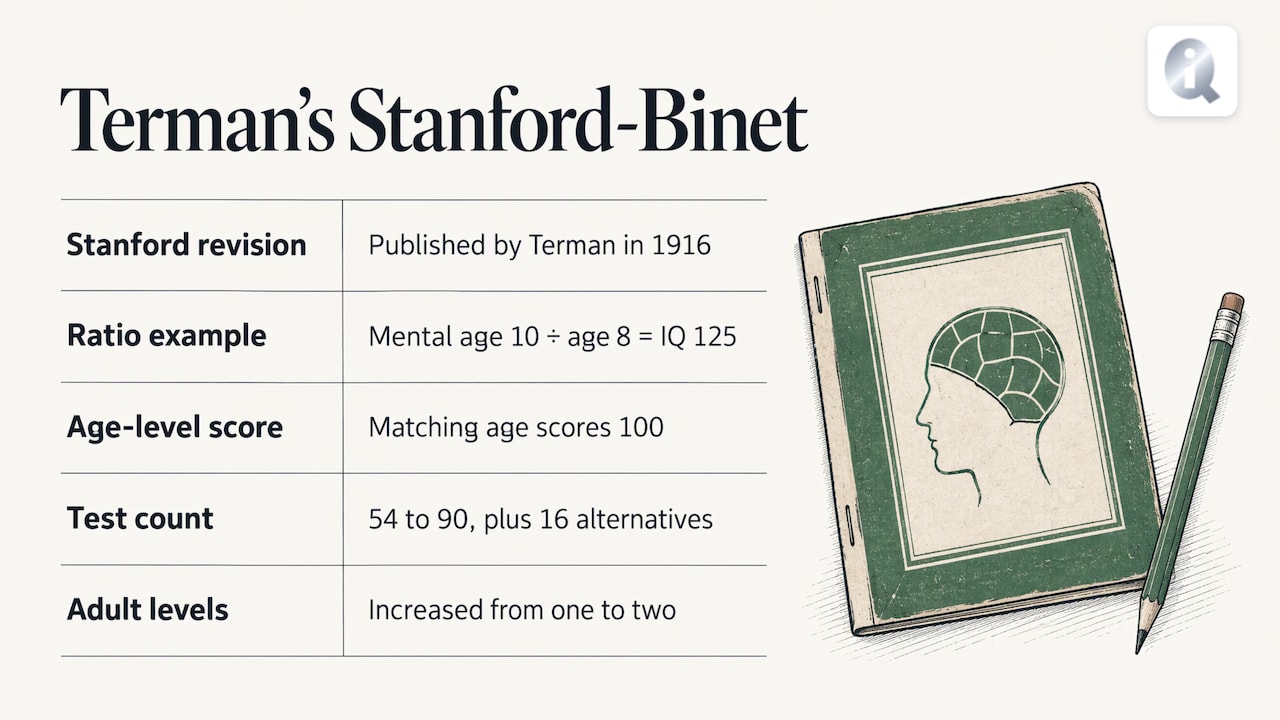
The version that defined American testing came from Lewis Terman at Stanford. In 1916 he published the Stanford revision. As the introduction to Terman’s book notes, this edition included the IQ, a ratio between chronological age and mental age that William Stern had proposed in 1912.
The ratio is simple. A child of 8 who performs like a typical 10-year-old has a mental age of 10, so the ratio is 10 divided by 8, or 1.25, which is reported as an IQ of 125. A child who performs exactly at age level scores 100.
Terman’s revision was also much larger than Binet’s original. The same source states that it grew from 54 to 90 tests, plus 16 alternatives, and added two adult levels where the original had one. The ratio worked reasonably for children but made little sense for adults, because mental age does not keep rising with chronological age. That limitation is one reason test makers later moved to comparing each person with others of the same age.
The Stanford-Binet also set the pattern that readers still see in education and admissions: a standardized score used to compare people. If you are weighing how such scores relate to other standardized measures, a guide to standardized university admission tests shows how that tradition continues in admissions, and our own article on how IQ and SAT scores relate explains what the two numbers share and where they differ.
Army Alpha and Beta: testing at scale
World War I turned individual testing into mass testing. A committee led by Robert Yerkes developed two group tests for the US Army. A history of intelligence assessment by John Wasserman describes the design:
| Test | Format | Who it was for |
|---|---|---|
| Army Alpha | Eight tests, about 40 to 50 minutes, administered to groups as large as 500 | Recruits able to read English |
| Army Beta | Demonstrations, pantomime and reduced-language tasks | Examinees who could not rely on English literacy |
The Beta test is historically important because it was an early attempt at a test that did not depend on language. The same concern drives today’s culture-fair tests and Raven’s Matrices, which use abstract patterns instead of vocabulary.
The wartime program had a lasting side effect. Large organizations, schools and employers learned that a test could be given to hundreds of people at once and scored quickly. Group testing became the model for the school and career tests that followed.
It also exposed problems. The recruits differed widely in schooling, language and background, so score differences often reflected opportunity as much as ability. After the war, some analysts used group differences to support hereditarian and eugenic claims, a use the data could not justify.
Eugenics, schools and the misuse of scores
Any honest history of IQ testing has to cover how scores were used. In the early US, testing was closely tied to the eugenics movement, which held that intelligence was fixed, inherited and divided along racial lines. A Yale National Initiative curriculum unit notes that tests were invoked to justify forced sterilization, as in the 1927 Supreme Court case Buck v. Bell, and to support the 1924 Immigration Act.
Schools were affected too. The same unit reports that IQ tests placed disproportionate numbers of Black and immigrant children in special education and lower academic tracks. A DePaul Law Review article on the eugenic origins of IQ testing describes how tests were used to sort students by supposed ability, often steering marginalized groups toward vocational tracks under a veneer of scientific objectivity.
The lesson for a modern reader is about interpretation, not about the instrument alone. The harm came from three assumptions that psychometrics no longer supports:
- that a single score captures all of intelligence;
- that the score is fixed from birth;
- that group averages reveal innate differences, when they also reflect schooling, language and opportunity.
Contemporary testing standards pull in the opposite direction: score against up-to-date norms, report several abilities, and treat the result as an estimate with a margin of error.
Wechsler and the shift to ability profiles
The next major change came from David Wechsler. According to OpenStax Psychology 2e, the major milestones of the field include Terman’s 1916 Stanford-Binet and Wechsler’s 1939 Wechsler-Bellevue. Wechsler’s approach separated different kinds of ability instead of presenting one blended number.
The modern descendants of that idea are the Wechsler scales. The same OpenStax chapter explains that they are periodically normed and standardized, and that the WISC-V reports five index scores alongside a Full Scale IQ:
- Verbal Comprehension
- Visual Spatial
- Fluid Reasoning
- Working Memory
- Processing Speed
Interpretation rests on comparison with contemporary norms for the same age group, not on a mental-age ratio. Most IQ tests are built with a mean of 100 and a standard deviation of 15.
That design has a practical meaning. A score of 100 is the average of the norm group. A score of 115 is one standard deviation above the mean, which places a person at about the 84th percentile: roughly 84 of every 100 people in the norm group score at or below it. A score of 130 is two standard deviations above, at about the 98th percentile. If you want to compare the major test families side by side, see our comparison of WAIS, Stanford-Binet and online IQ tests.
Because norms are re-collected periodically, they also reflect a pattern researchers have documented for decades: raw performance changes across generations. Our page on the Flynn effect covers why tests must be renormed.
A timeline of the main milestones
| Year | Milestone | What changed |
|---|---|---|
| 1905 | Binet-Simon scale | First practical test, built to identify children needing educational support |
| 1908 to 1913 | Goddard’s American adoption | Translation, school use by 1911, Ellis Island testing by 1913 |
| 1912 | Stern’s ratio | Mental age divided by chronological age |
| 1916 | Stanford revision | IQ introduced to US testing, 90 tests, adult levels |
| WWI | Army Alpha and Beta | Group testing, plus a reduced-language format |
| 1939 | Wechsler-Bellevue | Start of the Wechsler tradition of multiple abilities |
| Today | Wechsler scales | Five indices, Full Scale IQ, same-age norms, mean 100 and SD 15 |
What the history means when you take a test today
The history gives you four practical rules for reading any IQ result.
- Check what it was built to do. Binet’s scale answered a school question. Army tests answered a sorting question. A modern assessment should say which question it answers.
- Look at the profile, not only the total. Since Wechsler, a score is more informative when it shows verbal, spatial, reasoning, memory and speed separately.
- Remember the norm group. A score means something only relative to the people it was normed on, and norms age.
- Treat the number as an estimate. Reliability and validity limits apply to every test, which is why we publish our own approach on a page about IQ test validity and reliability.
The same caution applies to career uses. Scores relate to some kinds of work, but they do not decide who will succeed. Our audit of IQ career test recommendations explains what such recommendations can and cannot predict. Readers curious about how education roles are described can also see the cognitive demands on our page for special education teachers, a field closely connected to Binet’s original purpose.
Our perspective
The history of IQ testing is a history of a good idea outrunning its evidence. Binet wanted to find children who needed help. Within a generation the same instrument was being used to classify soldiers, immigrants and schoolchildren, with conclusions the data did not support.
We build our assessments with that record in mind. Our 50-question IQ assessment can be taken without an account, and it gives a broad result category first. If you want more, the full result adds your exact IQ, percentile context and a five-domain breakdown, which follows Wechsler’s central lesson that intelligence is better described as a profile than as one number. The report and certificate are for you to read in context, next to the average for your country or profession, and not as a verdict.
We think a score is most useful when you can see how it was produced, what it is compared with and how it could change. That is why we publish our methodology and keep the purchase a one-time unlock rather than a subscription.
Steve
Take the assessment and see your own profile
If the history made you curious about where you stand, you can start our 50-question IQ assessment without creating an account and see a broad result category. The Full IQ Result is a one-time $9.99 purchase per completed result, not a subscription. It unlocks your exact IQ score, percentile context, a five-domain breakdown, a personalized report, a verifiable certificate and Career Matches.
For work style rather than ability, the separate Big Five personality assessment gives you OCEAN trait percentiles and an archetype for free after sign-in. Personality Full Access is $14.99 once per result. See the Full IQ Result and Personality Full Access pricing, or go straight to the Big Five personality test. You can also compare your result with the US average IQ page.
FAQ
Who developed the first IQ test?
Alfred Binet and Théodore Simon created the first practical intelligence test in Paris in 1905. It was designed to identify children who needed special educational support. The term IQ and the ratio behind it came later, from William Stern’s 1912 proposal and Lewis Terman’s 1916 Stanford revision.
What was the origin of IQ tests in the United States?
Henry Goddard translated Binet’s test in 1908 and brought it into public schools by 1911. Lewis Terman’s 1916 Stanford-Binet then became the standard American version and introduced the IQ score. World War I Army testing spread group testing widely.
How is IQ scored today compared with the early tests?
Early scores were a ratio of mental age to chronological age. Modern tests compare you with people of your own age using current norms, with a mean of 100 and a standard deviation of 15. Wechsler tests also report five index scores alongside a Full Scale IQ.
Were IQ tests used for eugenics?
Yes. In the early twentieth century, scores were used to justify forced sterilization policies and immigration restrictions in the US, including the 1924 Immigration Act. Modern testing treats intelligence as multifaceted and reports scores as estimates against current norms.
Sources
- Life and Times of the Stanford-Binet Intelligence Scale, University of Toronto
- Introduction to Terman’s Measurement of Intelligence, Classics in the History of Psychology
- The birth of American intelligence testing, APA Monitor
- A History of Intelligence Assessment, John D. Wasserman
- Challenging the Standard: Testing and the Fight for Equity, Yale National Initiative
- The Eugenic Origins of IQ Testing, DePaul Law Review
- Measures of Intelligence, Psychology 2e, OpenStax