Bias Persists: 4 Tasks in a Culture Fair IQ Test

A culture fair IQ test is a nonverbal assessment built from pattern and matrix tasks designed to minimize the influence of language, education, and cultural background on the result. These instruments mainly measure fluid reasoning, the capacity to spot patterns and solve novel problems without relying on learned facts. Our short answer: they reduce some sources of bias but are not fully culture free, so we recommend treating any single score as one data point rather than a verdict.
TL;DR:
- Raw scores need publisher norms to convert them into scaled scores and percentiles, while the result estimates fluid reasoning rather than overall cognitive ability.
- Research finds that Raven’s matrices have weaker validity in culturally distant populations, and puzzle familiarity can affect performance independently of reasoning ability.
- On matrix items, check simple shape and color changes first, then combine rules; practicing timed sections can help prevent pacing errors.
- Choose a proctored, professionally normed assessment when results affect diagnosis, employment, or admissions; online scores and single sittings are informational snapshots.
Table of Contents
- Where Culture Fair Testing Came From and Why We Still Use It
- What a Culture Fair Test Actually Asks You to Do
- Raven’s Matrices, the Cattell CFIT, and Where You’ll Encounter Them
- How to Read a Culture Fair Score Without Overreading It
- Why “Culture Free” Is Misleading: What the Research Shows
- What to Expect When You Sit Down for a Culture Fair Test
- A Practical Take on Culture Fair Testing
- Try a Quick Online Assessment With a Detailed Report
- FAQ
- Sources
Where Culture Fair Testing Came From and Why We Still Use It
Raymond Cattell developed the Culture Fair Intelligence Test in the mid-twentieth century to separate fluid intelligence, the raw ability to reason with new information, from crystallized intelligence, the knowledge and vocabulary shaped by schooling. His goal was a measure that would not penalize people with less formal education or different native languages. That same motivation still drives test selection today, particularly when researchers compare cognitive performance across populations that do not share a common first language.
Testers lean on nonverbal formats for a few practical reasons:
- Cross-cultural research studies often involve participants with different schooling backgrounds, so a verbal test would confound language skill with reasoning ability.
- Clinical screening sometimes calls for a quick, language-independent estimate of fluid reasoning before deeper assessment.
- Educational settings use nonverbal batteries to identify reasoning strengths in students who are still building literacy skills.
What a Culture Fair Test Actually Asks You to Do
Most culture fair items fall into a small set of task types, each targeting a specific slice of reasoning.
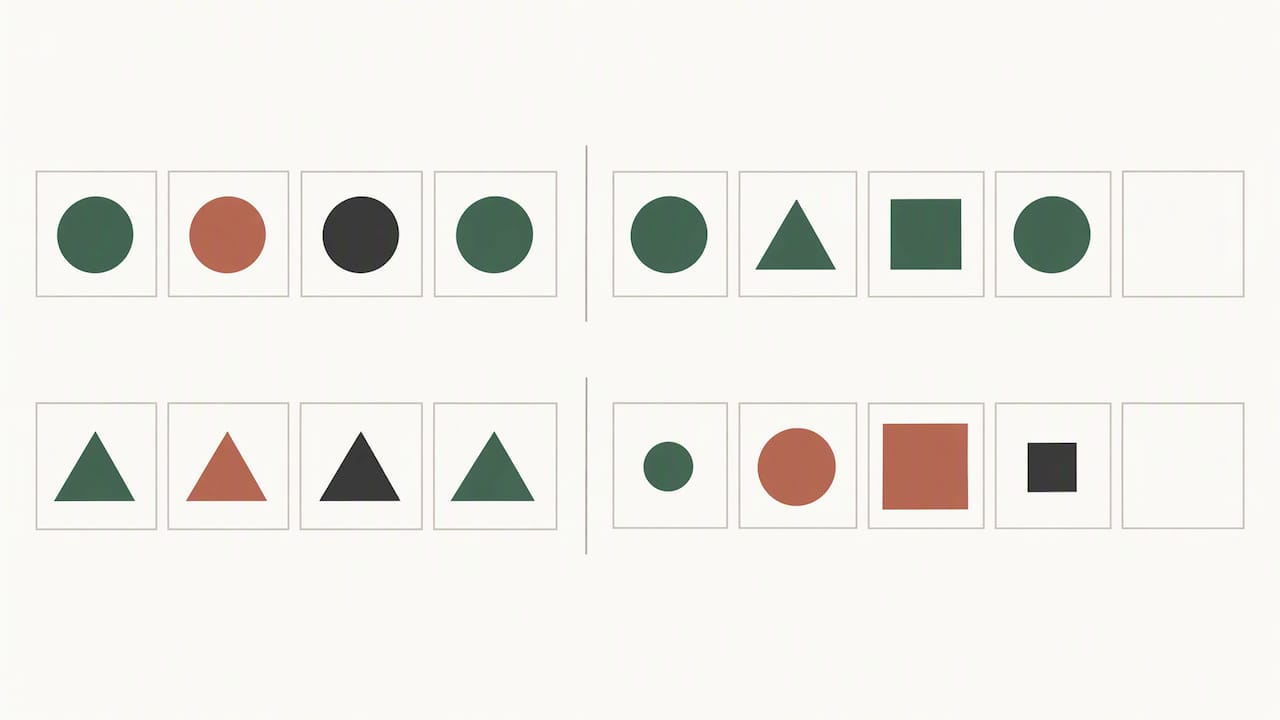
- Matrix or pattern reasoning items ask you to find the missing piece in a grid of shapes, which requires inducing the underlying rule that connects rows and columns.
- Classification items ask you to spot which shape does not belong in a set, testing your ability to group by shared features.
- Series completion items present a sequence of figures and ask what comes next, testing your ability to extend a rule rather than recall one.
- Visuo-constructive items, less common but present in some batteries, ask you to assemble or complete a figure, adding a motor and spatial-planning demand on top of pure reasoning.
Underneath these formats, the same cognitive machinery keeps showing up: encoding what you see, holding several relationships in working memory at once, abstracting a rule, and then producing a response. Research on Raven’s Progressive Matrices describes this as a multistep process in which incremental encoding and working memory management separate high scorers from low scorers as much as raw pattern recognition does.
Pro Tip: Work the simplest relationships in a matrix first (shape and color changes) before tackling items that combine three or four rules at once; it mirrors how higher scorers typically approach the same problems.
Raven’s Matrices, the Cattell CFIT, and Where You’ll Encounter Them
A handful of named instruments account for most of the culture fair testing done in research and practice.
- Raven’s Progressive Matrices, including the Standard and Colored versions, remain a common choice in cross-cultural research because they use abstract shapes rather than words or numbers. The Cattell Culture Fair Intelligence Test was built with several nonverbal subtests, including series, classification, and matrices, specifically to reduce cultural and educational loading on the score.
- The Colored Progressive Matrices use simpler, brighter items and are typically given to younger children or to adults being screened for cognitive decline, while the Standard version targets a broader age range with more demanding items.
- These instruments show up in psychological test batteries, some selective admissions screening, and large research datasets where comparing scores across language groups matters.
How to Read a Culture Fair Score Without Overreading It
Raw scores on a culture fair test, the simple count of items answered correctly, mean little on their own. Test publishers convert raw scores into scaled scores and then into percentiles or IQ-equivalent estimates using norms built from a reference sample. A tool like our IQ score converter can help you see how a raw score maps onto percentile standing across different scales.
A few points matter when you interpret a result:
- A culture fair score mainly estimates fluid reasoning, a narrower slice of cognitive ability than a full IQ battery that also measures vocabulary, working memory, and processing speed.
- Scores carry a margin of error, so two people with scores a few points apart may not differ meaningfully in ability.
- A single sitting, especially an untimed online version, should be treated as a snapshot rather than a diagnostic conclusion.
Why “Culture Free” Is Misleading: What the Research Shows
The term culture fair suggests neutrality, but an integrative review of visuo-spatial processing across cultures found measurable cultural effects at multiple steps of solving matrix items, from perception and encoding through rule abstraction and response production. That review also raises measurement invariance concerns, meaning a given score may not represent the same underlying ability across populations. A related peer-reviewed analysis found that Raven’s Progressive Matrices perform well psychometrically in educated, Western samples but show weaker validity in culturally distant populations.
Matrix reasoning tasks are widely treated as culture free, yet the processes required to solve them, including familiarity with abstract visual puzzles and specific problem-solving strategies, are themselves shaped by cultural and educational exposure.
Secular score gains over recent decades, known as the Flynn effect, are most pronounced on these supposedly culture-free tests, which points to shifting problem-solving habits across generations rather than a purely biological change in reasoning capacity. Familiarity with test materials such as pencils, grids, or puzzle formats can also shape performance independent of underlying reasoning, a pattern documented in cross-cultural testing observations. The practical implication: use a culture fair score alongside other information, and reserve proctored, professionally normed testing for decisions with real stakes.
What to Expect When You Sit Down for a Culture Fair Test
Format varies by instrument, but most culture fair tests share a predictable structure: a fixed set of items, typically several dozen depending on the scale, administered either timed or untimed. Some modern platforms use adaptive item selection, adjusting difficulty based on your previous answers, while traditional paper versions use a fixed sequence.
- Review a few sample items before starting so the format itself does not cost you time during the real test.
- Practice short, timed pattern drills in the days before a formal test to rebuild familiarity with shifting your attention between rows, columns, and diagonals; a guide to nonverbal reasoning practice outlines useful drill formats for this kind of preparation.
- Test in a quiet space on a reliable device if taking an online version, since interruptions and lag affect timed sections disproportionately.
- Choose a proctored clinical test rather than a quick online version when the result will inform a diagnosis, an employment decision, or a formal admissions process.
Pro Tip: Simulate a full-length section under timed conditions at least once before test day; pacing errors, not reasoning errors, cause most of the point loss on timed matrix tests.
A Practical Take on Culture Fair Testing
We think the most useful stance on culture fair tests is a cautious one: they are a genuine improvement over purely verbal IQ measures for cross-cultural comparison, but calling them culture free overstates what the evidence supports. Pair a quick online practice session with professional testing whenever a decision carries real consequences, and use our free IQ tools to build context around any single score before drawing conclusions from it.
— Steve
Try a Quick Online Assessment With a Detailed Report
Our 50-question IQ assessment gives you an initial score range with no sign-up required, which makes it a practical starting point if you want a sense of your reasoning profile before deciding whether to pursue formal testing.
- The free version returns an initial score range right after you finish.
- Unlocking the Full IQ Result adds your exact score, percentile standing, and a breakdown across five cognitive domains.
- A detailed report also connects your cognitive profile to live job listings through our career-matching tool, which is useful context alongside any culture fair style score you encounter elsewhere.
These results are built for informational and personal development purposes, not clinical diagnosis or formal employment qualification. If you want the full picture, including domain-level detail and percentile context, visit our pricing page to see current options.
FAQ
What is the culture-fair test of intelligence?
A culture fair intelligence test is a nonverbal assessment, usually built from matrix, series, and classification items, designed to measure fluid reasoning while minimizing the influence of language and formal education. The best-known example is the Cattell Culture Fair Intelligence Test, which combines several nonverbal subtests into one scale.
Is an IQ of 127 gifted?
A score in the superior range falls well above average on most standard IQ scales, with “gifted” classification criteria varying by school district and testing organization. We recommend checking the specific criteria used by the institution requesting the score rather than relying on a single threshold.
How do you interpret Culture Fair Intelligence Test results?
CFIT raw scores convert to scaled scores and then to percentile or IQ-equivalent estimates using the test’s normative sample, and the result mainly reflects fluid reasoning rather than broader cognitive ability. Because the test carries a margin of error and known measurement invariance concerns across cultural groups, we suggest treating any single result as one input among several rather than a definitive measure.
What are the differences between culture-fair and classical IQ tests?
Classical IQ tests, such as full-scale batteries, measure multiple domains including vocabulary, working memory, and processing speed, often through verbal or knowledge-based questions. Culture fair tests narrow their focus to nonverbal matrix and pattern reasoning specifically to reduce the weight that language and education place on the score, though research shows this reduction is partial rather than complete.
Sources
- Cross-cultural differences in visuo-spatial processing and the culture-fairness of visuo-spatial intelligence tests: an integrative review and a model for matrices tasks
- Cross-cultural differences in visuo-spatial processing and the culture-fairness of visuo-spatial intelligence tests: an integrative review and a model for matrices tasks
- A knowledge-based theory of rising scores on ‘culture-free’ tests