Cognitive Domains in IQ Tests: What Each Score Measures

An IQ test does not measure one thing. It samples several cognitive domains, usually verbal comprehension, visual-spatial or perceptual reasoning, fluid reasoning, working memory, and processing speed, and then combines them into a Full Scale IQ. The domain scores often tell you more than the total, because they show where your strengths sit and how far apart they are. Our 50-question IQ assessment follows the same logic: you see a broad result category for free, and the exact IQ, percentile context and five-domain breakdown unlock for $9.99 once per result.
TL;DR
- Modern Wechsler-style tests report index scores for verbal comprehension, visual-spatial or perceptual reasoning, fluid reasoning, working memory and processing speed, plus a Full Scale IQ.
- “Verbal vs performance” is the older Wechsler split. Current versions replaced it with domain indices, and “nonverbal” describes how a task is presented, not a separate kind of intelligence.
- Working memory is holding and manipulating information; processing speed is how fast you complete simple tasks accurately. They are scored separately.
- On most tests the mean is 100 and one standard deviation is 15 points, so each domain score can be read as a percentile.
- A large gap between domains makes a single total less informative. Read the profile first.
Table of Contents
- The domains an IQ test commonly measures
- What perceptual reasoning means
- Verbal IQ vs performance IQ, and verbal vs nonverbal IQ
- Verbal vs spatial ability
- Processing speed vs working memory
- How domain scores become percentiles
- Uneven profiles: how to read gaps between domains
- Online tests and individually administered tests
- Our perspective
- See your own domain profile
- FAQ
- Sources
The domains an IQ test commonly measures
The most widely used individual test for children, the WISC-V, has 14 subtests that form five indices: Verbal Comprehension, Visual Spatial, Fluid Reasoning, Working Memory and Processing Speed. The test-taker receives a score for each index and a Full Scale IQ, which OpenStax’s psychology text describes as reflecting intelligence as multiple abilities across several realms. A 2024 guide to the adult version, the WAIS-5, lists the same five domains for ages 16 through 90.
Earlier versions grouped things differently. The WISC-IV and WAIS-IV reported four composites: verbal comprehension, perceptual reasoning, working memory and processing speed. That is why you will see “perceptual reasoning” in older reports and “visual spatial” plus “fluid reasoning” in newer ones. The split of one older domain into two is the main difference.
The underlying idea comes from Cattell-Horn-Carroll (CHC) theory. As described in an introductory psychology text, CHC places general intelligence at the top, about 16 intermediate abilities such as processing speed, reasoning, memory and acquired knowledge below it, and more than 70 narrow abilities beneath those. Test publishers choose subtests to sample the middle layer.
The same structure appears outside the clinic. The U.S. Office of Personnel Management notes that cognitive ability tests used in hiring measure general mental ability plus specific abilities such as verbal analogies, reading comprehension, number series and spatial relations.
| Domain | What it asks you to do | Typical task |
|---|---|---|
| Verbal comprehension | Use word knowledge and verbal reasoning | Define words, explain how two things are alike |
| Visual spatial / perceptual reasoning | Analyze and build visual patterns | Assemble blocks to match a design |
| Fluid reasoning | Solve unfamiliar problems by rule and logic | Matrix puzzles, number series |
| Working memory | Hold information and work with it | Repeat digits forwards, backwards, in order |
| Processing speed | Complete simple visual tasks quickly and accurately | Match symbols to digits under a time limit |
What perceptual reasoning means
Perceptual reasoning is the older Wechsler label for nonverbal problem solving with visual material. A reference entry on the WISC-IV Perceptual Reasoning Index describes it as examining nonverbal fluid reasoning: working through novel problems, spotting rules and logical relationships, and testing solutions. It was derived from Block Design, Picture Concepts and Matrix Reasoning.
In practice, a high perceptual reasoning score means you handle new visual puzzles well without needing words to do it. A lower one does not mean you are “bad at thinking”. It means that this kind of task, at this sitting, produced a lower result than your other domains.
Verbal IQ vs performance IQ, and verbal vs nonverbal IQ
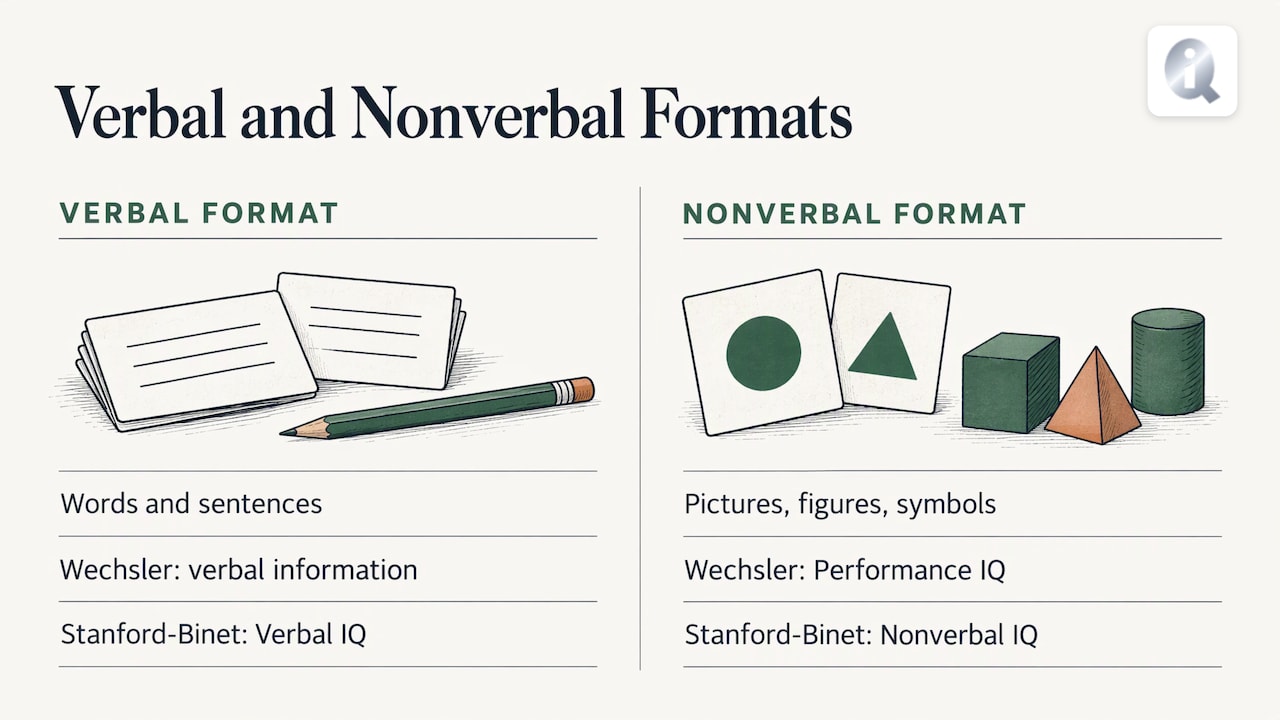
David Wechsler’s original model divided intelligence into two parts. As Psychology Today’s overview summarizes, Verbal IQ represented the ability to use verbal information and Performance IQ represented nonverbal abilities. Together they gave the Full Scale IQ. Current Wechsler tests no longer report those two scores and use the domain indices above.
The Stanford-Binet 5 keeps a two-part view under different names. According to its sample descriptive report, Verbal IQ covers reasoning, problem solving, visualizing and recalling information presented in words and sentences, while Nonverbal IQ covers the same abilities with information presented as pictures, figures and symbols. When the two are not significantly different, the Full Scale IQ is the most prominent score to interpret.
The key point is in the label. A chapter on IQ interpretation by Gary Canivez explains that the Wechsler verbal and performance measures were different ways of measuring intelligence, not different types of it, and quotes Naglieri: nonverbal refers to the content of a test, not a type of ability. So “verbal vs nonverbal” is a question of format. Both feed the same general factor.
Verbal vs spatial ability
Spatial ability is the capacity to generate, rotate and transform visual images in your head. A 2021 review in PMC conceptualizes intellect as three broad but correlated domains, verbal, numerical and spatial, and reports that spatial ability plays an important role in academic achievement, especially in STEM learning.
Because the domains are correlated, most people score in a similar range on each. But a gap can matter. Scientific American reports that verbally loaded tests often fail to capture spatial ability, so a person with strong spatial skills can go unrecognized. If you are weighing fields such as engineering, design or surgery, the spatial score is worth reading on its own.
Processing speed vs working memory
These two sit next to each other on the score report and are easy to confuse.
- Working memory is the ability to hold information in mind and do something with it. Digit Span is the classic subtest: repeat a string of numbers forwards, then backwards, then in ascending order.
- Processing speed is how quickly and accurately you carry out simple, well-learned tasks. On the WAIS-IV, Symbol Search and Coding make up the Processing Speed Index, while Digit Span is among the working memory measures.
The practical difference: working memory is about how much you can juggle, processing speed is about how fast you can execute. You can be quick at copying symbols and still struggle to hold a long instruction in mind, or the reverse. The two also carry different weight in the total. The WISC-IV doubled the weight of processing skills in the Full Scale IQ compared with earlier editions, according to a position paper from the National Association for Gifted Children.
How domain scores become percentiles
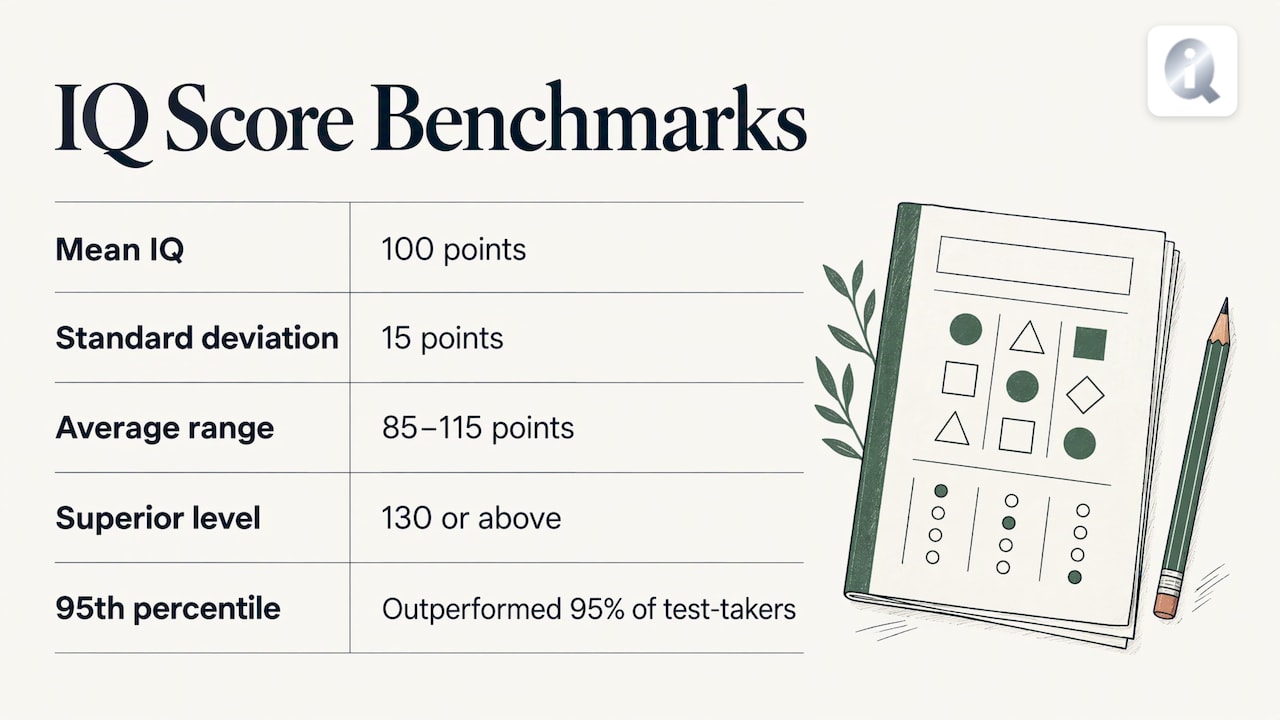
Domain scores use the same scale as the total. On most IQ tests the mean is 100 and one standard deviation is 15 points, so scores from 85 to 115 are average and cover 68% of the population, and 130 or above is a superior level. Subtest results are first converted to scaled scores against a standardized mean and then to percentile ranks. A 95th-percentile result means you outperformed 95% of test-takers, and the composite indices share the 100-and-15 scale.
To see where a score falls, use our IQ percentile calculator or the IQ percentile chart for scores 70 to 160. For the statistics behind the curve, see our explanation of the IQ score distribution. If your scores come from different tests, the IQ score converter puts them on one scale.
A worked example: a verbal comprehension index of 115 sits at about the 84th percentile, one standard deviation above the mean. A processing speed index of 100 sits at the 50th. The 15-point gap is exactly one standard deviation, large enough to notice in a profile and still common in the general population.
Uneven profiles: how to read gaps between domains
Uneven strengths are normal enough that test publishers build rules around them. The NAGC paper reports that a majority of gifted children show considerable variability across WISC-IV index scores. It cites Flanagan and Kaufman (2004) in treating the Full Scale IQ as not interpretable when composite scores differ by 23 points (1.5 standard deviations) or more, and recommends the General Ability Index, which uses only the verbal and perceptual reasoning composites, in that case.
What this means for you:
- Look at the spread before the total. If your highest and lowest domains are within about 15 points, the Full Scale IQ is a fair summary. If they are 23 or more apart, the profile is the result.
- Treat the score as a snapshot. Psychology Today’s discussion notes that a single number can misrepresent abilities when the four domains diverge, and that scores reflect functioning at test time, which fatigue, hunger, pain or stress can affect.
- Match the domain to the question. A student who struggles to follow multistep instructions should look at working memory. A person choosing between roles that reward quick visual checking and roles that reward deep reasoning should compare processing speed with fluid reasoning.
For children, subtest patterns can guide support at school. Our readers who want a practical starting point can read these learning tips for dyslexia. Any decision about a child’s diagnosis or accommodations belongs with a school psychologist or a licensed clinician who has administered an individual test.
Online tests and individually administered tests
The WAIS-IV is given one-on-one by a trained examiner in 60 to 90 minutes with 10 core subtests. An online assessment cannot replicate that session, and for a clinical, legal or educational placement decision you need the individual test. For understanding your own cognitive strengths, exploring careers or getting a reasoned estimate, an online assessment that reports domains is a practical start. Our scoring methodology and validity and reliability page set out how our scores are calculated.
Our perspective
We built the IQ Career Lab assessment around a simple observation: a single number hides the information most people want. When someone asks what their IQ is, they usually mean what they are good at and where that leads.
That is why the paid unlock is a breakdown, not only a figure. For $9.99, once per completed result and not a subscription, you get your exact IQ, percentile context, a five-domain breakdown, a personalized report, a verifiable certificate and Career Matches. The domain view is the part that lets you compare your own strengths against each other.
Read the profile first and the total second. If you add the free Big Five personality assessment, you can set cognitive strengths beside work-style traits and see the two together.
Steve
See your own domain profile
The 50-question IQ assessment needs no account and gives you a broad result category straight away. Unlocking the Full IQ Result for $9.99 adds the exact score, percentile context and five-domain breakdown. If you also want your work style, the Big Five personality assessment is free with sign-in, and Personality Full Access is $14.99 once per result.
Once you have a profile, the Career-IQ Matcher shows how cognitive scores line up with careers.
FAQ
What are the five cognitive domains in an IQ test?
The WISC-V and WAIS-5 report verbal comprehension, visual spatial, fluid reasoning, working memory and processing speed. Each gets an index score, and together they produce the Full Scale IQ. Older Wechsler tests combined visual spatial and fluid reasoning into perceptual reasoning, giving four domains.
Is verbal IQ more important than performance IQ?
Neither is more important. Wechsler’s verbal and performance scores were two ways of measuring the same underlying intelligence, and the modern tests replaced them with domain indices. What matters is whether your domain scores are close together or far apart.
Can I be strong in one domain and weak in another?
Yes. Uneven profiles are common, and a gap of 23 points or more between composites is the point at which the Full Scale IQ is considered not interpretable on the WISC-IV. In that case the individual domain scores carry the meaning.
Does a domain score mean the same thing as a percentile?
They are linked. With a mean of 100 and a standard deviation of 15, a domain score of 115 is about the 84th percentile and 130 is about the 98th. A percentile tells you the share of the norm group you outscored.
Sources
- 7.5 Measures of Intelligence, Psychology 2e (OpenStax)
- Cognitive Ability Tests (U.S. Office of Personnel Management)
- WAIS Test: The Wechsler Adult Intelligence Scale (Mental Health.com)
- Testing and Intelligence, Introduction to Psychology 4th edition
- Perceptual Reasoning Index (Springer reference entry)
- What’s in a Number? (Psychology Today)
- Stanford-Binet Intelligence Scales, Fifth Edition, sample descriptive report
- IQ Interpretation chapter (Canivez, 2013)
- Why spatial is special in education, learning, and everyday activities (PMC)
- Recognizing Spatial Intelligence (Scientific American)
- WISC-IV position paper (National Association for Gifted Children)
- WAIS-IV study (NSUWorks)
- Learning tips for dyslexia