Brain Training and IQ: What the Research Shows

Brain training reliably improves performance on the tasks you practice, but the best available evidence does not show that it raises general intelligence or your IQ. A 2018 review in Trends in Cognitive Sciences reached the same conclusion: cognitive training does not enhance general cognition. Below we separate what brain games do, what they do not do, how working memory fits in, and which activities have better support.
TL;DR
- Brain games and apps produce near transfer (better at the practiced task) but no dependable far transfer to general intelligence or IQ scores.
- A 2024 meta-analysis found only small working-memory gains after training (SMD = 0.18), and much larger ones only when the outcome task resembled the training task.
- Education has the strongest research link to higher IQ test scores, at roughly 1 to 5 points per additional year in one analysis.
- Practicing IQ-style questions can raise a score, but it makes that score a weaker measure of underlying ability.
- If you use an app anyway, judge it on placebo-controlled evidence, not marketing, and weigh the cost against exercise and learning new skills.
Table of Contents
- Key Takeaways on Brain Training and IQ
- Do Brain Games Increase IQ?
- Working Memory and IQ
- Can You Improve Your IQ at All?
- Does Practicing IQ Tests Raise Your Score?
- Do the Gains Last?
- Choosing a Working-Memory App or Test Sensibly
- What Has Better Support Than Brain Games
- Perspective
- Understand Your Own Score Before You Try to Change It
- FAQ
- Sources
Key Takeaways on Brain Training and IQ
Three distinctions organize the whole topic, and most confusion online comes from blurring them.
- Task performance versus general ability. Getting better at a memory game is not the same as becoming more intelligent.
- Practice effects versus real change. A higher score on a repeated test can reflect familiarity with the format.
- Short-term versus lasting effects. Gains from mental exercise tend to fade when the exercise stops.
The sections below take each in turn, with the sources.
Do Brain Games Increase IQ?
In general, no. The research distinguishes two kinds of transfer. Near transfer means improvement on tasks similar to the training. Far transfer means improvement on different abilities, such as reasoning, school performance or an IQ test. Cognitive training reliably produces the first and, according to the Trends in Cognitive Sciences review, there is no solid evidence for the second.
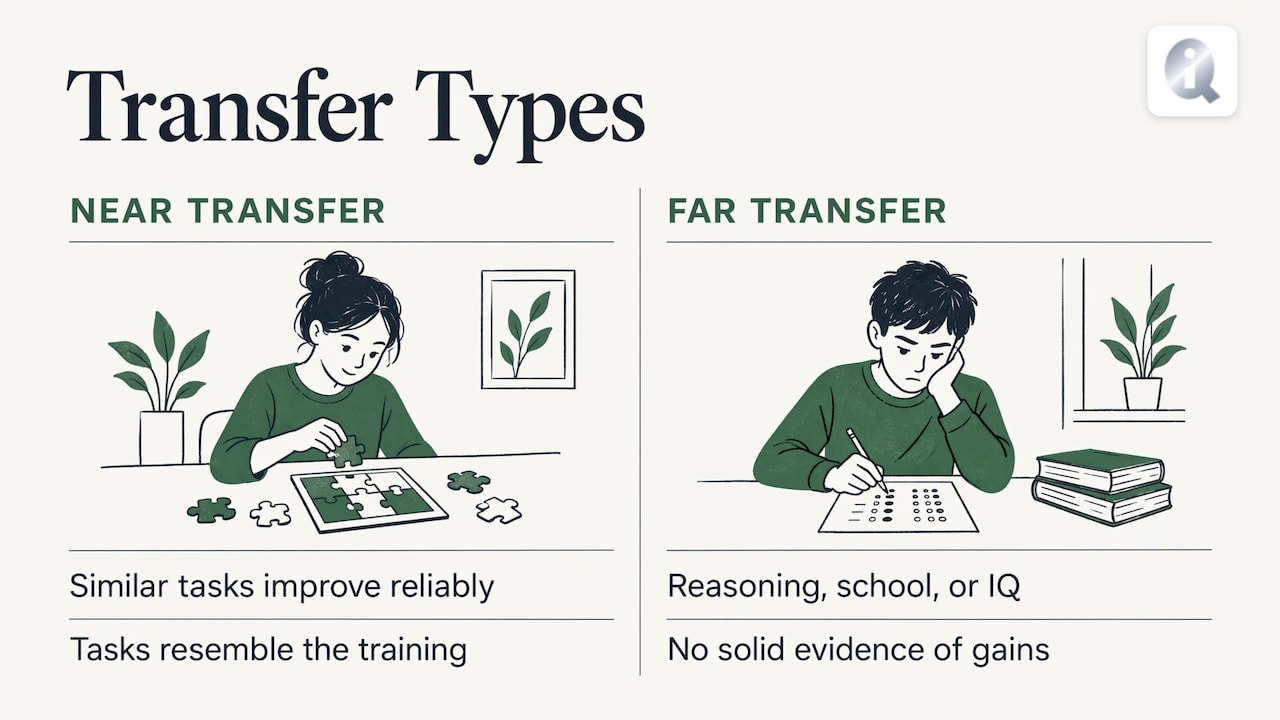
A 2022 review by Gobet and Sala goes further. The authors conclude that the field has maintained unrealistic optimism by neglecting meta-analyses and by reading statistical artifacts as meaningful cognitive gains. They argue that far-transfer effects are null and that apparent effects can come from sampling error and similar artifacts.
The commercial side moved faster than the science. Psychologist David Z. Hambrick noted in Scientific American that the brain-training industry was estimated at $1.3 billion in spending by 2014, despite the lack of solid evidence for benefits.
Why Some Studies Report Big Gains
Positive headlines usually trace back to study design. According to a meta-analysis of working-memory training, many studies compare trainees with a no-contact control group, meaning people who do nothing, instead of an active placebo group that also does something engaging. Without an active control, expectation and motivation can inflate the apparent benefit. The Association for Psychological Science makes the same point in its guidance on brain-training programs: consumers should weigh the scientific quality of the supporting studies above promotional claims.
The same logic applies to evidence reviews of game-based learning in general. A write-up on gamified studying benefits discusses how small, task-specific effects and study design shape what such tools can honestly claim, which is a useful frame for reading any brain-game study.
Working Memory and IQ
Working memory is the ability to hold and manipulate information over a few seconds, such as repeating a phone number backward or tracking several rules at once. It is one of the cognitive abilities that intelligence testing samples, which is why working-memory training looks like an attractive shortcut: if the ability can be trained, perhaps the score follows. The data do not support that chain.
- A meta-analysis in Psychological Science found no good evidence that working-memory training improves intelligence test scores or other real-world cognitive skills. Effects were short-term and specific to the trained tasks.
- A 2024 meta-analysis by Rodas, Asimakopoulou and Greene found only small working-memory improvements after training (SMD = 0.18). Effects were much larger (SMD = 1.15) only when the assessment tasks resembled the training tasks, which the authors read as evidence of significant bias in the literature.
- The same 2024 analysis found that program characteristics, including dosage and the type of exercise, had no significant effect on effectiveness. More hours or a different game format did not rescue the result.
In plain terms: you can become better at a digit-span or n-back style game. The evidence does not show that this raises the underlying capacity that an IQ test is meant to sample.
Reading the Effect Sizes
A standardized mean difference (SMD) expresses a group difference in standard-deviation units. An SMD of 0.18 is small, and the gap between 0.18 and 1.15 in the 2024 analysis is the key finding. It shows that the size of a training effect depends heavily on how close the outcome measure is to the practiced task, which is the definition of near transfer.
| Outcome measured | What the research reports |
|---|---|
| Same or similar task as the training | Large gains (SMD = 1.15 in the 2024 meta-analysis) |
| Working memory on dissimilar tasks | Small gains (SMD = 0.18) |
| Intelligence test scores and real-world cognition | No good evidence of improvement |
| Persistence after training stops | Gains tend to fade |
Can You Improve Your IQ at All?
Yes, in some circumstances, but not through brain games. Two points need to be held together.
Scores are fairly stable, not fixed. According to a Psychology Today review, IQ test scores are quite stable once people reach their early teens, although relative rankings are not identical from one testing to the next. A BOLD article adds that individual scores fluctuate across the lifespan, so they are not a measure of a fixed, immutable ability.
Education is the best-supported lever. A 2018 analysis by Ritchie and Tucker-Drob found that longer education is associated with higher IQ test scores, with each additional year estimated to add roughly 1 to 5 points. The Psychology Today piece cites an estimate of two to three points per year. These are population-level estimates, not guarantees for any one person.
Fluid and Crystallized Intelligence
Hambrick distinguishes two components in Scientific American. Learning new skills, such as playing a musical instrument or cooking, is an effective way to build crystallized intelligence, the accumulated knowledge and skill. Fluid intelligence, the capacity to reason through novel problems, remains difficult to enhance. The same article points to work by Arthur Kramer indicating that aerobic exercise has better support for improving cognitive functioning than commercial brain games.
Why a Change of 3 Points Is Hard to Interpret
Richard Haier argues in a 2014 paper that intelligence tests are interval scales, not ratio scales. A move from 100 to 103 is therefore not necessarily equivalent to a move from 133 to 136, and treating IQ like a physical measurement such as height misleads. Earl Hunt adds, in the Psychology Today review, a law of diminishing returns: the higher your starting performance, the harder further gains become.
For score interpretation, our guide to the IQ score distribution, bell curve and percentiles explains why a few points matter differently at different places on the curve.
Does Practicing IQ Tests Raise Your Score?
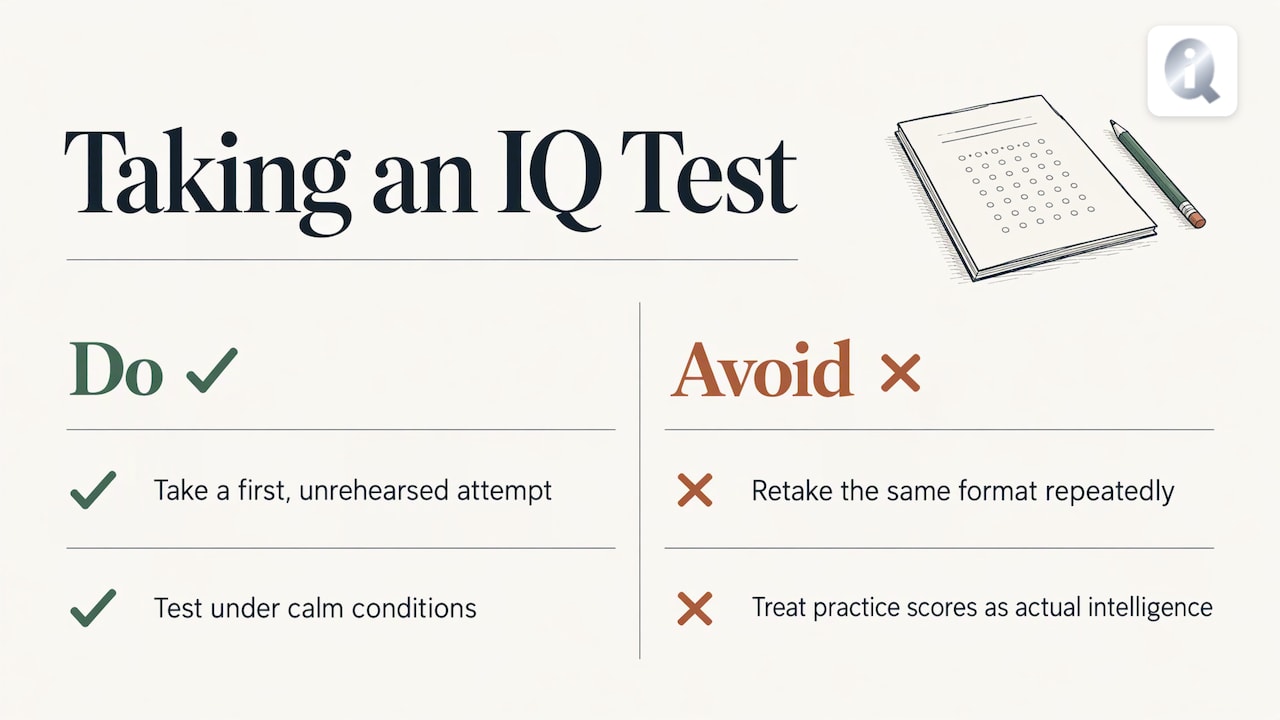
It can, and that is a separate effect from brain training. Researchers Sala and Gobet explain in The Conversation that practicing on IQ tests can raise scores by familiarizing people with the logic of the questions. They note that this makes the resulting scores uninterpretable as measures of actual intelligence.
For anyone taking an assessment, the practical consequence is straightforward. Retaking the same format repeatedly measures familiarity with the format. A first, unrehearsed attempt under calm conditions is the cleaner reading. Anxiety is another factor that can distort a single result, and we cover it in IQ test anxiety: what the research shows.
Do the Gains Last?
Usually not. Hunt compares mental exercise to physical fitness in the Psychology Today review: temporary cognitive effects can appear, then fade once the exercise ceases. Combined with the working-memory findings above, the pattern is consistent. Task-specific improvements appear, they are short-lived, and they do not reliably carry over to everyday cognitive skills.
Choosing a Working-Memory App or Test Sensibly
Some readers will use a working-memory app regardless, for enjoyment or routine. That is a reasonable personal choice if expectations match the evidence. These criteria follow the guidance in the Association for Psychological Science summary and Hambrick’s Scientific American analysis:
- Look for placebo-controlled evidence. Studies should compare against an active control, not only a no-contact group.
- Check the outcome measure. Gains on tasks resembling the training are expected and say little about general ability.
- Check for independent replication. Claims that rest on one company’s own study carry less weight than meta-analytic findings.
- Count the opportunity cost. Hambrick points out that time and money spent on unproven apps could go to exercise or learning complex new skills.
- Keep the goal realistic. Expect a better score on the game, not a higher IQ.
Working-Memory Tests Versus Training
A working-memory test measures where you stand today. Common formats ask you to recall digit sequences, reverse them, or track repeated items across a stream. Used once, such a task describes a current ability. Used repeatedly as training, it mostly builds skill at that task. Keeping measurement and training apart is the central methodological rule in this field.
What Has Better Support Than Brain Games
- Formal education and sustained learning. The strongest association with IQ test scores in the research above.
- Learning complex new skills. Instruments, cooking and similar skills build crystallized knowledge.
- Aerobic exercise. Better supported for cognitive functioning than commercial brain games, according to the work Hambrick summarizes.
- Spatial practice that is specific by design. If your goal is a particular skill, such as mental rotation, targeted practice is legitimate as long as you treat it as skill-building. Our mental rotation test and spatial skills guide shows sample items.
Perspective
Our position is simple. A score is only worth having if it measures something, and the way to protect that is to keep measurement separate from practice.
We designed our 50-question IQ assessment to be taken without an account, so the first result reflects a fresh attempt. The broad result category is free. The exact score, percentile context, five-domain breakdown, report and verifiable certificate unlock for $9.99 once per completed result, and it is not a subscription.
The five-domain breakdown matters here. A single number cannot show where you are strong, but a profile can, and profiles are what help people choose study paths, skills to learn and careers to explore. We would rather help you understand your cognitive strengths than sell you a promise that a game will move them.
Steve
Understand Your Own Score Before You Try to Change It
If you are curious where you stand, the useful first step is a clean baseline. Our 50-question IQ assessment gives a broad result category without creating an account. Unlocking the full result at $9.99, one time per completed result, adds your exact IQ, percentile context, a five-domain breakdown, a personalized report, a verifiable certificate and Career Matches.
You can see the details on the Full IQ Result pricing page. If you are also interested in work style, the separate Big Five personality assessment is free with sign-in, and Personality Full Access is $14.99 once per result. For context on how scores relate to jobs, see our average IQ by profession tool.
FAQ
Can brain training raise my IQ?
The best evidence says no. Reviews and meta-analyses find that training improves the practiced tasks but not general intelligence or IQ test scores. Education and learning new skills have stronger support.
Do brain games help with working memory?
Only modestly. A 2024 meta-analysis found small gains (SMD = 0.18) overall, and large gains only when the outcome task resembled the training task. That pattern indicates task-specific learning rather than a broader capacity change.
Is it worth paying for a brain-training app?
That depends on your goal. If you want a higher IQ, the evidence does not support the expectation. If you enjoy the game, treat it as entertainment and compare the cost with exercise or learning a new skill, which Hambrick identifies as better uses of time and money.
Can my IQ score change over time?
Scores are fairly stable after the early teens, yet they fluctuate across the lifespan and rankings shift somewhat between tests. Part of any change can also be a practice effect, which does not reflect real ability.
Sources
- Cognitive Training Does Not Enhance General Cognition (Trends in Cognitive Sciences, 2018)
- Cognitive Training: A Field in Search of a Phenomenon (2022)
- Brain Training Doesn’t Make You Smarter (Scientific American)
- Working Memory Training Does Not Improve Performance on Measures of Intelligence (2016)
- Do “Brain-Training” Programs Work? (Association for Psychological Science)
- Can we enhance working memory? Bias and effectiveness (2024)
- Improving Intelligence (Psychology Today)
- The fluctuation of IQ (BOLD)
- How Much Does Education Improve Intelligence? (2018)
- Increased intelligence is a myth (so far) (2014)
- IQ tests: can you improve your score by practising? (The Conversation)
- Gamified Studying Benefits: Evidence and Practical Tips