Big Five vs MBTI: Which Personality Test Holds Up?

The Big Five and the MBTI answer the same question in different ways. The Big Five places you on five continuous trait scales. The MBTI sorts you into one of 16 four-letter types. For prediction and consistency, the research favors the Big Five. The MBTI is better known and easier to talk about, but its binary structure and unstable results limit what you can conclude from it. This article compares the two on structure, evidence and practical use, and explains where HEXACO, a six-factor alternative, fits.
TL;DR
- The Big Five (OCEAN) measures Openness, Conscientiousness, Extraversion, Agreeableness and Neuroticism as continuous scales. The MBTI assigns one of two poles on four dimensions, producing 16 types.
- In a study reported by Scientific American, the Big Five was about twice as accurate as an MBTI-style test at predicting life outcomes.
- Studies find that a large share of people (39% to 76%) receive a different MBTI type when they retake it after five weeks.
- HEXACO adds a sixth dimension, Honesty-Humility, and is often discussed as a refinement of the Big Five rather than a rival to it.
- Use the MBTI, if at all, for low-stakes reflection. Do not use any personality test as the sole basis for hiring, firing or career decisions.
Table of Contents
- What each model measures
- How the two describe personality differently
- What the research says about accuracy
- Has the MBTI been debunked?
- Where HEXACO fits
- How to use personality results sensibly
- Our perspective
- Take the Big Five and see your own percentiles
- FAQ
- Sources
What each model measures
Before comparing accuracy, it helps to see how differently the three models are built.
| Feature | Big Five (OCEAN) | MBTI | HEXACO |
|---|---|---|---|
| Number of dimensions | 5 | 4 | 6 |
| Type of scale | Continuous (percentiles along a range) | Binary (one of two poles per dimension) | Continuous |
| Output | Trait scores | One of 16 four-letter types | Trait scores |
| Dimensions | Openness, Conscientiousness, Extraversion, Agreeableness, Neuroticism | E/I, S/N, T/F, J/P | Honesty-Humility, Emotionality, eXtraversion, Agreeableness, Conscientiousness, Openness |
The Big Five
The Big Five, also called the Five-Factor Model, describes personality along five continuous trait dimensions: Openness (curiosity and willingness to entertain new ideas), Conscientiousness (self-control, diligence and attention to detail), Extraversion (energy and social interactivity), Agreeableness (kindness and willingness to cooperate) and Neuroticism (proneness to anxiety and irritability). Nobody “is” an extravert or an introvert in this model. Everyone sits somewhere on a range, and most people land near the middle. For a fuller walkthrough of each scale, see our guide to the five dimensions of personality.
The MBTI
The Myers-Briggs Type Indicator measures four binary preference dimensions: Extraversion/Introversion, Sensing/Intuition, Thinking/Feeling and Judging/Perceiving. Each person is placed on one side of each pair, and the four letters combine into 16 types such as ISTJ or ENFP.
HEXACO
HEXACO measures six continuous dimensions: Honesty-Humility, Emotionality, eXtraversion, Agreeableness, Conscientiousness and Openness to Experience, with four facets inside each factor. We return to it below.
How the two describe personality differently
The core difference is not the number of letters. It is the assumption about how people vary.
Continuum versus category. The Big Five assumes that traits are spread along a range, with most people in the middle. A person at the 55th percentile for Extraversion and a person at the 45th percentile are nearly identical. The MBTI, by contrast, places those two people on opposite sides of a line and gives them different letters. A tiny difference in answers can therefore change a whole type, which is one reason results shift on retesting.
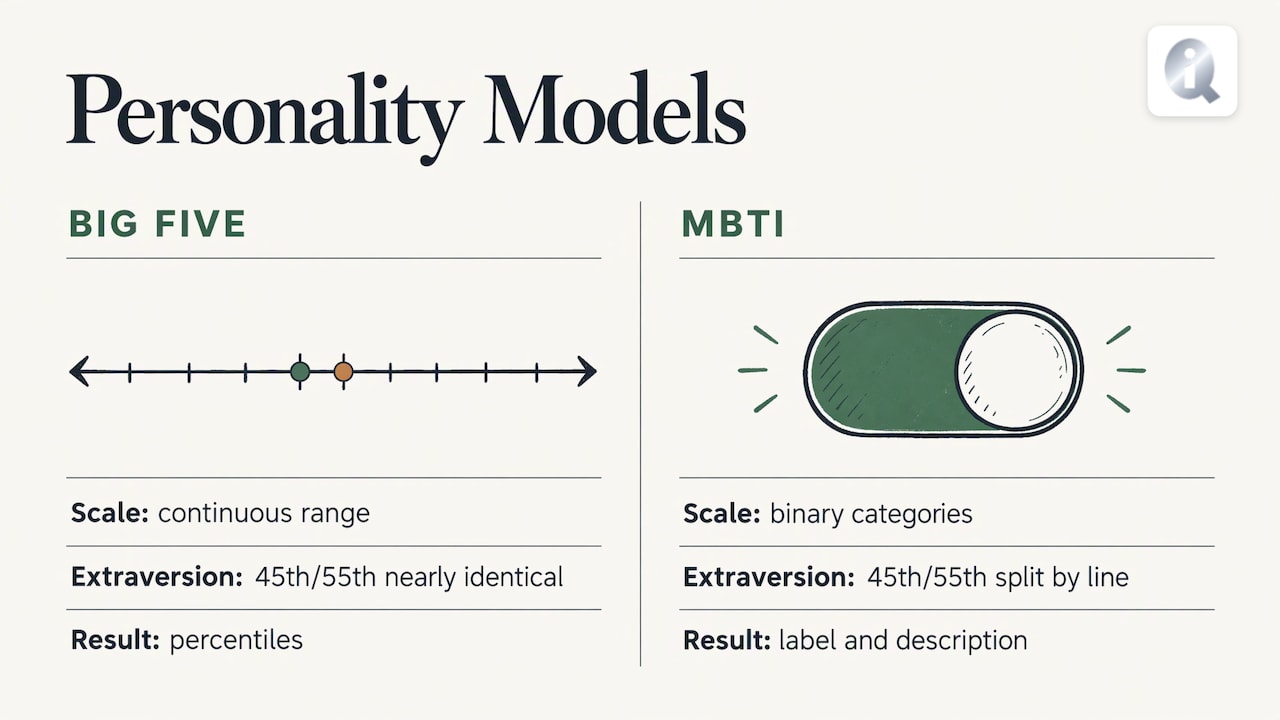
Traits versus preferences. The Big Five reports how strongly you show a trait, such as how organized or how anxious you tend to be. The MBTI frames its dimensions as preferences in how you take in information and make decisions. This is the distinction readers often describe as “conscious traits versus unconscious ways of judging,” but it is a theoretical framing. In practice, both tests ask you to rate your own behavior and attitudes in a questionnaire.
Coverage of emotional stability. The Big Five includes Neuroticism, a dimension that captures emotional reactivity and anxiety proneness. The MBTI has no equivalent scale, so it says nothing about this part of personality. Neuroticism matters in practice: the Big Five literature links it to outcomes such as self-harm and suicidal behavior, and a test that omits it leaves out a major source of difference between people.
Language of the result. A Big Five report lists percentiles. An MBTI report gives a label and a description. Labels are memorable and feel personal, which explains much of the MBTI’s popularity, while percentiles require a little statistical literacy to read. If you want help with that, our article on IQ and personality research explains how scores relate to one another.
What the research says about accuracy
Prediction of life outcomes
The most cited recent comparison is a study reported by Seth Stephens-Davidowitz and Spencer Greenberg in Scientific American. They found that the Big Five was about twice as accurate as an MBTI-style test at predicting life outcomes. They also reported that the MBTI-style test would be about 38 percent better at predicting major outcomes if it did not dichotomize people’s traits. In other words, a large part of the gap comes from forcing a continuous trait into two boxes. We summarize this finding in more detail in our breakdown of personality test accuracy.
Generalization across groups
A 2020 study by Soto used nationally representative U.S. samples (N = 6,126) and found that about 89% of nontrivial trait-outcome associations generalized across men and women, 77% across young-adult and age-representative samples, and 85% across non-Hispanic White and other racial and ethnic groups. That is a useful property for a test used with a diverse public.
Internal consistency
Internal consistency tells you whether the items on a scale hang together. A 2025 reliability generalization meta-analysis covering 57 studies and 43,715 participants reported BFI-2 estimates of 0.83 for openness, 0.86 for conscientiousness, 0.85 for extraversion, 0.80 for agreeableness and 0.89 for neuroticism. The same analysis reported estimates between 0.73 and 0.80 for the older 44-item Big Five Inventory. These are solid values for self-report scales, and they show that the quality of a Big Five instrument depends on which version you take.
Stability and replication
The five-factor structure has been replicated across cultures and over time, and conscientiousness is associated with job performance. This replication across independent samples is a key reason researchers treat the Big Five as the working standard for trait description.
Has the MBTI been debunked?
The fair answer is that the MBTI’s measurement problems are well documented, so many psychologists do not treat it as a rigorous scientific instrument. A 2026 Psychology Today article notes that psychologists have repeatedly argued that the Myers-Briggs has minimal predictive ability and rests on a debunked theory, and that retaking it often produces different answers.
The specific weaknesses reported in the literature are these:
- Retest instability. Between 39% and 76% of respondents obtain a different type when they retake the indicator after only five weeks. A systematic review of studies from 2017 to 2025 found that roughly half of retakers within five weeks receive a different four-letter type, with Thinking/Feeling and Judging/Perceiving particularly unstable.
- Uneven validity across scales. A 1991 National Academy of Sciences review found that only the E/I scale had adequate construct validity, while S/N and T/F showed relatively weak validity, according to the same human capital review.
- Binary oversimplification. Splitting a continuous range at the midpoint turns small differences into different types.
- Omitted traits. There is no scale for emotional stability, as described above.
This does not make the MBTI worthless as a conversation starter. The same review says it may be used in low-stakes settings, but not for hiring or other consequential organizational choices. That is the line we also draw.
Where HEXACO fits
Searchers who compare the Big Five with the MBTI often meet a third name, HEXACO. It is not a replacement for either test so much as a variation on the Big Five’s trait-based approach.
HEXACO’s distinguishing feature is its sixth domain, Honesty-Humility, together with somewhat different definitions of Agreeableness and Emotionality. Honesty-Humility covers traits such as sincerity, fairness and modesty, which the Big Five spreads thinly across other scales.
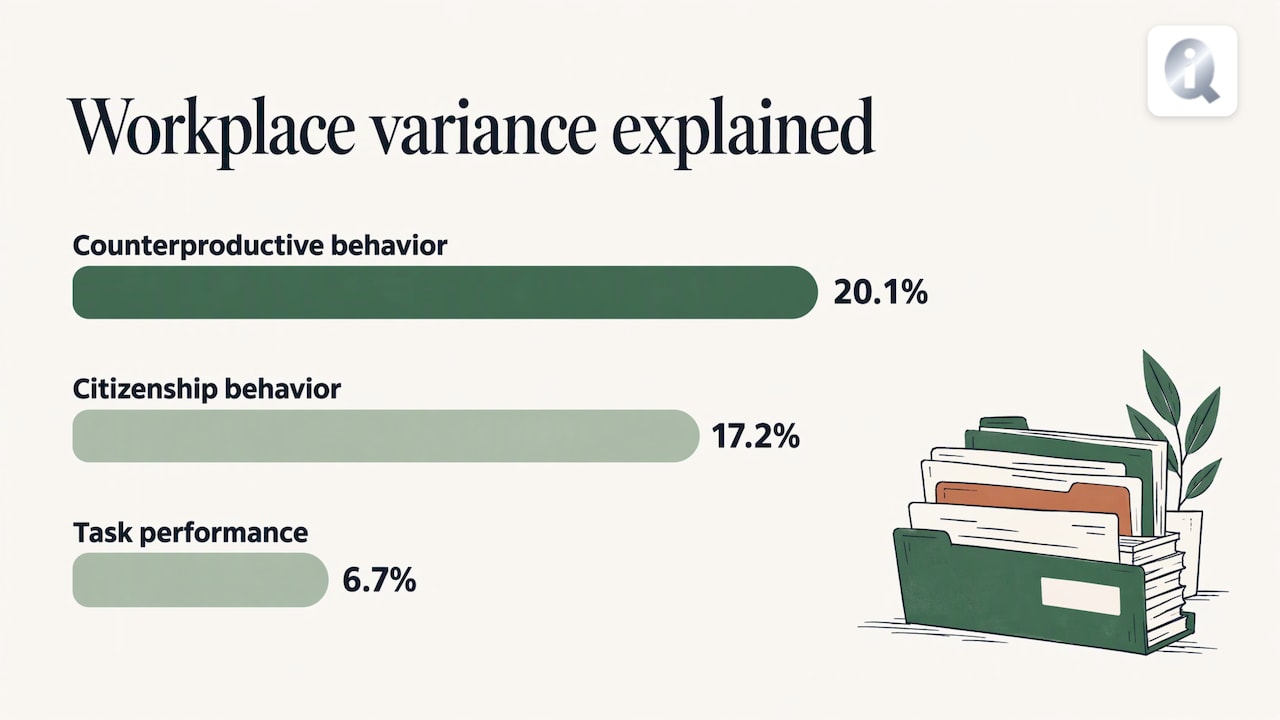
The workplace evidence is where HEXACO draws attention. A 2025 review by Pletzer and Abrahams found that HEXACO traits explain 20.1% of variance in counterproductive work behavior and 17.2% in organizational citizenship behavior, but only 6.7% in task performance. It also concluded that HEXACO traits explain more variance in job performance than Big Five or Dark Triad traits. An earlier 2005 study by Lee in Human Performance found that HEXACO substantially outperformed the Five-Factor Model in predicting workplace delinquency across samples from Australia, Canada and the Netherlands, with Honesty-Humility adding an average of 14% of variance.
Taya Cohen, writing in Scientific American in 2017, argued that the HEXACO model has begun to replace the Big Five as evidence for its validity mounts. That is one researcher’s perspective, and the Big Five remains far more widely used and normed. For a closer look at when the extra dimension matters, read our comparison of Big Five and HEXACO.
The practical takeaway: HEXACO and the Big Five share most of their architecture. If you understand one, you can read the other. Both are continuous, trait-based and empirically grounded, which is what separates them from the MBTI.
How to use personality results sensibly
A personality score describes a pattern of self-reported tendencies. It does not prove ability, character or fit. A few rules keep results useful:
- Treat percentiles as ranges. A score at the 60th percentile and one at the 66th are not meaningfully different. Read your profile for broad patterns, such as high Conscientiousness or low Agreeableness.
- Compare traits to context. High Extraversion may suit sales and client-facing roles, while high Openness may suit research and creative work. See our overview of careers for extraverts for how one trait connects to occupations.
- Keep stakes low. Personality results are one input for self-reflection. A personal values assessment can complement a trait profile by asking what you want from work and life, which a trait score cannot tell you.
- Avoid screening people out with a single test. The research above supports the Big Five and HEXACO as predictors in aggregate, not as individual verdicts. If you are an employer, treat results as one signal among several, such as work samples and structured interviews.
- Retest only when you have a reason. Trait scores are meant to be reasonably stable. A big change in your result after a short interval more likely reflects your mood on the day or how you interpreted the questions.
Our perspective
We built our personality assessment on the Big Five because it gives readers the most information per question and the most defensible interpretation. A percentile on each of five scales is harder to turn into a slogan than a four-letter label, but it carries what a label discards: how strongly you lean, and where you sit close to the middle.
We also think personality results are most useful when read next to other evidence. Cognitive strengths, interests and work context all shape which roles suit a person. That is why our Big Five assessment reports OCEAN trait percentiles and an archetype for free, and why the optional Personality Full Access adds a detailed profile, workplace-fit insights and a verifiable certificate for readers who want depth.
Our advice is simple: if you want a description you can check against research, start with trait scores. If you enjoy the MBTI as a conversation piece, enjoy it, and keep the decisions that matter for evidence that has been tested.
Steve
Take the Big Five and see your own percentiles
If you would rather see where you fall than read about it, our Big Five personality assessment gives you OCEAN trait percentiles and a personality archetype at no cost. It requires sign-in.
Readers who want more can unlock Personality Full Access for $14.99, paid once per result with no subscription. It adds a detailed personality profile, workplace-fit insights and a verifiable certificate. Details are on our pricing page.
FAQ
Is the Big Five better than the MBTI?
For prediction and consistency, the evidence favors the Big Five. In a study reported by Scientific American, it was about twice as accurate as an MBTI-style test at predicting life outcomes. The MBTI’s main advantage is familiarity and easy-to-remember labels.
Has the Myers-Briggs test been debunked?
Psychologists have raised serious concerns about its reliability and validity, including type changes when people retake it within about five weeks. It remains popular for low-stakes self-reflection, but it is not recommended for hiring or other consequential decisions.
What is more accurate than the MBTI?
Continuous trait models such as the Big Five and HEXACO have stronger research support than the MBTI. Their scores are placed on scales instead of being split into two categories, which keeps more information about each person.
What is the difference between HEXACO and the Big Five?
HEXACO has six dimensions, while the Big Five has five. The extra one is Honesty-Humility, and HEXACO also defines Agreeableness and Emotionality somewhat differently. Both are continuous, trait-based models.
Sources
- Personality Tests, Psychology Today
- Five-Factor Model (Big Five personality traits), Wikipedia
- HEXACO: Six-Factor Personality Model, CASRAI
- Personality Tests Aren’t All the Same. Some Work Better Than Others, Scientific American
- Do Links Between Personality and Life Outcomes Generalize? (Soto, 2020)
- Reliability generalization meta-analysis of the internal consistency of the BFI-2 (2025)
- Why Are We Suckers for Pseudoscientific Personality Tests?, Psychology Today
- Myers-Briggs Type Indicator, Wikipedia
- Personality MBTI: Why the World’s Most Popular Personality Test May Be Its Least Scientific
- Personality and job performance: A review of trait models (Pletzer and Abrahams, 2025)
- HEXACO and workplace delinquency (Lee, 2005), VU Research Portal
- How to Pick a Great Worker, Scientific American
- Personal Values Assessment: How It Works and How to Use It