Big Five Careers: How Your Personality Traits Point to Work That Fits

The Big Five does not hand you a job title. It gives you five trait scores (Openness, Conscientiousness, Extraversion, Agreeableness and Neuroticism), and those scores show the kinds of work environments, tasks and teams where you are most likely to do well. Used that way, the model is one of the most practical starting points for career exploration. You can take our free Big Five personality assessment after signing in and get your five trait percentiles and a personality archetype at no cost.
TL;DR
- The Big Five traits describe stable preferences for pace, structure, people contact and pressure. Those preferences map onto work environments more reliably than onto single job titles.
- Conscientiousness is the trait with the most consistent link to job performance across occupations. Extraversion matters most in management and sales, according to a classic meta-analysis.
- Read your results as clusters of roles to explore, not a single “perfect match”, and test them against real experience such as internships, shadowing and projects.
- Our Big Five assessment is free with sign-in. Personality Full Access costs $14.99 once per result and adds a detailed profile, workplace-fit insights and a verifiable certificate.
Table of Contents
- What the Big Five measure
- Which traits link most closely to job performance
- From trait scores to career clusters
- Example: one profile, three directions
- Using the Big Five with cognitive strengths and interests
- Comparing personality tests for career use
- Perspective: why we pair personality with cognition
- Take the next step
- Common mistakes when reading Big Five results
- FAQ
- Sources
What the Big Five measure
The Big Five is a framework psychologists use to describe personality along five broad dimensions. The Cleveland Clinic summary describes it as a stable, evidence-based way to understand behavior. The model is also called OCEAN after the first letters of the traits. Each trait is a spectrum, and your score is a position on it, not a label. Our guide to the five dimensions of personality covers each in more depth.
| Trait | High scorers tend to | Lower scorers tend to | Work-style implication |
|---|---|---|---|
| Openness | Seek novelty, abstract ideas, variety | Prefer the familiar and practical | Fit with changing, creative or research-heavy work versus stable, defined routines |
| Conscientiousness | Plan, organize, finish what they start | Work flexibly and spontaneously | Fit with detail-heavy, deadline-driven work versus improvisational work |
| Extraversion | Gain energy from interaction and visibility | Prefer focused, independent work | Fit with client-facing or team-led roles versus deep solo work |
| Agreeableness | Cooperate, support, avoid conflict | Challenge, negotiate, compete | Fit with care and service roles versus roles that require tough calls |
| Neuroticism | React strongly to stress and uncertainty | Stay even under pressure | Sensitivity to high-pressure or ambiguous settings, and to the support around it |
The table describes tendencies for groups of people, not rules for any one person. A lower score on a trait is not a deficit. It points to a different working style, and most careers have room for several.
Which traits link most closely to job performance
The best-known evidence comes from a meta-analysis by Barrick and Mount that pooled earlier studies across five occupational groups. They found that Conscientiousness related consistently to performance criteria in all five groups. Extraversion predicted performance for managers and for sales roles, and Openness predicted how well people did in training.
Three practical points follow:
- Conscientiousness travels well. Reliability, planning and follow-through are valued in nearly every field, so a high score is an asset in many directions.
- Extraversion is role-specific. It helps where the job is built on persuading, leading or constantly dealing with people. It is less central in roles based on independent analysis.
- Openness helps you learn. If you score high, fields with steep learning curves and frequent change are worth a look.
Academic reviewers also advise that personality information works best alongside other evidence. A 2007 review in Personnel Psychology suggests that when personality measures are used in selection, they should be clearly job-related and can be combined with other methods such as cognitive ability tests. The same logic applies to your own exploration: personality is one input, and your abilities, interests and values are the others.
From trait scores to career clusters
A good way to use your results is to move from traits to preferences to environments, and only then to job titles.
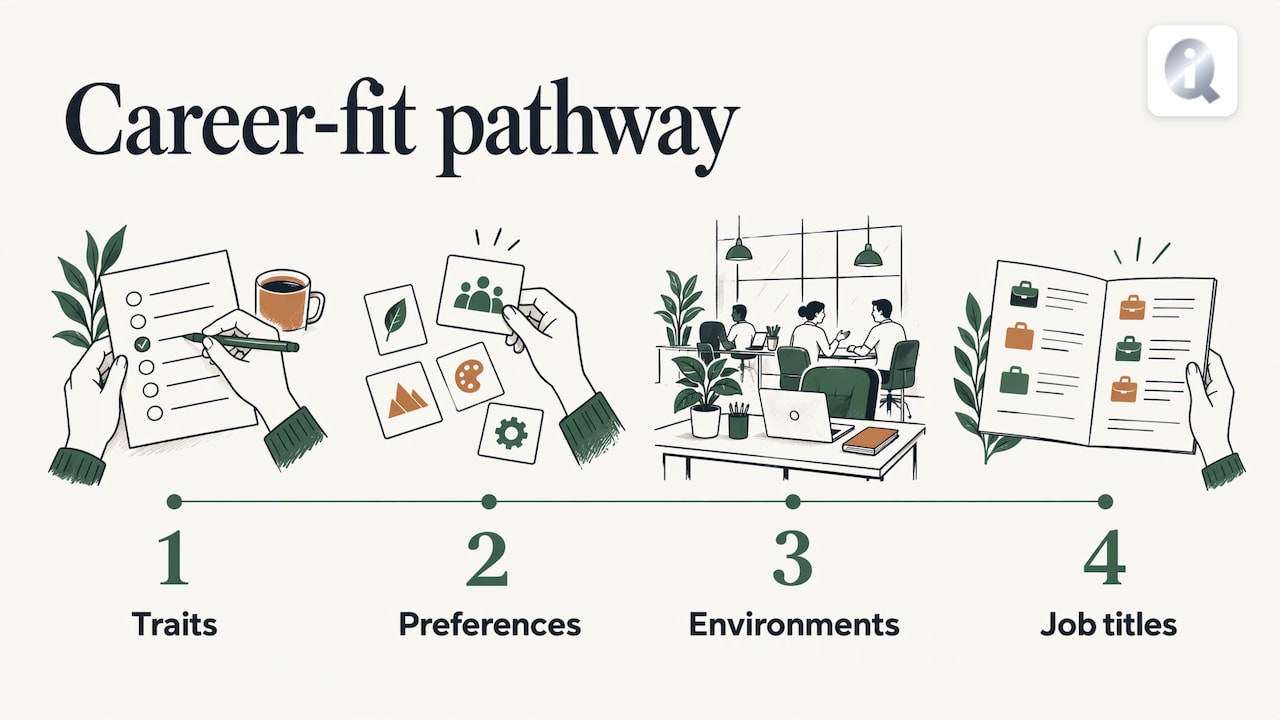
Step 1: Write down your top and bottom traits
Look at the two traits where you scored furthest from the middle. These are the ones that will shape your day most. A person with high Conscientiousness and low Extraversion, for instance, may like structured analytical work with limited meetings.
Step 2: Translate them into working conditions
Ask what each trait needs in practice:
- How much structure and predictability do you want?
- How much of the day should be spent with other people?
- Do you prefer to execute proven methods or invent new ones?
- Do you want collaboration or independent ownership of outcomes?
- How much time pressure and ambiguity do you tolerate comfortably?
Step 3: Build clusters, not a single answer
Career services at American University’s Kogod School of Business advise looking for clusters of roles where your natural talents solve real problems, rather than chasing a perfect match in which every trait is used daily. For Big Five results, that might mean three or four adjacent roles that share the same working conditions, such as research analyst, data analyst, editor and quality specialist for someone who is high in Conscientiousness and Openness and moderate on Extraversion.
Step 4: Check the clusters against real work
Results are possibilities, not decisions. A Times Higher Education piece on psychometric tests recommends discussing results with a counselor and connecting them to real experiences such as projects, internships, volunteering or job shadowing. For students, internships built into a degree plan are a structured way to see whether a role’s daily reality matches the trait-based picture. If you are working, a short project, a conversation with someone in the role or a day of shadowing does the same job.
Example: one profile, three directions
Take an illustrative profile, not a real person: high Conscientiousness (82nd percentile), high Openness (75th), moderate Extraversion (50th), moderate Agreeableness (55th), low Neuroticism (30th).
- Working conditions it suggests: organized, self-directed, intellectually varied, steady under pressure, comfortable with some collaboration.
- Clusters worth exploring: research and analysis roles, product and project roles that blend planning with new ideas, and editorial or content strategy work.
- What to test: whether you enjoy sustained independent work or want more people contact than the analysis roles offer. A two-week project or a shadowing day answers that faster than another questionnaire.
The same percentiles with high Extraversion instead of moderate would shift the cluster toward account management, consulting or team leadership. One trait changes the working conditions, which is why it helps to read the whole profile together.
Using the Big Five with cognitive strengths and interests
Personality describes how you prefer to work. It does not say how complex a task you can handle, or which activities you find engaging. Careers are shaped by all three, which is why we pair personality with cognitive measurement and interest exploration.
- Cognitive strengths show which kinds of reasoning come most easily to you. Our cognitive test for career choice playbook explains how to read them in a career context.
- Interests show which activities you will want to keep doing. A career aptitude test guide shows how aptitude, interest and personality measures fit together.
- Values show what you need work to give you. A personal values assessment is a reflective way to put words to those priorities before you narrow a shortlist.
If you want to see how the pieces combine, the Career-IQ Matcher relates cognitive level to occupations, and you can compare your result with IQ across jobs, countries and public figures.
Comparing personality tests for career use
Searchers who look for the best personality test for jobs usually meet three types of tools. They differ in what they measure and in how much research stands behind them.
| Type | What it measures | Typical output | Best used for |
|---|---|---|---|
| Big Five (trait model) | Where you sit on five continuous traits | Percentiles per trait | Understanding work style and environment fit |
| Type-based questionnaires | Which of several categories you fit | A four-letter or similar type label | Starting a conversation about preferences |
| Interest inventories | Which activity areas you like | Interest codes linked to occupations | Generating a list of occupations to research |
The Big Five measures traits on a continuum, so it keeps the detail that sorting people into categories loses. We summarize that comparison in our article on personality test accuracy and the Big Five. For choosing among career-matching tests, ask five questions: what does it measure, is the output continuous or a label, does it show how it was scored, does it separate free from paid results clearly, and does it link results to real occupations?
On our own platform the split is explicit:
| Big Five Personality | Personality Full Access | Full IQ Result | |
|---|---|---|---|
| Price | Free, sign-in required | $14.99 once per result | $9.99 once per completed result |
| What you get | OCEAN trait percentiles and a personality archetype | Detailed personality profile, workplace-fit insights, verifiable certificate | Exact IQ score, percentile context, five-domain breakdown, personalized report, verifiable certificate, Career Matches |
| Subscription | No | No | No |
The IQ assessment has 50 questions and needs no account. It shows a broad result category first, and the exact score is optional.
Perspective: why we pair personality with cognition
We built IQ Career Lab around a simple observation: people ask “what job fits me?” as though one number could answer it. It cannot, and we do not present it that way.
Personality tells you about preferences for pace, people, structure and pressure. Cognitive results tell you where your reasoning is strongest. Interests tell you what you will want to keep doing. Each is one angle on the same question, and the useful answer sits where they overlap.
That is why the Big Five assessment starts free. You see your five percentiles and archetype before spending anything, and you can decide whether the detailed profile and workplace-fit insights in Personality Full Access are worth $14.99, paid once per result. The IQ side works the same way: a broad category first, then an optional $9.99 unlock that adds your exact score, domain breakdown and Career Matches tied to live job listings.
Our advice is to treat any result as a hypothesis. Take the assessment, form two or three clusters of roles, then test them against real work.
Steve
Take the next step
If you have not yet seen your trait profile, start with the free Big Five assessment. It gives you five percentiles and an archetype to work from. If you want the full workplace-fit reading, Personality Full Access adds a detailed profile, workplace-fit insights and a verifiable certificate for $14.99 once per result, with no subscription. You can compare the options on our pricing page, or see what the personality certificate includes.
If you also want the cognitive side of the picture, the 50-question IQ assessment requires no account, and Career Matches connects your profile to real jobs.
Common mistakes when reading Big Five results
- Treating a percentile as a verdict. A 40th and a 60th percentile are close. Focus on the traits far from the middle.
- Searching for a single matching title. Roles within a field vary widely by employer, team and manager, so look at the conditions of the work.
- Ignoring your own blind spots. Self-reported questionnaires reflect how you see yourself. Time’s reporting on personality tests quotes a University of Illinois scientist on the value of looking beyond a single self-report, which is why feedback from colleagues and friends is a useful second view.
- Skipping the real-world test. A result that has never met a real workday is still a guess. Shadowing, projects and internships turn it into evidence.
FAQ
What are the best personality tests for careers?
For work style, a Big Five assessment is a strong choice because it reports continuous trait percentiles rather than a single label. Pair it with an interest inventory and a cognitive assessment to cover preferences, activities and reasoning strengths. Our free Big Five assessment is a practical first step.
Which Big Five trait matters most for careers?
Conscientiousness has the most consistent link to job performance, appearing across all five occupational groups in the Barrick and Mount meta-analysis. Extraversion mattered particularly for managers and sales, and Openness for training. The best trait for you depends on the working conditions you want.
Can a personality test tell me which job to take?
It can narrow the field and give you a language for what you need from work. It is a prompt for exploration, so combine it with real experience and, where possible, a conversation with a career counselor.
Is the Big Five test free?
Yes. Our Big Five assessment gives you OCEAN trait percentiles and a personality archetype at no cost, with sign-in. Personality Full Access is optional and costs $14.99 once per result.
Should I also take an IQ test when exploring careers?
It adds a different kind of information. Personality describes preferences, while a cognitive assessment shows relative strengths across reasoning areas. Together they give a fuller basis for choosing roles to explore.
Sources
- What Are the Big 5 Personality Traits? (Cleveland Clinic)
- The Big Five Personality Dimensions and Job Performance (Barrick and Mount, 1991)
- Reconsidering the Use of Personality Tests in Personnel Selection Contexts (Morgeson et al., 2007)
- CliftonStrengths for Career Exploration (American University Kogod Career Center)
- What psychometric tests can and cannot tell students (Times Higher Education)
- Are Personality Tests Actually Useful? (Time)