Average IQ by Profession: What the Data Shows and Doesn't

Average IQ by Profession: What the Data Shows and Doesn’t
No single, definitive table of average IQ by profession exists. What exists is a set of studies with different samples, different tests and different decades, and they agree on one pattern: occupations with heavier cognitive demands, such as medicine, engineering and other professional and technical work, tend to employ people whose average scores sit above the general population mean of 100. The numbers circulating online, especially “doctors average 120” or “engineers average 125,” are best read as rough estimates with wide overlap between jobs, not as entry requirements.
This guide explains where those figures come from, what is known about doctors, engineers and coders, why occupational averages are less precise than they look, and how to compare your own score with them sensibly.
TL;DR
- The population mean IQ is set at 100 with a standard deviation of 15, and higher-demand professions tend to average above that, with large overlap between occupations (APA Dictionary of Psychology).
- One recent study estimated the average IQ of American physicians at 120, higher than any other occupation it assessed (Cambridge Quarterly of Healthcare Ethics, 2023).
- Engineers, lawyers and teachers sit in the upper part of the occupational range in the best-known U.S. occupational comparison, while manual and routine jobs sit lower.
- An average describes a group, not a person. Your score does not qualify or disqualify you for a career.
Table of Contents
- What “average IQ by profession” actually means
- How reliable are occupational IQ estimates?
- The broad U.S. pattern
- Average IQ of doctors
- Average IQ of engineers
- Coding and software engineer IQ
- IQ by college major
- What a score does and does not predict
- Our perspective
- Compare your own result with a profession
- FAQ
- Sources
What “average IQ by profession” actually means
An IQ score is a standardized measure of intelligence with a customary mean of 100 and a standard deviation of 15. Over 95% of scores fall between 70 and 130 (APA Dictionary of Psychology). If you want to see where a given number falls on that curve, our IQ standard deviation calculator and our explainer on IQ score distribution and percentiles show the percentile for any score.
An occupational average is the mean (or median) score among people who hold a given job and were tested in a particular study. That definition has three consequences worth stating plainly:
- It describes people who ended up in the job, not people who could do it. Selection happens through education, licensing, hiring and attrition, so the averages reflect who passed through those filters.
- It depends on the test. Studies use full IQ batteries, shorter tests, military aptitude scores, or admissions exams, then convert them to an IQ-like scale. The conversion adds error.
- It hides the spread. Two professions with averages ten points apart can still share most of their members’ scores.
How reliable are occupational IQ estimates?
Less reliable than the tidy lists suggest. Reviewers of the occupational IQ literature note that studies vary in data quality and sample size, and that much of the headline evidence depends on meta-analysis, which can obscure how people actually perform in different professional settings (Richardson and Norgate, PMC, 2015).
The U.S. Bureau of Labor Statistics makes a related point from the job side. Education level is a common proxy for how demanding a job is, but it overlooks the specific cognitive requirements of individual occupations. This is why the agency’s Occupational Requirements Survey collects information on elements such as problem-solving and social interaction (BLS, Beyond the Numbers).
The practical reading: treat any single figure as a plausible center of a wide distribution, and be wary of any list that gives a precise number such as 127.4 for a job.
The broad U.S. pattern
The most cited U.S. comparison of occupations is the work of sociologist Robert Hauser, who broke down average cognitive scores across more than 50 occupations. Blue-collar occupations such as janitor, assembler and construction craftsman fell at the lower end, while white-collar professions including engineer, lawyer and teacher fell at the upper end (EDN summary of Hauser’s study).
That gradient is the stable finding. The approximate bands usually reported are:
| Occupational group | Typical position relative to the mean of 100 | How to read it |
|---|---|---|
| Physicians and other advanced-degree clinicians | Roughly 10 to 20 points above | Strongest selection, driven by admissions tests and long training |
| Engineers, scientists, lawyers | Above the mean | Quantitative or verbal screening in degree programs |
| Teachers, managers, technical workers | Modestly above the mean | Degree-level entry, broad ranges |
| Clerical, sales, skilled trades | Near the mean | Wide overlap with the general population |
| Routine manual and service work | Near or slightly below the mean | Large overlap; mean differences are small relative to the spread |
This table is a synthesis of the research above and our own tool data, not a measurement from one study. For a ranked view across 176 occupations, see our average IQ by profession tool, which also notes how each estimate is built.
Average IQ of doctors
Doctors are the most searched occupation, and they are also the most heavily selected. One recent study estimated the average IQ of American physicians at 120, substantially higher than any other occupation assessed (Cambridge Quarterly of Healthcare Ethics, 2023). A 120 corresponds to roughly the 91st percentile of the general population.
A 2025 study in Frontiers in Public Health used cognitive testing rather than reporting a single IQ average. It found that healthy physicians, as a group, typically performed about 0.5 to 1.0 standard deviations above non-physicians (Frontiers in Public Health, 2025). On an IQ scale with a standard deviation of 15, that is about 7 to 15 points, which is consistent with an average somewhere between 107 and 115 and consistent with higher estimates in other samples.
Two cautions apply:
- Sample limits. The Frontiers study was done at one academic medical center, and its authors say the sample may not represent physicians nationally. They call for multi-site, representative norms.
- Specialty differences. Medicine is not one population. Admissions and training pipelines differ by specialty, so one number for “doctors” blends very different groups.
The 2025 authors also argue that general-population norms may fail to detect cognitive decline in physicians, because physicians typically perform at a higher baseline. They recommend physician-specific norms for fitness-for-duty evaluations. That is a point about measurement, not about who is a better doctor.
In fact, commentators in JAMA and in Cambridge Quarterly of Healthcare Ethics caution against equating intelligence or admissions metrics with clinical quality. Cognitive ability may support performance in training, but the available evidence does not show that small differences in test scores determine clinical skill or patient-centered care (JAMA, 2018).
Average IQ of engineers
Engineering follows the same logic as medicine: selection through demanding quantitative coursework. In the Hauser comparison, engineers appear in the upper portion of the occupational range alongside lawyers and teachers (EDN). Most popular figures place the average engineer somewhere in the 110s to low 120s, but we do not know of a representative study that reports a single authoritative number, and the label “engineer” covers very different work.
How the figure varies in practice:
- By discipline. Fields with heavier mathematical content in their degree programs tend to select for higher quantitative scores than fields where applied or hands-on training dominates.
- By role. A design engineer, a field technician with an engineering title and a project manager hold the same word on a business card but face different cognitive demands.
- By study. Older samples, military samples and university samples measure different slices of the profession.
If you searched for an “engineer IQ average” to decide whether you are smart enough for the field, the useful answer is that degree programs screen on coursework performance and persistence at least as much as on a raw IQ score.
Coding and software engineer IQ
There is no credible study that sets a minimum IQ for programming, and software engineering is too varied for one number. What the research does show is that cognitive load in coding depends heavily on experience. Eye-tracking research on programming tasks finds greater cognitive effort among novices than among experts during code comprehension (Maletic and colleagues, ETRA 2023).
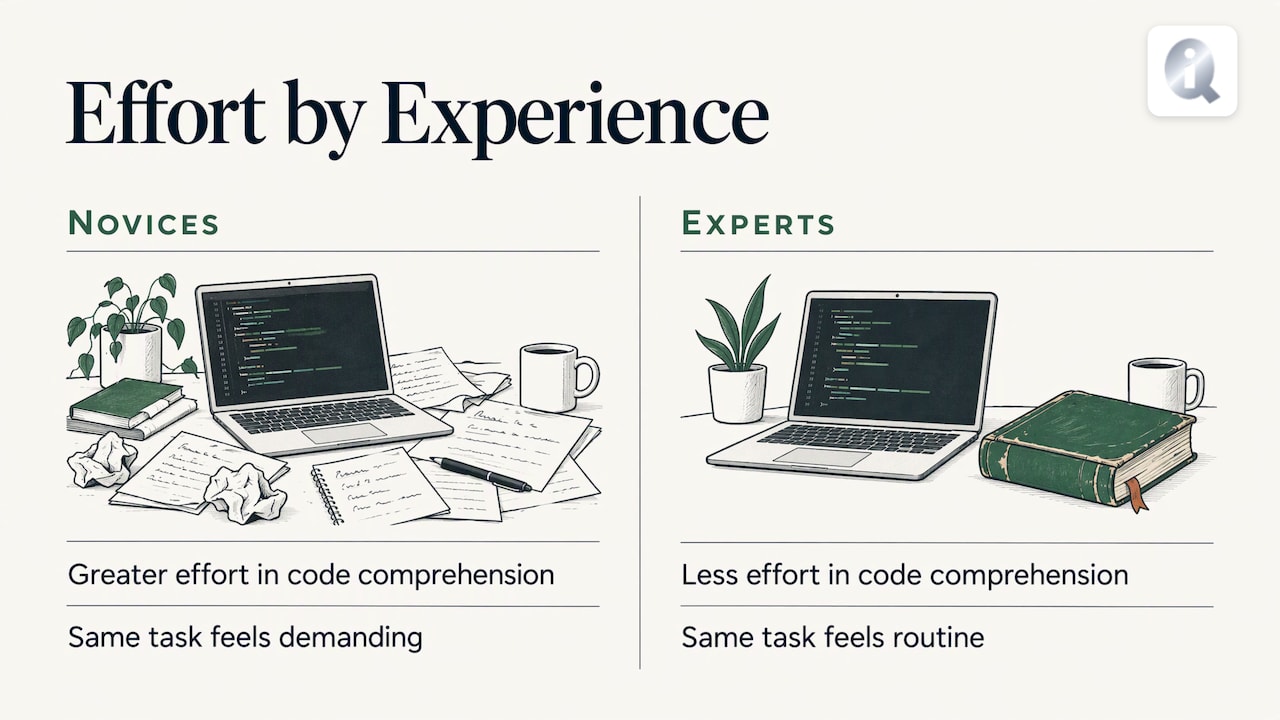
That finding matters for how to read a score. The same task can be heavy for a beginner and routine for an expert, which means practice shifts the effective demand. A person with a typical score who has practiced for years can outperform a higher-scoring newcomer on the work itself.
Software engineers as a group are likely to average above 100, because the field draws on degree-level math and logic. But the range inside the field is wide, from front-end work to systems and machine learning research.
IQ by college major
Readers also ask about major. Average scores by major in published data usually track the quantitative intensity of the field, with physical sciences, engineering and mathematics near the top and fields with broader entry paths nearer the middle. The same caveat applies: these reflect admissions selection and test mix, and they say nothing about who can succeed in a given major. Our career and IQ hub lists 176 professions ranked by cognitive demand, which is a better starting point than a single ranking by major.
What a score does and does not predict
General mental ability is a consistent predictor of job performance across occupations, although specific abilities can sometimes be more relevant to job-specific content (Journal of Applied Psychology, 2015). That supports the idea that cognitive demand varies by job.
It does not mean IQ decides outcomes. Work success also involves personality traits, preferences and typical work behavior (APA PsycTESTS supporting materials). The APA dictionary also records criticism that IQ tests measure previously learned skills and knowledge, and that testing conditions can influence results (APA Dictionary of Psychology).
A fair way to use occupational averages:
- Convert your score to a percentile so you know where you stand in the general population.
- Compare it with the typical range for a field, not the average alone. Most people in any profession score within about 15 points either side of that profession’s average.
- Weigh interests, personality, training and work style at least as heavily.
Our guides to what a good IQ score is, what IQ scores mean and why 100 is a norm rather than a national score cover the interpretation step in more detail. If your result came from a test with a different scale, the IQ score converter puts it on the common one.
Our perspective
We built our occupational data around one principle: a profession’s average is a context for your score, never a verdict on it.
Most pages on this topic print a single number per job and stop. We think readers are better served by seeing three things together: where their exact score falls as a percentile, how wide the range is inside the profession they are considering, and which other factors, such as personality and interests, shape fit. That is why our assessment pairs a 50-question IQ test with a five-domain breakdown, and why our Big Five assessment sits alongside it as a separate instrument.
Cognitive strengths are not uniform. A person can be strong in verbal reasoning and average in spatial tasks, and different careers lean on different domains. A domain breakdown shows that profile, which a single average cannot. We also state the limits of our comparisons openly, because trust in this field depends on reproducible methods and honest uncertainty.
If you want to move from reading averages to understanding your own profile, the full result and Career Matches are designed for exactly that step.
Steve
Compare your own result with a profession
If you want your own number instead of a population estimate, you can take our 50-question IQ assessment without creating an account. You see a broad result category first. Unlocking your exact IQ score, percentile context, five-domain breakdown, personalized report, verifiable certificate and Career Matches costs $9.99 once per completed result. It is a one-time purchase, not a subscription.
See the Full IQ Result pricing for details, or try the Career-IQ Matcher to explore careers by cognitive profile. If you are weighing personality as well, our Big Five assessment is free with sign-in and returns OCEAN trait percentiles and a personality archetype. Personality Full Access is $14.99 once per result and adds a detailed profile, workplace-fit insights and a verifiable certificate.
FAQ
What is the average IQ of doctors?
One recent study estimated the average IQ of American physicians at 120, higher than any other occupation it assessed (Cambridge Quarterly of Healthcare Ethics, 2023). Other work using cognitive tests finds physicians perform about 0.5 to 1.0 standard deviations above non-physicians. Estimates differ by sample and specialty, so 120 is best read as a rough center.
Do engineers have higher IQs than other professions?
Engineers appear in the upper part of the occupational range in the best-known U.S. comparison, near lawyers and teachers and well above routine manual work. No representative study gives one exact figure, and averages differ by discipline and role. The overlap with other professions is large.
Is there a minimum IQ for coding?
No credible research sets one. Programming demands vary widely, and eye-tracking studies show that cognitive effort on code comprehension is higher for novices than for experts, so experience changes how demanding the same task feels. Practice and training matter alongside test scores.
Can my IQ score tell me which career to choose?
It can add context, but it should not decide the choice. General mental ability predicts job performance across occupations, yet personality, interests and work behavior also shape success. Use your score alongside those factors, and discuss decisions with a career counselor or school advisor.
Sources
- APA Dictionary of Psychology: IQ
- Against Intelligence? Rethinking Criteria for Medical School Admissions, Cambridge Quarterly of Healthcare Ethics
- A model for the cognitive assessment of physicians, Frontiers in Public Health
- Does IQ Really Predict Job Performance? PMC
- Minds at work, U.S. Bureau of Labor Statistics
- Does Medicine Overemphasize IQ? JAMA
- Engineer vs engineer: Who has the higher IQ? EDN
- Studying Developer Eye Movements to Measure Cognitive Workload, ETRA 2023
- Journal of Applied Psychology, 2015
- APA PsycTESTS supporting materials