Mental Rotation Test: Try Mirror Trap Items, Then Train Spatial Skills
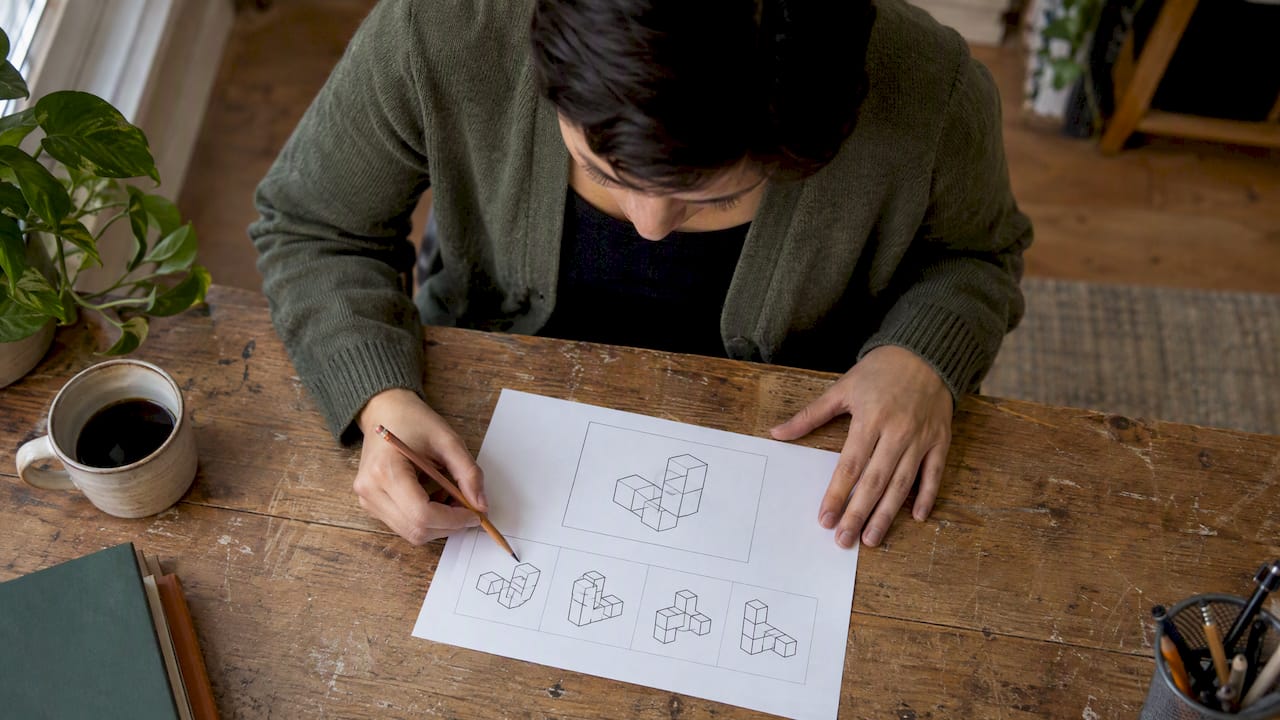
A mental rotation test asks you to identify which shapes are the same three-dimensional object rotated, not mirrored, and you can try a few practice items below to see how you perform. We walk through the task format, the research behind it, worked examples, and evidence-based ways to improve, so you leave with both a practice session and a clear sense of what your result means.
TL;DR:
- The classic Vandenberg and Kuse test has 20 items and two correct answers per item; shorter online scores cannot be compared with lab norms.
- Use the same mouse, browser window, and screen size across sessions; when reaction time is recorded, device latency can affect results independently of ability.
- A 2012 meta analysis found moderate gains from spatial skills training, with some transfer to mathematics; begin untimed, then add complexity and timed trials.
- Check distinctive features and rule out mirror images before selecting; for complex or partly hidden shapes, rotate smaller sections and infer obscured structure.
Table of Contents
- Quick start: how the test works
- What the test measures and core research findings
- Sample problems and worked examples you can try now
- How to take the MRT online: device, latency, timing, and scoring
- How to improve: evidence-based practice strategies and drills
- How IQ Career Lab complements MRT practice
- Common errors and pitfalls to avoid during the test
- Author perspective: practical uses for MRT practice
- Try the IQ Career Lab full assessment or unlock a detailed report
- FAQ
- Sources
Quick start: how the test works
In a standard mental rotation test (MRT), we show you a target object and a set of alternatives. Your job is to pick the alternative, or alternatives, that represent the same object rotated in space, while ignoring options that are mirror images rather than true rotations.
The sequence is consistent across most versions:
- Study the target shape carefully, noting any protrusions or asymmetries.
- Compare each alternative to the target, checking for the same configuration.
- Select the option or options that match after rotation, not reflection.
- Watch for mirror-image traps, which look identical at a glance but are reversed.
Formats vary. Some presentations use pairwise comparisons (is this one shape or two?), while the classic Vandenberg & Kuse version presents four alternatives per item, two of which are correct. Web-based versions often run 10 to 40 trials, sometimes untimed and sometimes under a clock. A timed administration measures processing speed alongside accuracy, while an untimed version isolates pure accuracy, which matters when comparing your result to a specific research norm.
What the test measures and core research findings
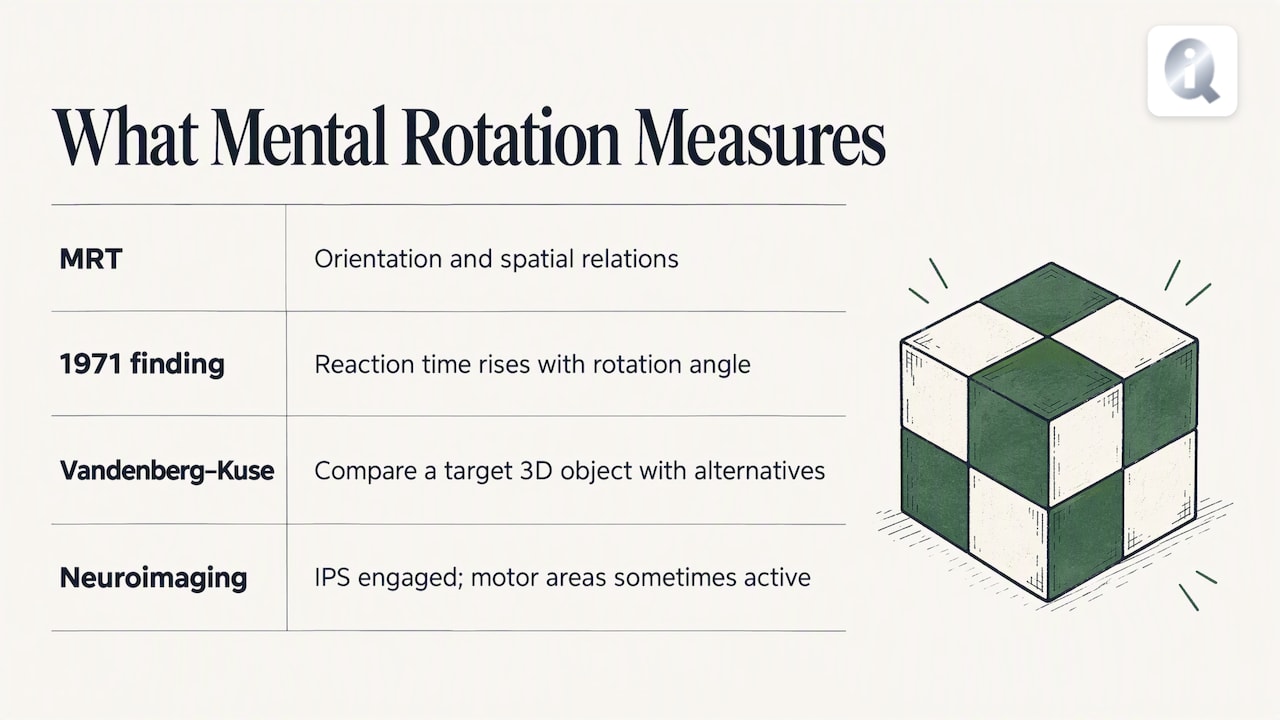
The MRT measures spatial visualization: your capacity to mentally manipulate an object’s orientation and judge spatial relationships without physical movement. The task traces back to a 1971 finding by Shepard and Metzler, who showed that reaction time increases in a roughly linear way as the angle of rotation between two objects grows, suggesting people mentally rotate images in analog fashion rather than comparing them instantly.
The formalized version most researchers use today, the Vandenberg & Kuse Mental Rotation Test, presents a set of items comparing a target 3D object to multiple alternatives, built directly on that 1971 rotation-angle effect. Neuroimaging work adds a physiological layer: a meta-analysis of neuroimaging studies found that mental rotation consistently engages the intraparietal sulcus, a region tied to spatial mapping, with motor-simulation areas also activating under certain task conditions. That pattern suggests rotation sometimes recruits the same circuits involved in physically moving an object, not just abstract visual comparison.
Performance on these tasks is not fixed. Research on motor expertise and training malleability, covered further below, shows the ability responds to practice and to certain kinds of physical experience.
Sample problems and worked examples you can try now
Practicing with a few items builds intuition faster than reading about the format. Try working through these in order.
- Item one, a simple L-shaped block. Picture an L-shaped block with one short arm and one long arm. Rotate it 90 degrees around the vertical axis in your mind, then check whether the resulting shape matches the alternative shown. Focus on which arm stays longer after the turn.
- Item two, a block with a notch. A cube with a small notch cut from one corner is shown next to four alternatives. One alternative is a true rotation; another is a mirror image with the notch on the opposite side. Identify the notch’s position relative to the block’s other features before deciding.
- Item three, an occluded stimulus. Part of the target object is partially hidden behind another shape. Use the visible protrusions and edges to infer the hidden structure, then rotate that inferred shape mentally rather than guessing from the visible portion alone.
- Item four, a multi-part figure. A figure built from several connected cubes tests whether you can track multiple segments at once. Break it into two or three smaller chunks, rotate each chunk, then reassemble the result mentally.
For each item, identify the object’s unique features first (a notch, a longer arm, a missing block), check for occlusion that might hide a distinguishing detail, and rotate in small checkpoints rather than attempting the full rotation in one mental leap. Early in practice, prioritize accuracy over speed. Once you reliably identify correct matches, start timing yourself to build comfort under time pressure.
Pro Tip: When two alternatives look nearly identical, check whether one is a mirror image first. Mirror traps cause more errors than genuine rotation mismatches.
How to take the MRT online: device, latency, timing, and scoring
Your setup affects both your experience and the comparability of your result. A few adjustments reduce unnecessary variability:
- Use a mouse rather than a trackpad, since trackpad input introduces inconsistent timing and precision.
- Keep your browser window and screen size consistent across sessions if you plan to compare scores over time.
- If the version you are using records reaction time, device latency can shift your numbers independent of your actual ability, so input-device consistency matters for measurement reliability.
- If reaction time is not recorded, focus entirely on accuracy rather than worrying about speed.
Scoring conventions differ by version. Classic lab administrations of the Vandenberg & Kuse format use 20 items with two correct answers each, producing a score out of 40 possible correct selections. Online versions often use shorter item sets, so a raw score from a 10-item web quiz is not directly comparable to published lab norms built on the full 20-item test. Treat online results as a general indicator of where you stand, not a substitute for a standardized, proctored assessment.
How to improve: evidence-based practice strategies and drills
Spatial visualization responds well to deliberate practice. A 2012 meta-analysis covering many studies found that spatial skills training yields moderate positive effects, with some transfer to mathematics performance also observed. That transfer effect is notable: practicing mental rotation does not just help you on similar tasks, it appears to carry over into related reasoning domains, according to the spatial visualization training meta-analysis.
A practical drill plan:
- Start with untimed, low-difficulty items and increase complexity gradually rather than jumping to hard items immediately.
- Mix holistic practice (rotating the whole object at once) with piecemeal practice (tracking individual features), since research on strategy flexibility links switching between approaches to stronger performance.
- Schedule short, frequent sessions rather than occasional long ones, since repeated exposure over time tends to produce more durable gains.
- Incorporate physical or motor-based spatial activities when possible, since motor expertise has been linked to stronger spatial task performance in some populations.
Pro Tip: Alternate untimed accuracy runs with timed trials. Tracking both numbers separately shows whether you are getting more accurate, faster, or both.
How IQ Career Lab complements MRT practice
Mental rotation practice tells you about one specific skill. For a wider view of where that skill fits among your other cognitive strengths, we offer a 50-question IQ assessment alongside a Big Five personality assessment and free tools for understanding IQ scores, percentiles, and brain age.
A domain-level breakdown shows how your spatial reasoning compares to your verbal, numerical, or memory performance, which gives percentile context that a single MRT score cannot provide on its own. If you want to see where your mental rotation practice fits within a fuller cognitive profile, our IQ score converter helps translate results across common scales once you have a baseline to work from.
Common errors and pitfalls to avoid during the test
Most mistakes on mental rotation tasks fall into a few predictable categories. Recognizing them in advance makes them easier to catch during practice.
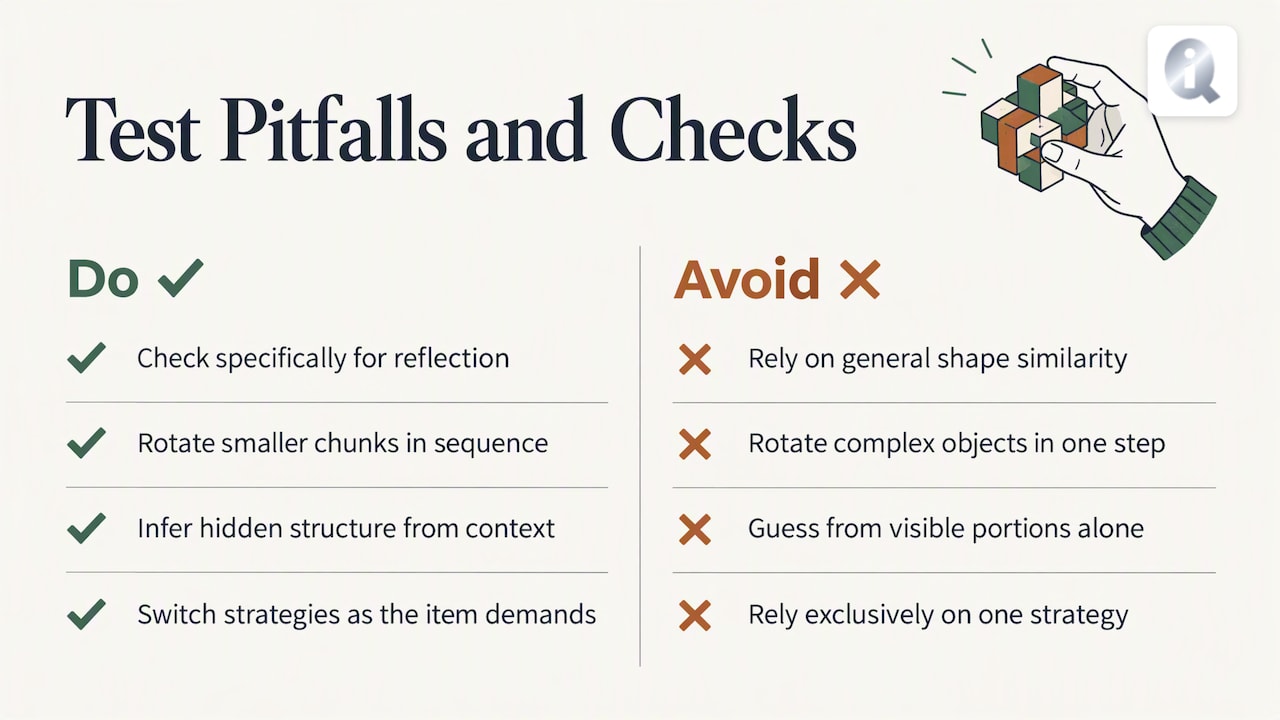
Mirror-image confusion is the most frequent error. Two shapes can look nearly identical at a glance, with one simply reflected rather than rotated, and under time pressure test-takers often select the mirrored option by mistake. Slowing down specifically to check for reflection, rather than just general shape similarity, cuts this error down substantially.
Rushing the rotation is another common pitfall. Attempting to rotate a complex multi-part object in a single mental step increases the chance of losing track of one segment. Breaking the object into smaller chunks and rotating each piece in sequence reduces that load.
Ignoring occlusion causes problems on items where part of the target is hidden. Test-takers sometimes guess based on the visible portion alone instead of inferring the hidden structure from context, which leads to selecting an alternative that only partially matches.
Finally, rigid strategy use can slow you down. Relying exclusively on either a whole-object or a feature-by-feature approach, rather than switching between them as the item demands, tends to produce slower and less accurate responses than flexible strategy switching.
Author perspective: practical uses for MRT practice
Mental rotation practice has real value for STEM preparation, geometry coursework, and general spatial confidence, and the gains tend to transfer to related reasoning tasks. It is not a clinical or diagnostic tool, so we recommend pairing it with a fuller cognitive assessment if you want context beyond a single skill.
— Steve
Try the IQ Career Lab full assessment or unlock a detailed report
Mental rotation practice shows you one slice of spatial ability. A Full IQ Assessment places that slice alongside four other cognitive domains, giving you percentile context and a breakdown of where your strengths actually sit.

If you want the complete picture, unlocking a Full IQ Result for $9.99 gives you your exact score, domain analysis, and a verifiable certificate, available on our pricing page. It is a practical next step once you have a feel for your spatial reasoning from the practice items above.
FAQ
What is a mental rotation test?
A mental rotation test asks you to identify which of several shapes is the same three-dimensional object as a target shape, just rotated rather than mirrored. The format traces back to a 1971 finding that reaction time scales with rotation angle, and the most widely used version was formalized by Vandenberg and Kuse in 1978.
What is a high spatial IQ?
There is no single universal cutoff for a “high” spatial score, since norms depend on the specific test, item count, and population used for comparison. A strong performance generally means accurately matching rotated objects across most items while maintaining reasonably fast response times relative to the test’s own norm group.
Which patient is most likely to have problems with mental rotation?
Spatial visualization difficulties are not tied to one specific clinical population in the research we cite here, and claims about particular conditions should come from a qualified clinician rather than an online practice test. Mental rotation tasks used in research settings are tools for studying cognitive patterns, not diagnostic instruments.
Do people with ADHD have good spatial memory?
Spatial memory and mental rotation ability vary widely among individuals, and the sources reviewed for this guide do not establish a specific link between ADHD and spatial task performance. Anyone with concerns about attention or cognitive functioning should speak with a qualified professional rather than relying on an online spatial test for assessment.
Sources
- Mental Rotations, a Group Test of Three-Dimensional Spatial Visualization — Vandenberg & Kuse (1978)
- The influence of spatial visualization training on students’ spatial reasoning and mathematics performance — meta-analysis (2012)
- Neuroimaging studies of mental rotation: A meta-analysis and review — Journal of Cognitive Neuroscience (2008)