How Average IQ Varies Across 200+ Countries: What the Data Actually Shows

Keep exploring
Use another free IQ Career Lab tool to put this result in a wider context.
Roger's experience is common. National IQ data circulates widely online, often presented as settled science: neat tables with a single number for each country. The reality is more complicated, more contested, and far more interesting than those tables suggest.
National IQ averages range from roughly 60 to 108 across more than 200 countries, but only about 81 have direct psychometric measurements.
Key Takeaways
- National IQ data covers 200+ countries, but only about 81 have direct psychometric measurements. The rest are estimated from neighboring nations or proxy data
- Each standard deviation in national cognitive scores correlates with up to 2 percentage points of GDP growth. Cognitive capital is economic capital, and the environment you work in shapes your earning power
- Environmental factors explain most variation between countries: nutrition, education access, disease burden, and economic development account for the largest gaps
- The Flynn Effect proves scores aren't fixed. Cognitive test performance can shift 25+ points in a single generation when conditions improve
- The primary global dataset has been formally opposed by the European Human Behaviour and Evolution Association (EHBEA) over methodological and ethical concerns
- Individual cognitive profiles matter more than national averages. Your personal strengths and weaknesses predict career outcomes far better than any country-level statistic
The Global IQ Landscape
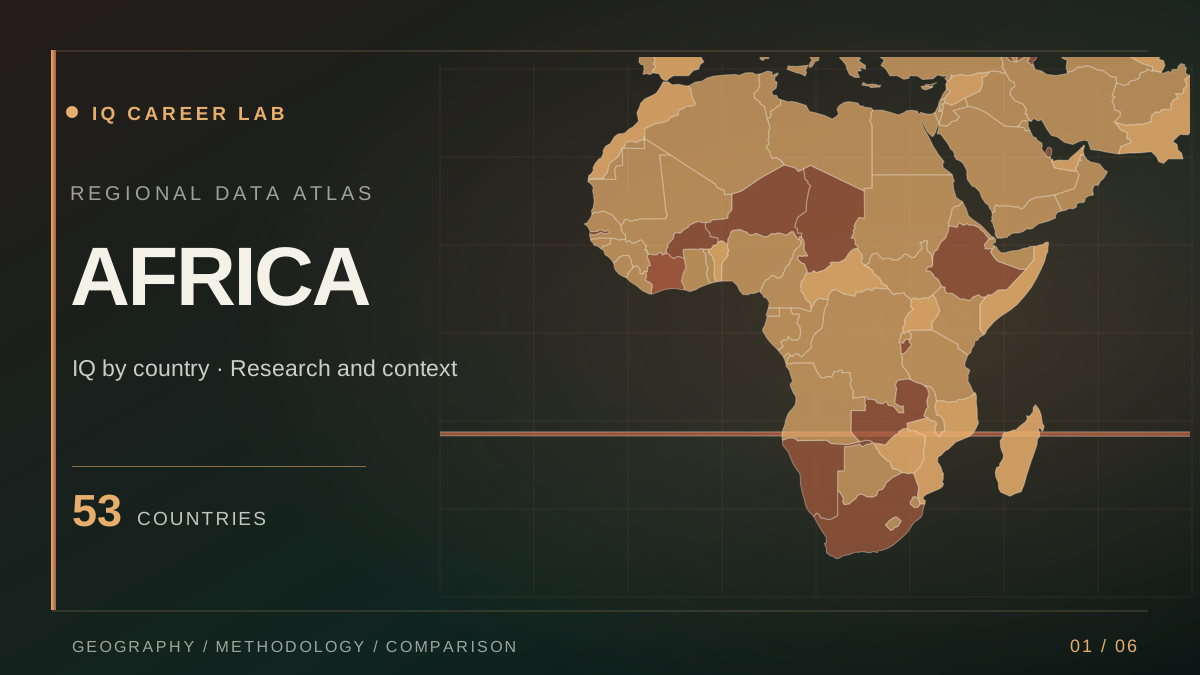
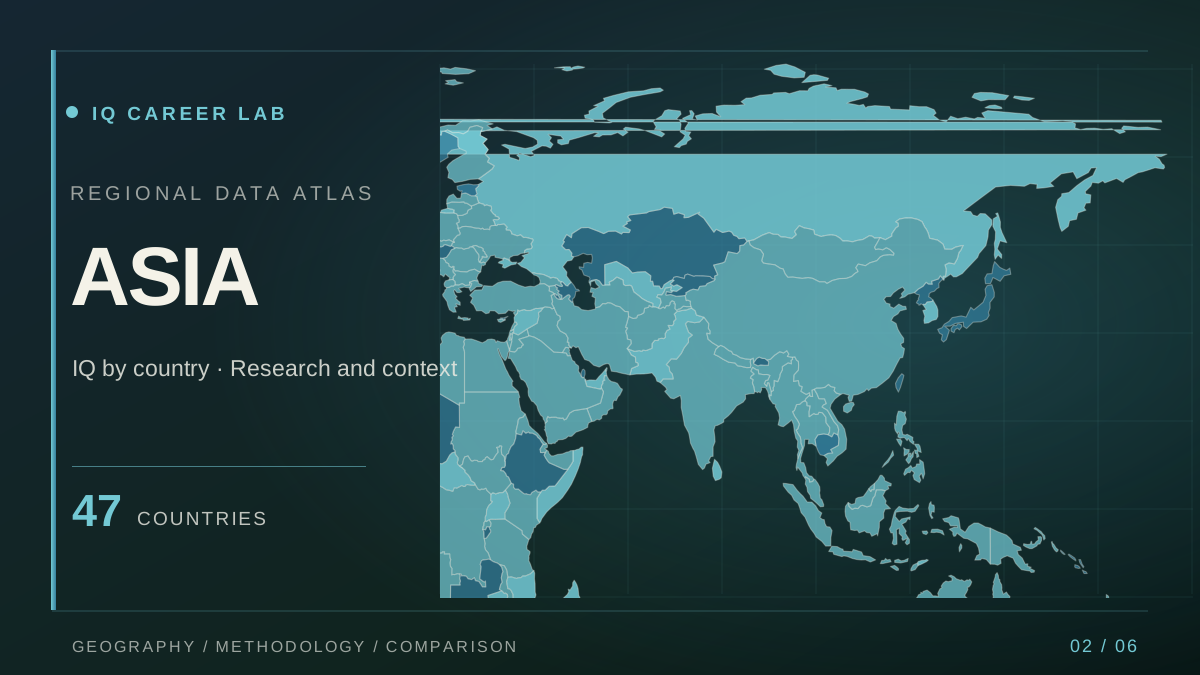
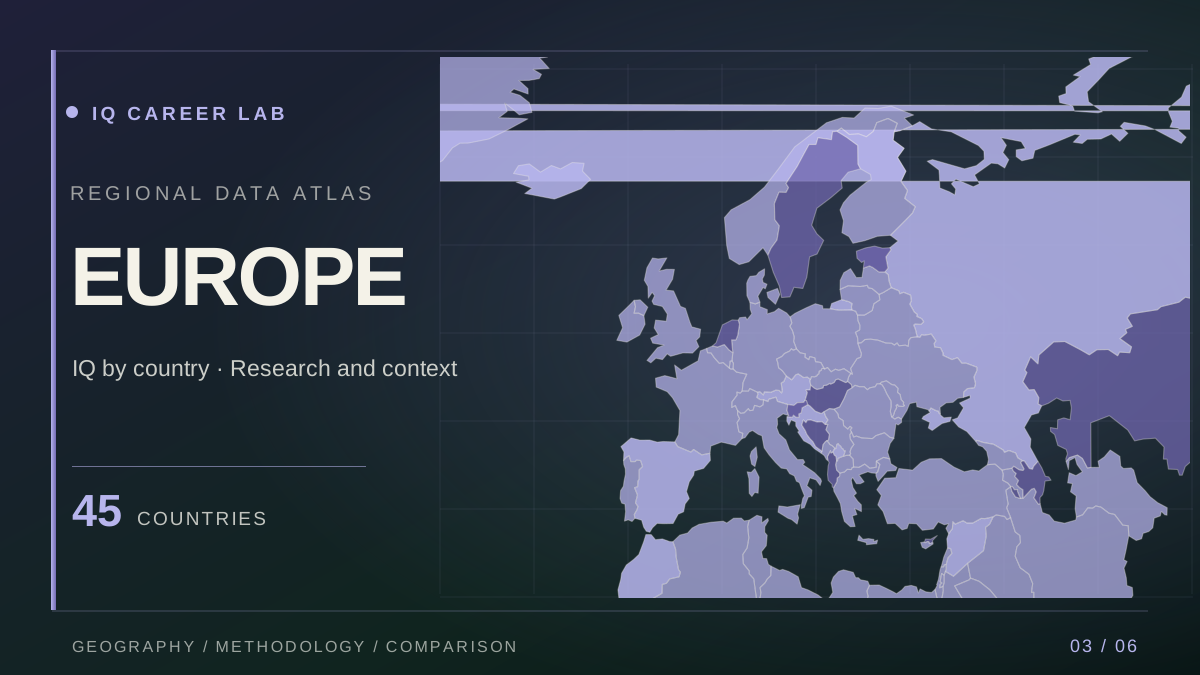
Two main approaches produce the national IQ estimates you see on websites and in research papers. You can explore our country-by-country data for a detailed breakdown. Understanding how they differ is essential before drawing any conclusions from the numbers.
The first and most widely cited is the Lynn/Vanhanen dataset, originally published in the 2002 book IQ and the Wealth of Nations. Richard Lynn and Tatu Vanhanen compiled IQ test results from available studies worldwide, then estimated scores for countries without direct data by averaging their neighbors' values. David Becker later expanded this into the National IQ (NIQ) dataset, which currently covers over 200 countries and territories. About 174 published studies have relied on some version of this dataset, generating roughly 4,500 citations since 2019.
The second approach derives cognitive scores from international educational assessments (PISA, TIMSS, and PIRLS) which test millions of students in standardized conditions across 80+ participating nations. These correlate strongly with IQ estimates at the country level (r = 0.85-0.86), but they measure academic achievement, not raw cognitive ability, and they only cover countries wealthy and organized enough to participate.

The gap between these two approaches creates real problems. Vietnam offers a striking example: Lynn-based datasets long assigned the country an estimated IQ of 78, which would place it among the lowest-scoring nations globally. Yet Vietnamese students consistently score at or above wealthy OECD nations on PISA mathematics assessments, suggesting actual cognitive performance closer to 95-100. That's a 20-point discrepancy from a single country, and it's not an isolated case.
Rankings shift by 20 or more positions depending on which dataset you consult, which edition of that dataset you use, and which statistical corrections the compiler applied. Singapore sits at the top of most lists with a PISA mathematics score of 560, the only country more than two standard deviations above the OECD mean. But whether a country ranks 15th or 45th often comes down to methodological choices rather than genuine differences in cognitive performance.
| Countries with Direct Data | Sub-Saharan Africa Avg. IQ | Vietnam Estimate | |
|---|---|---|---|
| Lynn/Vanhanen (2002-2012) | ~81 of 185 | ~67 | ~78 |
| Wicherts Reanalysis (2010) | Same raw data | ~82 | Not reanalyzed |
| PISA-Derived (2022) | 80+ (tested nations only) | Not separately estimated | ~95-100 (math equivalent) |
The table above captures the core issue: the same regions can look radically different depending on who compiled the data and how they handled gaps. A 15-point difference in sub-Saharan African estimates between Lynn's original figures and Wicherts's reanalysis of the same raw data. That's a full standard deviation, the difference between "below average" and "solidly average" in clinical terms.
Why National IQ Scores Differ
If national averages genuinely vary (and the available evidence, however imperfect, suggests they do), the next question is why. The short answer: environment. The long answer requires separating several overlapping factors that compound across populations and generations.
The Flynn Effect
Named after the New Zealand researcher James Flynn, the Flynn Effect documents one of the most replicated findings in psychology: IQ scores rose approximately 3 points per decade throughout the 20th century across every industrialized nation studied. Flynn documented gains of 5 to 25 points across 14 nations within a single generation.
The most dramatic case comes from rural Kenya. Between 1984 and 1998, children in the Embu district gained 26.3 points on Raven's Progressive Matrices, a test designed to measure fluid intelligence independent of cultural knowledge. Researchers traced the gains to three converging factors: rising maternal literacy, improved childhood nutrition, and increased school enrollment (Daley et al., 2003, Psychological Science).
Saudi Arabia gained an estimated 11.7 points over 33 years (1977-2010), or about 3.54 points per decade. These are not genetic shifts. Populations don't evolve that quickly. They reflect changes in the conditions under which brains develop.
Nutrition, Iodine, and Early Development

Of all environmental factors, iodine deficiency may have the single largest documented effect on cognitive development. A meta-analysis of Chinese studies (Qian et al., 2005) found that children with iodine deficiency scored 12.45 points lower on IQ tests, and that supplementation programs recovered approximately 8.7 points of that deficit. When the United States mandated salt iodization in the 1920s, IQ in previously deficient regions rose by an estimated 15 points, roughly a full standard deviation.
UNICEF estimates that 19 million newborns per year remain at risk of iodine deficiency-related cognitive impairment, concentrated in South and Southeast Asia and sub-Saharan Africa. This single, correctable nutritional factor accounts for a meaningful share of the gap between wealthy and developing nations on cognitive assessments.
Lead exposure produces dose-dependent IQ reductions documented across populations. General malnutrition during critical developmental windows (particularly the first 1,000 days) constrains brain growth in ways that show up on cognitive tests decades later.
Education Access and Quality
A meta-analysis spanning 42 datasets and 600,000 participants found that each additional year of schooling raises IQ by 1-5 points. The researchers called education "the most consistent, robust, and durable method yet identified for raising intelligence." This isn't just about learning facts. Formal schooling trains abstract reasoning, pattern recognition, and the kind of systematic thinking that IQ tests measure.
The socioeconomic status gap in cognitive scores triples from roughly 6 points at age 2 to about 18 points by age 16, reflecting the cumulative impact of differential access to nutrition, healthcare, stimulation, and educational quality. Countries with universal, high-quality education systems (from Finland to South Korea to Singapore) consistently produce higher cognitive assessment scores than countries where large segments of the population lack access to secondary schooling.
The Methodology Problem
The data behind national IQ rankings isn't just incomplete. Parts of it have been formally challenged by the scientific community on both methodological and ethical grounds.
IQ and the Wealth of Nations
Wicherts Reanalysis
EHBEA Opposition
Elsevier Review
The Lynn/Vanhanen Critique
The most fundamental problem: of the 185 countries in the original dataset, only about 81 had direct IQ measurements. The remaining 104 were estimated. Scores extrapolated from neighboring countries, sometimes from a single study with a small, unrepresentative sample. Wicherts et al. (2010) demonstrated that when they applied proper inclusion criteria to the African data Lynn used, the sub-Saharan average rose from 67 to approximately 82. That 15-point difference came not from new data but from correcting selection bias in existing data.

Becker's updated NIQ dataset introduced its own issues. All values below 60 were arbitrarily "corrected" upward to 60, an implicit acknowledgment that the low-end estimates were implausible. But adjusting implausible data points to an arbitrary floor isn't a methodological fix; it's a patch that obscures the underlying measurement problems.
The Southern Poverty Law Center listed Richard Lynn as a "scientific racist," and the EHBEA's 2020 formal opposition statement cited both methodological flaws and the dataset's misuse to support claims of racial cognitive hierarchy. Elsevier, one of the world's largest academic publishers, began reviewing Lynn's publication record, with the review becoming public in December 2024.
This doesn't mean national cognitive differences don't exist. It means the most widely cited numbers should be treated as rough estimates from a contested dataset, not as precise measurements.
104 of 185 countries in the original Lynn/Vanhanen dataset had no direct IQ measurements. Their scores were estimated from neighboring nations.
Measurement Invariance and the "Culture-Free" Myth
Even the best-designed cognitive tests face a fundamental challenge across cultures. Raven's Progressive Matrices, often called "culture-fair" because they use abstract visual patterns rather than language, show lower g-factor loading and convergent validity in African samples. Research published in PMC found "little support for measurement invariance across cultures," meaning the test may not measure the same constructs equally across populations.
The idea of a truly "culture-free" cognitive test is, at this point, recognized as a myth by most measurement experts. Even abstract, non-verbal tests are influenced by familiarity with timed testing, comfort with multiple-choice formats, and cultural attitudes toward competitive individual performance. Different nations administer different tests, standardized on different populations, at different times, making direct comparisons across the full bell curve of scores far less precise than a single national average implies.
Cognitive Capital and Economic Growth
Despite the measurement problems, a consistent finding emerges from multiple research teams using different methods: national cognitive ability (however imperfectly measured) correlates with economic outcomes.

Economists Eric Hanushek and Ludger Woessmann demonstrated that a one standard deviation improvement in cognitive test scores predicts up to 2 additional percentage points of annual GDP growth, a relationship that holds after controlling for years of schooling, institutional quality, and other economic variables. Their work, published in the Journal of Economic Literature (2008), shifted the development economics conversation from "years in school" to "what students actually learn."
A 2026 study in a Nature portfolio journal (Humanities and Social Sciences Communications) found that instrumented national IQ has a significant positive effect on GDP growth (coefficient = 0.042, p<0.01), confirming the basic relationship with more rigorous causal methods.
Garett Jones's "Hive Mind" theory offers a mechanism: national cognitive ability matters more than individual IQ because it creates spillover effects: higher savings rates, greater cooperation, stronger institutional quality, and more effective governance. Your individual career success depends more on the cognitive environment around you than on any single country's ranking.
The Smart Fraction and Country Anomalies
Rindermann, Sailer, and Thompson (2009) proposed that the cognitive elite disproportionately drives economic growth. Their "smart fraction" analysis found that each IQ point in the top 5% of a population raises per-capita GDP by roughly $468, compared to about $229 for each point in the national average. The implication: a country's economic trajectory depends heavily on the productivity of its most cognitively able citizens.
But the relationship between cognitive scores and economic outcomes is far from deterministic. China maintained high estimated IQ (~105) for centuries while underperforming economically due to institutional factors. Qatar posts low IQ estimates (~78) alongside extraordinarily high GDP from petroleum wealth. The PISA 2022 results revealed a record 15-point drop in OECD average math scores between 2018 and 2022 (likely a COVID effect), reminding us that cognitive assessment data reflects current conditions, not permanent characteristics.
Where Do You Rank?
What's Actually Changing
The most encouraging finding in global cognitive research is convergence. The countries showing the fastest Flynn gains are precisely the countries that historically scored lowest, and the drivers of those gains are known and addressable.
“All countries start with the same genetic potential. That potential is developed much more effectively in some nations than in others.”
Kenya's 26-point gain in 14 years. Saudi Arabia's 12-point rise over 33 years. The developing world's average gain of 2.9 points per decade. These aren't abstract statistics. They represent millions of children whose brains developed more fully because their mothers could read, their food contained iodine, and their schools stayed open.

The interventions that work are well-documented: micronutrient supplementation (especially iodine and iron), universal education access, childhood disease reduction, and economic development that lifts families out of the poverty conditions that constrain cognitive growth. UNICEF's iodization campaigns alone may be producing the largest single cognitive intervention in human history.
Meanwhile, the reverse Flynn Effect in wealthy nations adds another layer of complexity. If scores can decline in countries with excellent nutrition and universal education, then the story is more nuanced than "development raises IQ." Screen time, reduced reading, changes in educational emphasis, and even the saturation of earlier environmental gains all may play roles. The global picture is dynamic, not a fixed snapshot that lends itself to permanent country rankings.
James Flynn himself warned that snapshot comparisons across countries with vastly different developmental conditions are "essentially meaningless as measures of underlying cognitive capacity." The numbers tell you about conditions (past and present), not about the innate potential of populations.
What This Means for You
National IQ averages tell a story about infrastructure, nutrition, educational access, and public health. They tell you almost nothing about any individual person's cognitive profile, including yours.
If you grew up in a country with strong educational institutions, adequate nutrition, and low disease burden, your test scores reflect those advantages as much as your personal ability. If you grew up in conditions that constrained cognitive development, a national average may underestimate what you're capable of under better circumstances. Either way, the number that matters is the one attached to your name, not your country.
Your individual cognitive strengths (your processing speed, working memory capacity, verbal reasoning, and spatial ability) predict your career fit and earning potential far more precisely than any population-level statistic. A data analyst in Lagos and a data analyst in London face the same cognitive demands. National averages cannot tell you which one will perform better.
And here is where the "Hive Mind" research becomes personally actionable: because cognitive spillover effects shape your earning environment, knowing your own cognitive edge within that environment is a financial advantage. The same Hanushek and Woessmann data that links national cognitive capital to GDP growth also implies that individuals who understand and leverage their specific strengths capture disproportionate returns, especially in economies where cognitive demand is rising.
At IQ Career Lab, we use validated, culture-reduced assessments grounded in the same psychometric research reviewed throughout this article. Over 50,000 professionals have used the platform to benchmark their cognitive profiles against career-relevant norms.
Remember those Kenyan children who gained 26 points in a single generation, or Vietnam's students outperforming wealthy OECD nations despite decades of low estimates. Flynn was right. Snapshot rankings are meaningless as measures of underlying capacity. What matters is what you do with the capacity you have, and that starts with measuring it accurately.
Measure What Matters: Your Own Cognitive Profile
Find out where you actually stand.
No sign-up is required to start the 50-question assessment. Finish the test to see your result summary and unlock deeper analysis if you choose.
By starting the assessment, you agree to our Terms of Service and acknowledge our Privacy Policy.